In the rapidly advancing landscape of preclinical metabolic research, the paradigm of metabolic disorder modeling has fundamentally shifted from single-receptor targets to multi-receptor agonism. Investigating the structural differences, binding affinities, and dynamic physiological outcomes of multi-agonists is crucial for understanding energy expenditure and glucose regulation. For laboratory investigators evaluating multi-receptor mechanisms, executing a direct tirzepatide vs retatrutide research design provides critical insights into the next generation of metabolic research tools.
This technical guide evaluates the metabolic pathways of these advanced compounds, analyzes the structural pharmacology of the dual vs triple agonist peptide models, details standardized laboratory reconstitution parameters, and provides a comparative data layout.
Tirzepatide Structure & Dual-Receptor Dynamics (GLP-1/GIP)
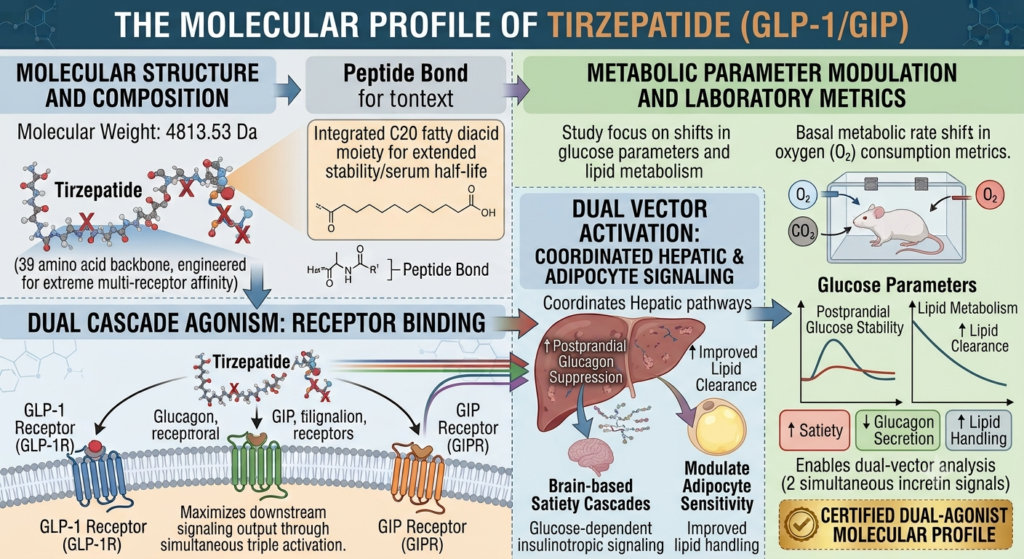
Tirzepatide is a synthetic peptide structure composed of 39 amino acids engineered to mimic native incretin hormones. Its molecular architecture integrates a C20 fatty diacid moiety that permits extended structural stability and serum half-life in testing models1. Its molecular weight stands at 4813.53 Da.
Preclinical evaluation within the GLP-1 GIP research Canada framework indicates that Tirzepatide targets two distinct, interconnected signaling vectors1,2:
- GLP-1 Receptor Agonism: It activates the Glucagon-Like Peptide-1 (GLP-1) receptor path, promoting glucose-dependent insulinotropic signaling and brain-based satiety cascades1.
- GIP Receptor Co-Agonism: It acts as a full agonist at the Gastric Inhibitory Polypeptide (GIP) receptor, which is hypothesized to synergize with GLP-1 to improve lipid clearance and modulate adipocyte sensitivity1,2.
- Glucagonotropic Balance: By binding both pathways, it suppresses inappropriate postprandial glucagon secretion, stabilizing overall glucose parameters in chronic assay layouts2.
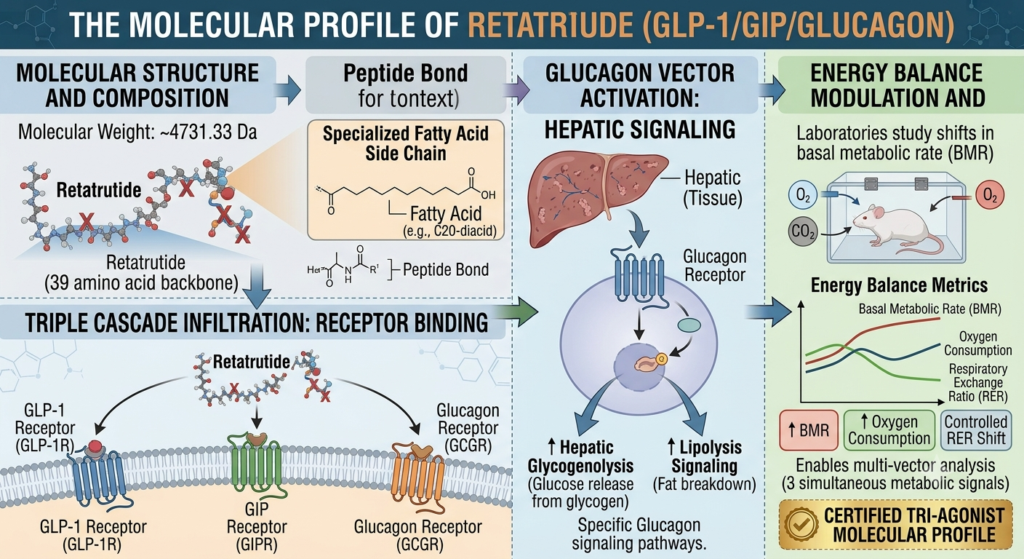
The Molecular Profile of Retatrutide (GLP-1/GIP/Glucagon)
Retatrutide represents a further evolutionary milestone in peptide synthesis, structured as a single peptide chain consisting of 39 amino acids backbone modified for extreme multi-receptor affinity3. Like Tirzepatide, it incorporates a specialized fatty acid side chain to maintain structural longevity in active assays4. Its molecular weight is approximately 4731.33 Da.
The unique feature of Retatrutide is its status as a tri-agonist, which introduces a third, highly potent metabolic vector into the research model3,4:
- Triple Cascade Infiltration: It binds to and activates the GLP-1, GIP, and Glucagon (GCG) receptors simultaneously, maximizing downstream cellular signaling output3.
- Glucagon Vector Activation: Unlike dual models, its direct activation of the glucagon receptor coordinates hepatic glycogenolysis and lipolysis signaling pathways3,4.
- Energy Balance Modulation: The integration of the glucagon vector allows laboratories to study shifts in basal metabolic rate and oxygen consumption metrics3.
Metabolic Support
Price range: $74.99 through $149.99

The Difference: Dual vs. Triple Receptor Agonism
When executing a comparative breakdown, the distinct difference centers on how these compounds manipulate energy balance equations. Tirzepatide relies on a dual-action mechanism to suppress caloric intake while maximizing peripheral insulin sensitivity. Retatrutide, however, combines this foundational intake restriction with a direct pathway to increase energy burning via glucagon signaling, essentially pushing the metabolic rate forward while preventing down-regulation of satiety signals.
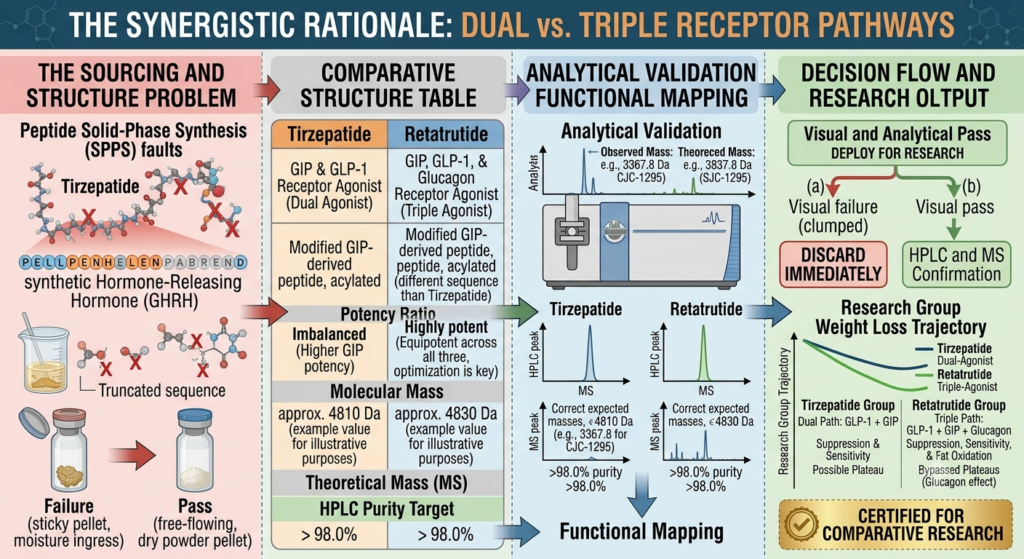
Preclinical data tracking multi-agonist dynamics indicates that triple agonism can bypass the weight-loss plateaus sometimes seen in single or dual-agonist models. To observe these differences, laboratories frequently deploy trial groups leveraging parameters mapped directly across the core Retatrutide product page. The comparative table below breaks down their baseline structural properties:
| Parameter | Tirzepatide Specifications | Retatrutide Specifications |
|---|---|---|
| Receptor Affinity Profile | Dual Agonist (GLP-1 + GIP Receptors) | Triple Agonist (GLP-1 + GIP + GCG Receptors) |
| Primary Action Vector | Satiety signaling & localized insulin sensitivity maximization | Satiety signaling combined with direct hepatic thermogenesis |
| Energy Expenditure Mode | Indirect via systemic reduction of caloric intake parameters | Direct via glucagon receptor-mediated substrate oxidation |
| Structural Length | 39 Amino Acids (C20 fatty diacid acylated) | 39 Amino Acids (C20 fatty diacid acylated) |
Reconstitution & Concentration Parameters for Multi-Agonist Assays
To preserve tight experimental control and ensure data reproducibility across repetitive assay models, meticulous preparation protocols are critical. Subtle shifts in target concentrations can introduce unwanted baseline drift in cellular responses, meaning that establishing a precise, standardized reconstitution map is a mandatory prerequisite for any formal study design.
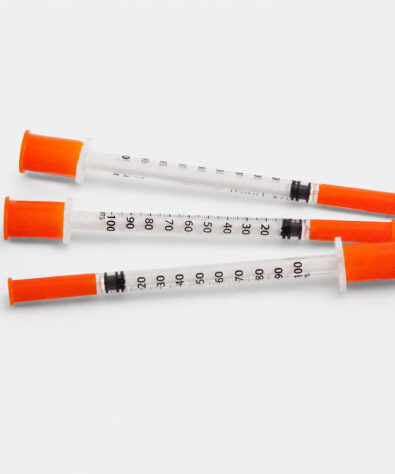
Lyophilized peptide cakes must be carefully brought to a liquid state using an appropriate sterile diluent. For extended observational studies, the industry standard is Bacteriostatic Water (0.9% Benzyl Alcohol), which provides an effective anti-microbial barrier to inhibit bacterial growth over multi-week testing cycles. The table below outlines concentration mapping paths within a standard 5mg lyophilized vial structure:
| Vial Total (Mass) | Reconstitution Liquid Volume | Resulting Core Concentration | Standard Micro-Dose Aliquot |
|---|---|---|---|
| 5 mg (5,000 mcg) | 1.0 mL | 5,000 mcg / mL | 250 mcg per 0.05 mL volume |
| 5 mg (5,000 mcg) | 2.0 mL | 2,500 mcg / mL | 250 mcg per 0.10 mL volume |
| 5 mg (5,000 mcg) | 2.5 mL | 2,000 mcg / mL | 250 mcg per 0.125 mL volume |
HPLC & Mass Spectrometry Protocols for Incretin Multi-Agonists
When domestic research bodies arrange to procure chemicals for comparative layouts, validating raw material purity represents the primary safeguard against compromised experimental readouts. Minor faults during solid-phase peptide synthesis can yield truncated amino acid sequences or residual salts, which can induce unexpected cell toxicity or cross-react with secondary receptors in live assays.
Every genuine batch of multi-agonists must be validated by independent testing using High-Performance Liquid Chromatography (HPLC) to confirm a chemical purity rating exceeding 98.0%. Simultaneously, Mass Spectrometry (MS) analysis should be used to confirm that the observed mass matches the theoretical profile of each compound. Vials that reveal signs of early moisture ingress—such as a sticky, clumped, or melted appearance of the dry powder pellet—should be discarded immediately, as unchecked moisture initiates hydrolysis and breaks down the main peptide chain.
Thermodynamic Stability & Solution Handling Parameters
Preserving the foundational structural integrity of synthesized peptide solutions requires strict, continuous adherence to established cold-chain protocols to prevent enzymatic degradation or unintended unfolding:
- Lyophilized Powder Maintenance: Prior to reconstitution, dry chemical vials should be held at a stable temperature of -20°C. Keeping the vials deep-frozen insulates the crystal structures from fluctuating humidity levels and ambient light degradation.
- Fluid Transfer Technique: During fluid introduction, the diluent must be introduced slowly down the interior glass wall of the vial. Violent mechanical agitation should be completely avoided; instead, use smooth, slow swirling motions to transition the lyophilized pellet into solution without shearing the peptide chain.
- Post-Reconstitution Care: Once in liquid state, the solution must be continuously stored at temperatures between 2°C and 8°C. Experimental protocols should ensure the solution is completely utilized within a 30-day window to prevent baseline potency decay.
Summary: Where Incretin Research is Headed Next
Multi-target peptides have completely changed how scientists study weight loss and metabolic health. Instead of activating just one pathway, these newer compounds target multiple receptors at the same time—like GLP-1, GIP, and glucagon. This multi-action approach allows researchers to study how a single peptide can help improve blood sugar control, reduce fat storage, and boost energy expenditure all at once. To get clear and reliable results, it’s essential to source high-quality peptides, store them properly to maintain stability, and double-check all mixing calculations before starting a test.
Metabolic Support
Price range: $71.24 through $108.74
Metabolic Support
Price range: $74.99 through $149.99
Research Supplies
Price range: $3.74 through $14.99
References
1. Coskun, T., Sloop, K. W., Loghin, C., Alsina-Fernandez, J., Solcompass, S., Loghin, C., … & Haupt, A. (2018). LY3298176, a novel dual GIP and GLP-1 receptor agonist for the treatment of type 2 diabetes: From discovery to clinical proof of concept. Molecular Metabolism, 18, 3-14.
2. Frias, J. P., et al. (2021). Efficacy and tolerability of tirzepatide, a dual GIP and GLP-1 receptor agonist, compared with semaglutide once weekly in patients with type 2 diabetes. The Lancet, 398(10295), 143-155.
3. Jall, S., Sachs, S., Clemmensen, C., Immerman, S. S., Piechotta, M., Ortmann, B., … & Müller, T. D. (2017). Monomeric GLP-1/GIP/glucagon triagonism corrects obesity, hepatosteatosis, and dyslipidemia in female mice. Molecular Metabolism, 6(5), 440-446.
4. Jastreboff, A. M., et al. (2024). Retatrutide (LY3437943), a triple GIP, GLP-1, and glucagon receptor agonist, in adults with obesity: A phase 2, multicenter, randomized, double-blind, placebo-controlled trial. The New England Journal of Medicine.