
Research Disclaimer: Retatrutide is discussed here strictly in the context of scientific and laboratory research. References to published clinical studies describe the investigational compound and formulations evaluated in those studies and should not be interpreted as personal medical guidance or as evidence that a commercially available research product will produce equivalent effects.
Retatrutide (LY3437943) is an investigational peptide that activates three metabolically relevant receptors: glucose-dependent insulinotropic polypeptide (GIP), glucagon-like peptide-1 (GLP-1), and glucagon receptors. This triple-receptor profile has made retatrutide an important subject of metabolic research and distinguishes its mechanistic design from single GLP-1-receptor agonists and dual GIP/GLP-1-receptor agonists.
The retatrutide research landscape has also changed considerably. Early clinical studies established proof of concept, a Phase 2 obesity trial published in 2023 generated substantial research interest, and the subsequent TRIUMPH development program has produced multiple Phase 3 results through 2025 and 2026.
This guide reviews what retatrutide is, how its three-receptor mechanism is being studied, what Phase 2 and Phase 3 research has reported, where important evidence limitations remain, and what Canadian researchers should understand when evaluating retatrutide research products.
What Is Retatrutide?
Retatrutide, also known by the development code LY3437943, is a single peptide engineered to act as an agonist at the GIP, GLP-1, and glucagon receptors. Because it engages three receptor systems, it is commonly described in the scientific literature as a triple hormone receptor agonist.
Some online discussions use terms such as “triple GLP-1 agonist,” “GLP-3,” or simply “reta peptide.” These descriptions can be convenient shorthand, but they are not equally precise. Retatrutide does not activate three GLP-1 receptors. Its three principal targets are three distinct receptors: GIPR, GLP-1R, and the glucagon receptor.
The compound’s multi-receptor design is the central reason it has attracted research attention. Instead of studying one incretin-related pathway in isolation, researchers can examine the combined biological effects of simultaneous signalling through GIP, GLP-1, and glucagon receptor systems.
How Does Retatrutide’s Triple-Receptor Mechanism Work?
GIP, GLP-1, and glucagon are naturally occurring peptide hormones with distinct but interacting roles in metabolic physiology. Retatrutide was designed to combine agonist activity at receptors for all three within a single molecule.
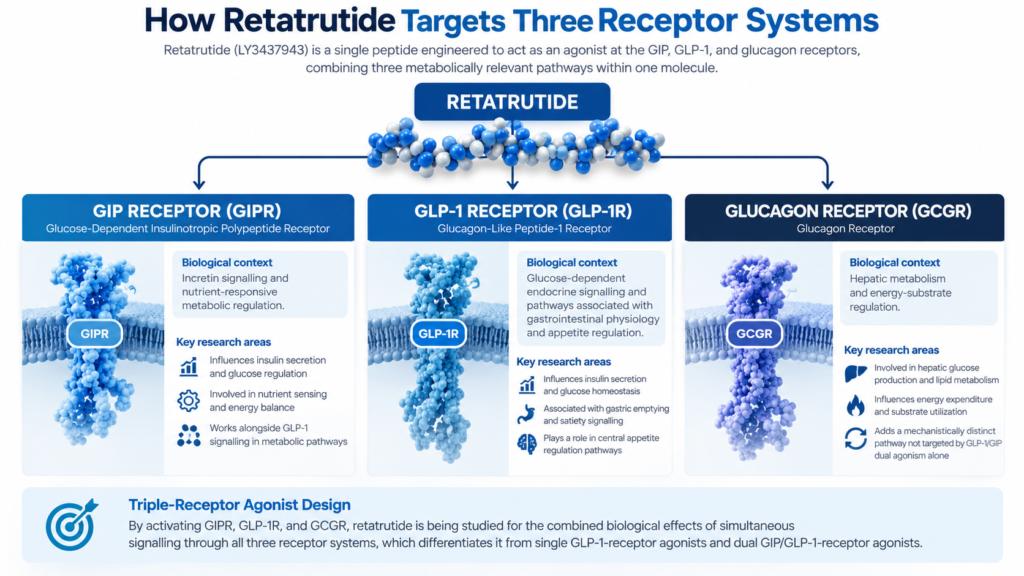
| Research Target | General Biological Context | Why It Matters in Retatrutide Research |
|---|---|---|
| GIP receptor | Incretin signalling and nutrient-responsive metabolic regulation | Adds a second incretin-related pathway alongside GLP-1 signalling |
| GLP-1 receptor | Glucose-dependent endocrine signalling and pathways associated with gastrointestinal physiology and appetite regulation | Provides a well-studied metabolic signalling component within the triple-agonist design |
| Glucagon receptor | Hepatic metabolism and energy-substrate regulation | Adds a mechanistically distinct pathway not targeted by GLP-1/GIP dual agonism alone |
The scientific interest is therefore not simply that retatrutide interacts with “more receptors.” Researchers are investigating whether the particular balance of activity across these receptor systems produces biological effects that differ from single- or dual-receptor agonism.
That distinction is important when interpreting triple GLP-1 agonist research. Retatrutide should be understood as a GIP/GLP-1/glucagon receptor agonist rather than as an intensified version of a GLP-1-only compound.
What Did the Phase 2 Retatrutide Research Find?
A major source of interest in retatrutide came from a randomized, double-blind, placebo-controlled Phase 2 trial published in the New England Journal of Medicine in 2023.
The study enrolled adults with obesity, or overweight plus at least one weight-related condition, and evaluated several retatrutide dose regimens over 48 weeks. The study was designed to investigate efficacy, safety, and dose-response relationships for the investigational drug.
At 48 weeks, the study reported mean body-weight reductions of 22.8% in the 8 mg group and 24.2% in the 12 mg group. These findings applied to the investigational retatrutide formulations and protocol evaluated in that clinical trial; they should not be generalized to commercially available research products.
The significance of the study was broader than a single percentage. It provided human Phase 2 evidence that simultaneous GIP, GLP-1, and glucagon receptor agonism could produce substantial measurable metabolic effects, supporting continued investigation of the triple-receptor strategy.
What Did the Study Report About Tolerability?
Interpreting a clinical trial requires examining adverse events as well as primary endpoints. In the Phase 2 obesity study, gastrointestinal adverse events were among the most commonly reported and were generally dose-related. The study also reported dose-dependent increases in heart rate that peaked during the trial and subsequently declined.
These observations are part of the investigational evidence base and are one reason later Phase 3 studies are important. Larger and longer trials provide more information about the reproducibility of observed effects and the safety profile of an investigational compound.
Retatrutide Research in Type 2 Diabetes
A separate Phase 2 trial published in The Lancet evaluated retatrutide in people with type 2 diabetes.
This research expanded the evidence base beyond the obesity-focused Phase 2 population and examined glycemic and body-weight endpoints across different retatrutide dose groups.
For researchers, the importance of this trial is that it demonstrates how retatrutide has been studied across multiple metabolic research questions rather than in a single clinical context.
Results from one population, however, should not automatically be assumed to apply to another. Study population, baseline characteristics, dose design, endpoints, duration, and comparator all matter when interpreting clinical research.
Retatrutide and Liver-Fat Research
Another area of investigation has been metabolic dysfunction-associated steatotic liver disease (MASLD).
A randomized Phase 2a substudy published in Nature Medicine in 2024 evaluated 98 participants from the larger Phase 2 obesity study who had at least 10% liver fat at baseline.
At week 24, the researchers reported mean relative liver-fat changes of:
- -42.9% with 1 mg retatrutide
- -57.0% with 4 mg
- -81.4% with 8 mg
- -82.4% with 12 mg
- +0.3% with placebo
The researchers also reported relationships between reductions in liver fat and changes in body weight, abdominal fat, and several metabolic measures.
These results require appropriate context. The substudy was relatively small, and the participant population and study design limit how broadly its findings can be generalized. Liver-fat measurements are also not interchangeable with every clinically relevant liver endpoint. The study adds an important research signal, but it does not resolve all questions about retatrutide and liver disease.
Retatrutide Phase 3: Understanding the TRIUMPH Program
The transition from Phase 2 to Phase 3 represents an important stage in the retatrutide research program. Phase 3 trials generally involve larger populations and are designed to investigate efficacy and safety across specific clinical populations and endpoints.
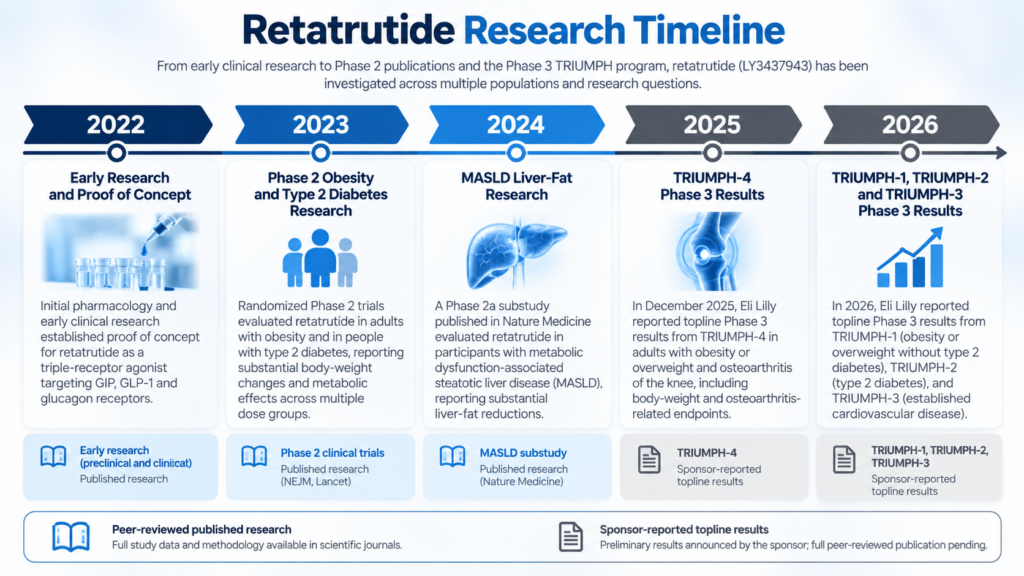
The TRIUMPH program includes multiple trials examining retatrutide across different populations and research questions. This makes “retatrutide Phase 3 TRIUMPH” less a reference to one study than to a broader development program.
TRIUMPH-4
TRIUMPH-4 evaluated retatrutide in adults with obesity or overweight and osteoarthritis of the knee.
In December 2025, Eli Lilly reported sponsor topline results from the trial. The company reported mean body-weight changes at 68 weeks of approximately -26.4% with 9 mg and -28.7% with 12 mg, compared with approximately -2.1% with placebo.
The study also evaluated osteoarthritis-related pain and physical-function endpoints.
Because these figures were announced as sponsor-reported topline Phase 3 results, they should be distinguished from results that have undergone full peer-reviewed publication. Topline announcements can provide meaningful information, but detailed publication allows researchers to evaluate methodology, subgroup analyses, statistical procedures, adverse events, missing data, and other important context more completely.
TRIUMPH-1
In May 2026, Lilly announced topline results from TRIUMPH-1, a pivotal Phase 3 trial evaluating retatrutide in adults with obesity or overweight without type 2 diabetes.
The company reported an average body-weight reduction of approximately 28.3% at 80 weeks in the 12 mg group. Lilly also reported that 45.3% of participants receiving 12 mg achieved at least 30% body-weight reduction under the reported analysis.
Additional analyses were reported for an extension population with higher baseline BMI and longer follow-up.
Again, these results should be identified as sponsor-reported Phase 3 findings where full peer-reviewed publication is not yet the source being cited.
TRIUMPH-2 and TRIUMPH-3
In July 2026, Lilly announced additional Phase 3 topline findings from TRIUMPH-2 and TRIUMPH-3.
TRIUMPH-2 studied adults with obesity or overweight and type 2 diabetes. The sponsor reported average body-weight reductions at 80 weeks of approximately 12.7%, 19.1%, and 20.8% across the 4 mg, 9 mg, and 12 mg groups, respectively, along with reductions in A1C.
TRIUMPH-3 studied adults with severe obesity and established cardiovascular disease, with or without type 2 diabetes. Lilly reported average body-weight reduction of up to approximately 22.6% at 80 weeks.
These studies broaden the populations in which the triple-receptor approach has been investigated. They also illustrate why individual trial results should not be compared casually: the participant populations, endpoints, baseline characteristics, and protocols differ.
What Does Phase 3 Change About Retatrutide Research?
The progression of retatrutide into a broad Phase 3 program substantially expands the available evidence, but it does not eliminate the need for careful interpretation.
Several questions remain scientifically important:
- How consistent are observed effects across different populations?
- How does longer follow-up change the understanding of efficacy and adverse events?
- What can be learned from complete peer-reviewed Phase 3 datasets beyond sponsor-reported topline results?
- How do individual receptor contributions affect the overall biological response?
- Which observed effects are directly attributable to triple-receptor pharmacology, and which may be secondary to broader metabolic changes?
- How do findings vary across obesity, diabetes, cardiovascular, liver, sleep-apnea, osteoarthritis, and other research populations?
These are examples of why Phase 3 should be viewed as an expansion of the evidence base rather than the end of scientific investigation.
Retatrutide Research in Canada
Canadian researchers searching for retatrutide Canada research should distinguish several different questions that are often blended together online: whether retatrutide is being investigated in Canadian-authorized clinical trials, what the published international scientific literature reports, and what analytical evidence exists for a particular commercially available research product.
Health Canada’s Canadian Clinical Trial Search Portal includes retatrutide (LY3437943) trials within the TRIUMPH research program. Examples include Canadian records for TRIUMPH-3, TRIUMPH-4, TRIUMPH-6, and TRIUMPH-9.
The existence of a Canadian clinical-trial record establishes that the investigational compound is being studied under that clinical-trial framework. It should not be interpreted as evidence about the quality of a third-party research product, nor should clinical-trial authorization be treated as equivalent to general marketing authorization.
This distinction matters because the phrase “retatrutide Canada” can refer to very different things depending on context: clinical research, regulatory development, scientific literature, or commercially available material intended for laboratory research.
Understanding Retatrutide Analytical Testing
Scientific literature about retatrutide and analytical testing of a commercial research sample answer fundamentally different questions.
A clinical study may investigate biological effects of an investigational drug in a defined participant population. A laboratory report on a research-product sample instead evaluates specific analytical characteristics of the submitted material under the methods listed in that report.
Those two evidence types should never be treated as interchangeable.
For peptide research materials, analytical terms also need to remain distinct:
- Purity describes the purity result defined by the analytical method used in the report.
- Content or measured mass addresses the amount of analyte measured in the submitted sample.
- Identity or characterization requires evidence appropriate to confirming or characterizing the compound and is not automatically established by a purity percentage alone.
- Bacterial endotoxin testing evaluates endotoxin under the stated method and conditions; it is not the same as sterility testing.
A single “lab tested” label therefore communicates much less than a report that clearly identifies the analytical method and result.
Example: A Researched Peptides Retatrutide Laboratory Report
One Retatrutide report supplied to Researched Peptides was generated by Testides on May 11, 2026. For the specific submitted sample represented by that report, HPLC-UV analysis reported an expected content of 10.00 mg, a measured mass of 12.59 mg, and a reported purity of 99.79%.
The same report included a USP <85> kinetic LAL bacterial endotoxin test, reporting <0.125 EU/mL against the laboratory specification shown on the report.
Important testing context: These results describe the specific submitted sample and laboratory report. They should not be interpreted as a guarantee that every Retatrutide vial, batch, or future sample will produce identical analytical results. Purity, measured content, identity, endotoxin, and sterility are separate analytical questions.
What Do We Know — and What Still Requires Investigation?
| Evidence Area | Current Research Context |
|---|---|
| Receptor pharmacology | Retatrutide is designed as an agonist of GIP, GLP-1, and glucagon receptors. |
| Phase 2 obesity research | Peer-reviewed human Phase 2 research reported substantial body-weight changes over 48 weeks, alongside adverse-event and physiological observations. |
| Type 2 diabetes research | Phase 2 and Phase 3 programs have investigated glycemic and body-weight endpoints in participants with type 2 diabetes. |
| Liver-fat research | A Phase 2a substudy reported substantial liver-fat reductions, but the study population and design limit broad conclusions. |
| Phase 3 evidence | Multiple TRIUMPH studies have generated Phase 3 results, with some 2025–2026 findings currently represented by sponsor-reported topline announcements. |
| Long-term evidence | Longer follow-up, complete publication of Phase 3 datasets, and research across additional populations continue to expand the evidence base. |
Retatrutide for Canadian Laboratory Research
For Canadian researchers evaluating a reta peptide Canada source, the published literature and the commercial product should be assessed separately.
The scientific literature can help answer questions such as what retatrutide is, which receptors it targets, what study populations have been evaluated, and what researchers have observed under defined clinical protocols.
Product-specific documentation answers a different set of questions: what material is being offered, what strengths are available, and what analytical evidence is available for a particular submitted sample or batch.
Researched Peptides currently lists Retatrutide in 10 mg and 20 mg research formats. Researchers can review the current product information and applicable analytical documentation before selecting material for a laboratory project.
View Retatrutide Product Details
Frequently Asked Questions About Retatrutide Research
What is retatrutide?
Retatrutide (LY3437943) is an investigational peptide designed to activate the GIP, GLP-1, and glucagon receptors. This three-target profile is why it is described scientifically as a triple hormone receptor agonist.
Is retatrutide a GLP-1 agonist?
GLP-1 receptor agonism is one component of retatrutide’s pharmacology, but describing it only as a GLP-1 agonist is incomplete. Retatrutide also targets the GIP and glucagon receptors.
Is “GLP-3” another name for retatrutide?
“GLP-3” is an informal term sometimes used online, but it is not a precise description of retatrutide’s mechanism. The compound targets three distinct receptor systems: GIPR, GLP-1R, and the glucagon receptor.
What is the TRIUMPH retatrutide program?
TRIUMPH refers to a broader Phase 3 clinical-development program evaluating retatrutide across multiple populations and research questions. Individual TRIUMPH trials differ in their participant populations, endpoints, and study designs.
Has retatrutide reached Phase 3 research?
Yes. Multiple Phase 3 trials in the TRIUMPH program have reported sponsor topline results through 2025 and 2026, while additional trials and analyses continue to expand the research program.
Is retatrutide being researched in Canada?
Yes. Health Canada’s Canadian Clinical Trial Search Portal contains records for retatrutide clinical trials, including studies within the TRIUMPH program. A clinical-trial record should be understood within the context of investigational clinical research and should not be confused with evidence about a commercially available research product.
Does published retatrutide research prove the quality of a research peptide product?
No. Published studies investigate specific study formulations under defined protocols. The identity, purity, content, and other analytical characteristics of a commercially available research sample require product-specific analytical evidence.
What should researchers look for in a retatrutide COA?
Researchers should look at the actual tests performed, the analytical methods used, the sample or batch represented, and the reported results. Purity, identity, measured content, bacterial endotoxin, and sterility are different analytical questions and should not be treated as interchangeable.
References & Research Sources
- Jastreboff AM, Kaplan LM, Frías JP, et al. Triple–Hormone-Receptor Agonist Retatrutide for Obesity — A Phase 2 Trial. New England Journal of Medicine. 2023;389:514–526. doi:10.1056/NEJMoa2301972.
- Rosenstock J, et al. Retatrutide in participants with type 2 diabetes: a Phase 2 clinical trial. The Lancet. 2023.
- Sanyal AJ, Kaplan LM, Frias JP, et al. Triple hormone receptor agonist retatrutide for metabolic dysfunction-associated steatotic liver disease: a randomized phase 2a trial. Nature Medicine. 2024;30:2037–2048. doi:10.1038/s41591-024-03018-2.
- Eli Lilly and Company. TRIUMPH-4 Phase 3 retatrutide topline results. December 2025.
- Eli Lilly and Company. TRIUMPH-1 Phase 3 retatrutide topline results. May 2026.
- Eli Lilly and Company. TRIUMPH-2 and TRIUMPH-3 Phase 3 retatrutide topline results. July 2026.
- Health Canada. Canadian Clinical Trial Search Portal. Retatrutide (LY3437943) TRIUMPH clinical-trial records.
Explore Retatrutide for Laboratory Research
Researched Peptides provides Retatrutide for laboratory and scientific research in Canada, with current product information and applicable analytical documentation available for researchers to review.
Discover Related Metabolic Research
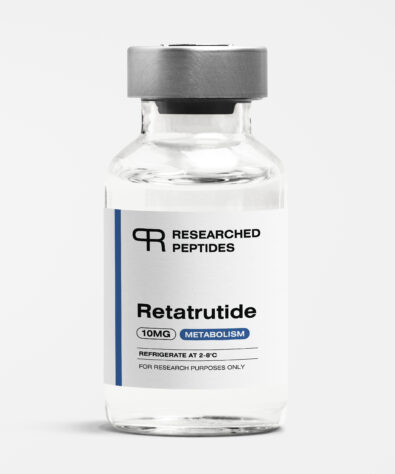
Metabolic Support
Price range: $74.99 through $149.99
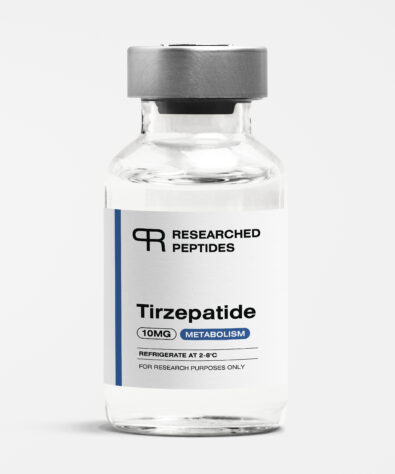
Metabolic Support
Price range: $71.24 through $108.74

Metabolic Support
Price range: $89.99 through $431.96