In the domain of preclinical endocrinology and cellular metabolism research, optimizing the pathways of growth hormone (GH) secretion remains a primary focus. Traditional secretagogue models are frequently restricted by rapid biological clearance rates, receptor desensitization, or unintended elevations in secondary hormones like cortisol and prolactin. Recently, laboratory investigators exploring somatotroph signaling have oriented their research toward the CJC-1295 (No DAC) and Ipamorelin stack in Canada paradigm, evaluating how these two distinct classes of peptides intersect to alter physiological GH release patterns.
This technical guide evaluates the distinct biochemical properties of CJC-1295 (No DAC) and Ipamorelin, analyzes the molecular rationale behind an intentional growth hormone peptide stack, maps precise laboratory reconstitution metrics, and outlines quality control benchmarks critical for validating experimental data sets.
CJC-1295 No DAC Mechanics & GHRH Agonist Signaling
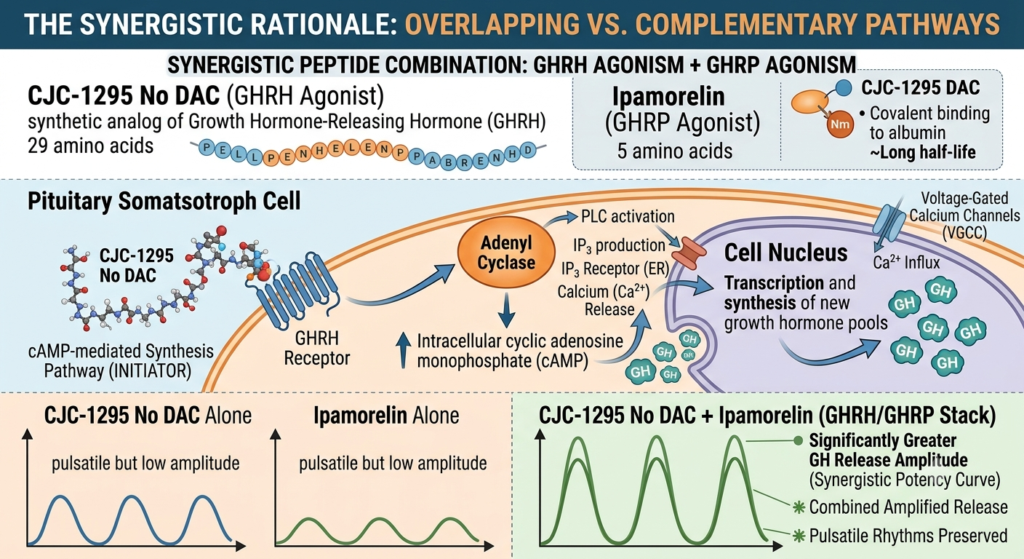
CJC-1295 No DAC (specifically modified GRF 1-29) is a synthetic analog of Growth Hormone-Releasing Hormone (GHRH) consisting of 29 amino acids1. Unlike versions utilizing a Drug Affinity Complex (DAC), which covalently bind to blood albumin to cause an artificial, non-physiological continuous growth hormone elevation, the No DAC variant features a targeted, truncated metabolic half-life of approximately 30 minutes2. This brief window of activity allows investigators to evaluate natural, dynamic cell signaling pathways and native, periodic growth hormone delivery rhythms without risking early somatotroph receptor down-regulation or permanent desensitization.
In vitro and in vivo research models demonstrate that CJC-1295 No DAC targets the somatotroph GHRH receptor to stimulate specific biological cascades:
- Adenyl Cyclase Activation: It binds to the GHRH receptor on pituitary somatotrophs, activating adenyl cyclase and increasing intracellular cyclic adenosine monophosphate (cAMP) pathways1.
- GH Synthesis: The elevation of cAMP cascades directly encourages the transcription and synthesis of new growth hormone pools within the anterior pituitary2.
- Pulsatile Preservation: When utilized without a Drug Affinity Complex, No DAC preserves the natural physiological surges of growth hormone—frequently deployed alongside a GHRP to amplify natural peaks—rather than inducing an unnatural, constant background hormone bleed that exhausts pituitary output capacity1.
Ipamorelin Mode of Action: Selective GHRP Signaling
In comparison, Ipamorelin is a synthetic pentapeptide composed of 5 amino acids that functions as a highly selective Growth Hormone Secretagogue Receptor (GHSR) agonist3. It serves as a premier example of a Growth Hormone-Releasing Peptide (GHRP)4.
The structural design of Ipamorelin allows it to mimic the action of ghrelin, triggering a separate pathway to maximize somatotroph output:
- Phospholipase C Activation: It binds to the GHSR, initiating a cascade that activates Phospholipase C and increases intracellular calcium ions, prompting the immediate exocytosis of stored GH vesicles3.
- Somatostatin Inhibition: At the hypothalamic level, GHRP class molecules actively inhibit somatostatin (growth hormone-inhibiting hormone), removing the biological brakes on the pituitary gland4.
- Highly Selective Output: Unlike older GHRPs, Ipamorelin does not activate receptors responsible for releasing cortisol or prolactin, ensuring an isolated growth hormone release profile3.
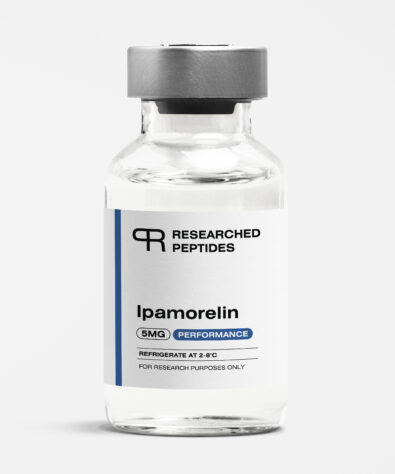
Performance & Endurance
$44.99
Research Supplies
Price range: $3.74 through $14.99
GHRH & GHRP Receptor Synergy: Evaluating Stack Dynamics
When evaluated as a combined GHRH GHRP combination, CJC-1295 No DAC and Ipamorelin display what is known in endocrinology literature as a synergistic potency curve. Endogenous growth hormone release is governed by a delicate balance: GHRH stimulates the initial production of the hormone, while somatostatin suppresses its release. Co-administering these two peptides works on complementary fronts to change this balance entirely.
CJC-1295 No DAC acts as the initiator, increasing the total capacity of the somatotroph cells to produce growth hormone via cAMP pathways. Concurrently, Ipamorelin works via calcium ion influx to trigger immediate vesicle release while suppressing the inhibitory effects of somatostatin. Preclinical data indicates that combining a GHRH and a GHRP results in a significantly greater amplitude of growth hormone release than applying either compound alone, as the two intracellular signaling pathways amplify each other’s downstream effects. Because this specific stack preserves native pulsatile rhythms without triggering a constant baseline release, investigators evaluating this combined axis often cross-reference deployment logs with technical data found on the CJC-1295 No DAC + Ipamorelin product pages.
Reconstitution Protocol & Aliquot Calculations for Blended Vials
To preserve tight experimental control and ensure data reproducibility across repetitive assay models, meticulous preparation protocols are critical. Subtle shifts in target concentrations can introduce unwanted baseline drift in cellular responses, meaning that establishing a precise, standardized preparation protocol is a mandatory prerequisite for any formal study design.
Lyophilized peptide cakes must be carefully brought to a liquid state using an appropriate sterile diluent. For extended observational studies, the industry standard is Bacteriostatic Water (0.9% Benzyl Alcohol), which provides an effective anti-microbial barrier to inhibit bacterial growth over multi-week testing cycles. The table below outlines standard concentration configurations for a blended 5mg + 5mg dual-peptide vial matrix:
| Vial Matrix Total | Reconstitution Liquid Volume | Blended Core Concentration | Standard Micro-Dose Aliquot |
|---|---|---|---|
| 10 mg Total (5mg CJC No DAC / 5mg Ipamorelin) | 2.0 mL | 2,500 mcg per mL (Each) | 125 mcg CJC / 125 mcg Ipamorelin per 0.05 mL |
| 10 mg Total (5mg CJC No DAC / 5mg Ipamorelin) | 4.0 mL | 1,250 mcg per mL (Each) | 125 mcg CJC / 125 mcg Ipamorelin per 0.10 mL |
| 10 mg Total (5mg CJC No DAC / 5mg Ipamorelin) | 5.0 mL | 1,000 mcg per mL (Each) | 100 mcg CJC / 100 mcg Ipamorelin per 0.10 mL |
Quality Control Benchmarks: Purity Validation for CJC-1295 & Ipamorelin
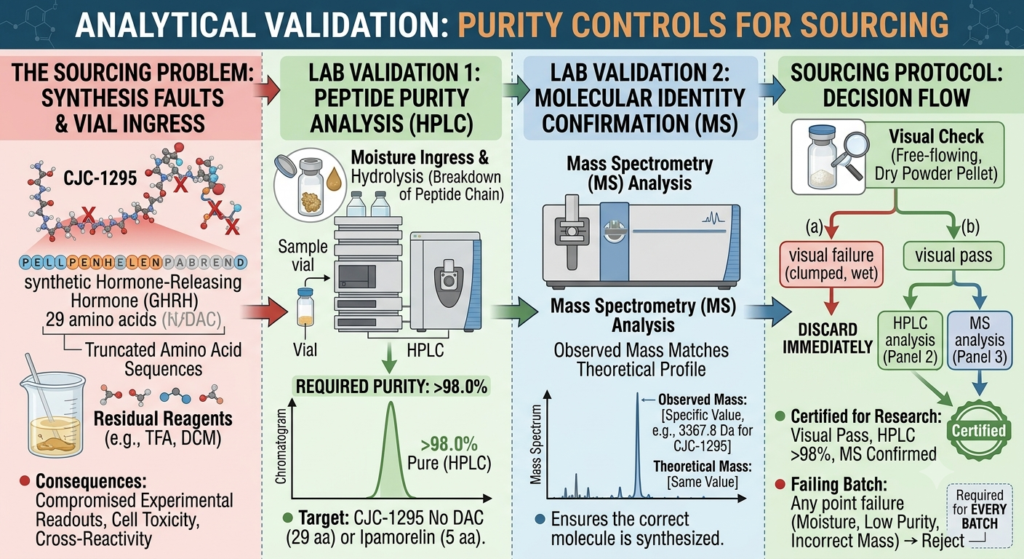
When domestic research bodies arrange to purchase chemical materials, validating raw material purity represents the primary safeguard against compromised experimental readouts. Minor faults during solid-phase peptide synthesis can yield truncated amino acid sequences or residual reagents, which can induce unexpected cell toxicity or cross-react with secondary receptors in live assays.
Every genuine batch of CJC-1295 No DAC or Ipamorelin must be validated by independent testing using High-Performance Liquid Chromatography (HPLC) to confirm a chemical purity rating exceeding 98.0%. Simultaneously, Mass Spectrometry (MS) analysis should be used to confirm that the observed mass matches the theoretical profile of the molecule. Vials that reveal signs of early moisture ingress—such as a sticky, clumped, or melted appearance of the dry powder pellet—should be discarded immediately, as unchecked moisture initiates hydrolysis and breaks down the main peptide chain.
Handling Protocol & Cold-Chain Storage SOPs
Maintaining biological activity across dual-peptide reconstitutions requires protective handling practices that shield fragile peptide bonds from mechanical stress and temperature spikes:
- Freeze-Dried Cake Preservation: Unopened vials should remain sealed and stored at -20°C to maintain long-term structural purity. Avoid frequent temperature cycling of dry vials prior to reconstitution.
- Diluent Integration: Direct the diluent stream down the inside wall of the vial so it trickles down into the lyophilized powder. Allow the powder to absorb the liquid naturally, then gently roll the vial between your palms until clear. Avoid vigorous shaking, which induces air bubbles and can cause structural shearing.
- Reconstituted Solution Protocol: Keep the reconstituted liquid refrigerated constantly between 2°C and 8°C, protected from direct UV light exposure. Work quickly during assay sampling to minimize the amount of time reconstituted vials spend at room temperature.
Summary: Implications for Somatotroph & Secretagogue Research
Evaluating the growth hormone axis through combined peptide signaling provides researchers with a distinct model for analyzing dual-receptor pituitary kinetics. Rather than relying on non-specific secretagogues, combining a GHRH analog with a selective GHRP allows laboratory teams to replicate natural, pulsatile somatotroph release patterns while avoiding unwanted cortisol or prolactin spikes. Achieving consistent, high-fidelity data in preclinical trials ultimately depends on rigid analytical standards—specifically verifying sequence purity via HPLC/MS, maintaining proper cold-chain storage at -20°C, and executing precise volumetric dilutions prior to assay entry.
Performance & Endurance
Price range: $52.49 through $74.99
Performance & Endurance
$44.99
Research Supplies
Price range: $3.74 through $14.99
References
1. Teichman, S. L., et al. (2006). Prolonged stimulation of growth hormone (GH) and insulin-like growth factor I secretion by CJC-1295, a long-acting analog of GH-releasing hormone, in healthy adults. The Journal of Clinical Endocrinology & Metabolism, 91(3), 799-805. https://doi.org/10.1210/jc.2005-1536
2. Alba, M., et al. (2006). Once-daily administration of CJC-1295, a long-acting growth hormone-releasing hormone analog, normalizes growth in growth hormone-deficient rats. American Journal of Physiology-Endocrinology and Metabolism, 291(6), E1290-E1294. https://doi.org/10.1152/ajpendo.00201.2006
3. Raun, K., et al. (1998). Ipamorelin, the first selective growth hormone secretagogue. European Journal of Endocrinology, 139(5), 552-561. https://doi.org/10.1530/eje.0.1390552
4. Adeghate, E., & Parvez, S. (2000). Ghrelin and growth hormone secretagogues: History, mechanism of action and clinical applications. Biogenic Amines, 15(4), 321-344.