Bacteriostatic Water for Peptides: The Quick Answer
Bacteriostatic water is water containing a preservative, commonly benzyl alcohol, that inhibits the growth of certain microorganisms. In peptide research, laboratories may consider it as a solvent for compatible lyophilized materials. However, suitability depends on the peptide, analytical method, intended experiment, formulation and available compatibility data.
Bacteriostatic water is not interchangeable with every sterile diluent. Its preservative does not sterilize contaminated materials, prevent all microbial growth or guarantee that a reconstituted peptide remains chemically stable. This guide explains the differences and the evidence researchers should check.
Key Takeaways
- Composition: Common bacteriostatic water formulations contain 0.9% benzyl alcohol, but labelled products can differ.
- Purpose: The preservative inhibits some microbial growth; it does not replace aseptic technique.
- Comparison: Preservative-free sterile water and bacteriostatic water serve different laboratory requirements.
- Compatibility: A peptide’s solubility and stability must be assessed independently.
- Storage: Follow the actual product label and validated laboratory procedures, not a universal online timeline.
What Is Bacteriostatic Water?
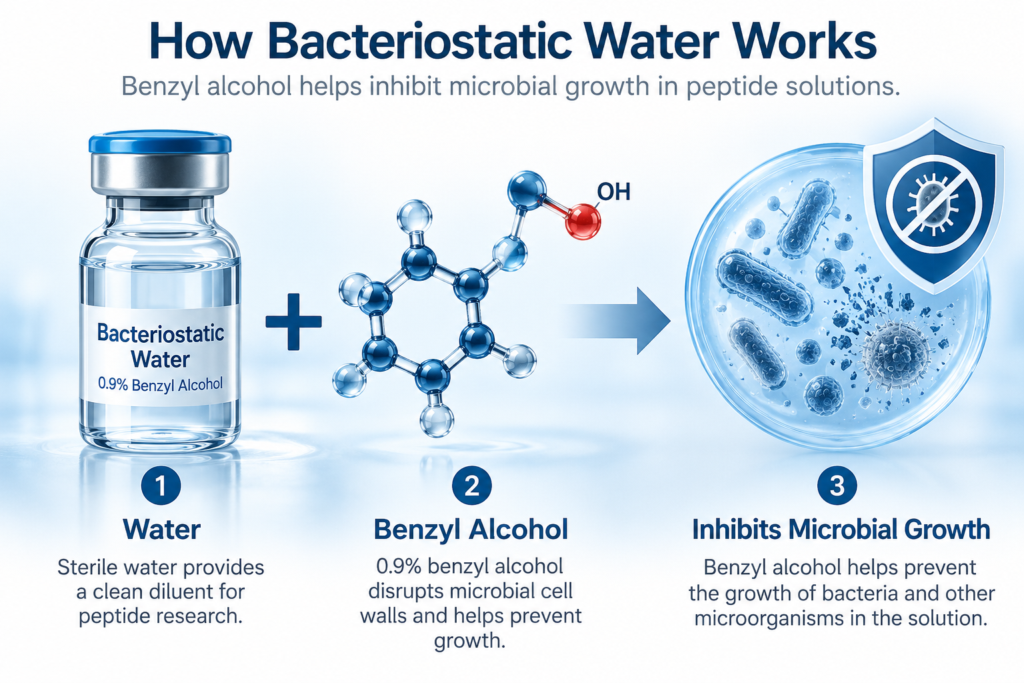
Bacteriostatic water is an aqueous diluent with an antimicrobial preservative. In widely used pharmaceutical formulations, that preservative is benzyl alcohol. For example, official US labelling describes Bacteriostatic Water for Injection, USP, as sterile water for injection containing either 0.9% or 1.1% benzyl alcohol, depending on the labelled presentation. These are examples of regulated pharmaceutical formulations, not specifications that can automatically be applied to every product sold as BAC water.
In laboratory research, a diluent can serve as the liquid medium used to dissolve a dry research material. A peptide supplied in lyophilized form may require dissolution before an analytical assay. Selecting the solvent is part of the experimental design: the presence of benzyl alcohol may be acceptable in some methods and undesirable in others.
What Does “Bacteriostatic” Mean?
The word describes an inhibitory effect on bacterial growth rather than a guarantee of microbial destruction. Bacteriostatic is not synonymous with sterile, sterilizing, antimicrobial against every organism, or suitable for any application. The starting material’s microbiological quality, container integrity, handling environment and time since opening all remain relevant.
Why Is Benzyl Alcohol Added to BAC Water?
Benzyl alcohol is used as an antimicrobial preservative in certain multi-dose aqueous preparations. It can interfere with microbial growth, helping reduce the risk of proliferation under the formulation’s intended conditions. Preservative effectiveness is formulation-dependent; it should not be assumed to cover every species, concentration, container or storage scenario.
A 0.9% benzyl alcohol concentration corresponds to 9 mg per mL. This is a composition statement, not a measure of peptide purity or an indication that the preparation is suitable for all experiments. Benzyl alcohol can also interact with experimental systems, including some sensitive protein or peptide formulations, so its presence must be considered when interpreting laboratory results.
Important distinction: An antimicrobial preservative is not a substitute for sterility testing, validated aseptic processes or appropriate controls. It also cannot repair degradation that has already occurred in a peptide sample.
Bacteriostatic Water vs Sterile Water: What Is the Difference?
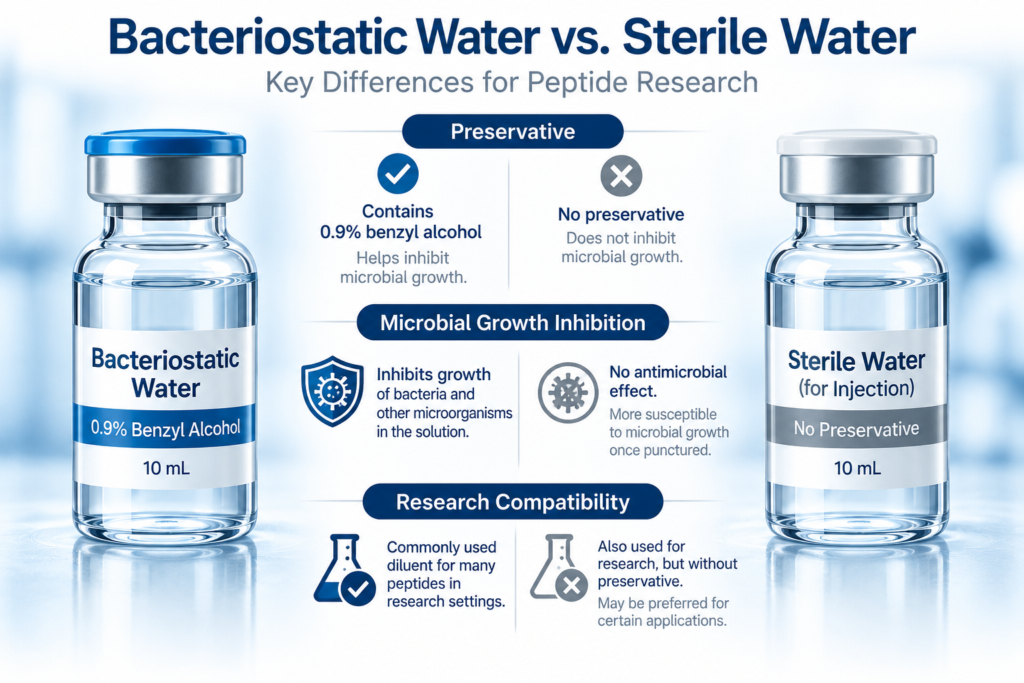
The key difference is the presence of an antimicrobial preservative. “Sterile water” is a broad description, so the exact labelled product and intended use must always be checked. Preservative-free Sterile Water for Injection is not the same formulation as Bacteriostatic Water for Injection, and neither should be confused with ordinary purified or laboratory-grade water.
| Attribute | Bacteriostatic water | Preservative-free sterile water |
|---|---|---|
| Antimicrobial preservative | Present; often benzyl alcohol | Absent |
| Microbial growth inhibition | Formulation-dependent preservative action | No preservative protection |
| Potential assay interference | Benzyl alcohol must be considered | No benzyl alcohol, but other suitability checks remain |
| Peptide compatibility | Must be verified for the material and method | Must also be verified |
| Use after opening | Follow labelled and institutional requirements | Follow labelled and institutional requirements |
Neither category is inherently the best solvent for every research application. Some assays require preservative-free conditions, a buffered medium, controlled ionic strength or a solvent specified by a validated protocol.
What Should Researchers Consider Before Using BAC Water With Peptides?
1. Solubility Is Not the Same as Stability
A peptide may appear to dissolve completely while still undergoing chemical changes over time. Solubility describes the extent to which material dissolves; stability concerns whether the molecular composition and relevant properties remain acceptable. Visible clarity alone cannot establish identity, purity or long-term stability.
2. Preservatives May Affect Experimental Readouts
Benzyl alcohol can be a variable in sensitive biochemical, cellular or analytical experiments. A suitable laboratory method may require a solvent blank or other appropriate controls to distinguish effects associated with the peptide from those associated with the vehicle. The correct controls depend on the assay and institutional protocol.
3. Lyophilized Peptides Do Not Share One Universal Diluent
Lyophilization removes water under controlled conditions, but the resulting material’s formulation and behaviour vary. Different peptides can have different pH sensitivities, aggregation tendencies, adsorption behaviour and susceptibility to chemical degradation. A general claim that BAC water is compatible with every lyophilized peptide is not scientifically justified.
4. A Preservative Does Not Establish Peptide Quality
Peptide identity, chromatographic purity, measured content, endotoxin and sterility are distinct analytical questions. A solvent’s preservative does not replace evidence about the original peptide or the final prepared sample. Laboratories should interpret the actual methods and sample identifiers on relevant reports rather than relying on a generic “research grade” description.
5. Reproducibility Requires Documented Inputs
For defensible experimental records, researchers should document the diluent identity, labelled composition, relevant lot information, sample preparation conditions and controls required by the approved laboratory method. This supports comparison across experiments without assuming that a preparation method is universally applicable.
How Should Bacteriostatic Water Be Stored and Handled?
Storage instructions are product-specific. As one example, an official Hospira pharmaceutical label specifies controlled room-temperature storage at 20–25°C for its named formulation. That label cannot establish the storage conditions, expiry or in-use period of an unrelated BAC water product. Researchers should follow the actual container label, applicable institutional SOPs and manufacturer documentation.
Before laboratory use, examine container and seal integrity, the labelled expiry date and any visible abnormalities. An intact-looking container does not independently prove sterility. After a container has been accessed, contamination risk depends on the environment, technique, closure system and use conditions.
Does BAC Water Last 28 Days After Opening?
Some multi-dose medication-vial guidance uses a 28-day discard interval after initial puncture unless the manufacturer specifies otherwise. That is not a universal chemical stability guarantee for BAC water, and it does not establish that a peptide dissolved in it remains stable for 28 days. Laboratory procedures and the specific product’s approved instructions take precedence.
Does Refrigeration Extend Peptide Stability?
Not necessarily. Temperature can influence degradation and microbial growth, but the effect depends on the formulation and peptide. A general storage recommendation cannot replace validated, compound-specific stability studies. Repeated temperature changes, light exposure and container interactions may also matter in particular methods.
What If a Prepared Sample Looks Cloudy?
Unexpected cloudiness, particles, precipitation or colour change may indicate a preparation issue, but visual inspection alone cannot determine the cause. Researchers should follow their laboratory’s deviation and sample-rejection procedures rather than assuming the preservative has made the sample acceptable.
Where Does Bacteriostatic Water Fit Into Peptide Research in Canada?
Canadian laboratories searching for bacteriostatic water for peptide research should first confirm whether the proposed solvent meets their analytical and institutional requirements. Procurement considerations include accurate product identification, labelled composition, package integrity, lot traceability and the availability of relevant supporting documentation.
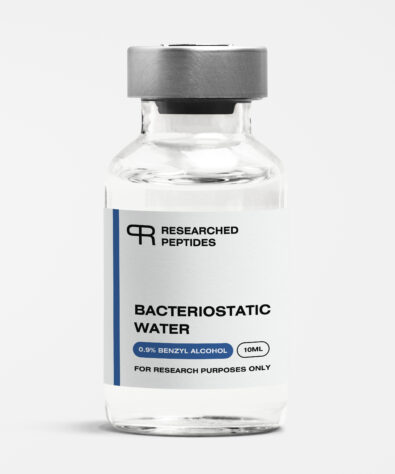
Researched Peptides lists BAC Water for laboratory research in its Research Supplies collection. Its approved catalog identifies a 10 mL format with 0.9% benzyl alcohol. Researchers should consult the current product page for up-to-date product information. These catalog details do not independently establish pharmaceutical approval, sterility certification or suitability for any specific peptide formulation.
For research workflows, the appropriate choice is the diluent supported by the method—not simply the one most frequently mentioned in online peptide discussions.
Frequently Asked Questions About BAC Water
Bacteriostatic Water Research FAQ
BAC water is shorthand for bacteriostatic water: water formulated with an antimicrobial preservative, commonly benzyl alcohol. Its precise composition depends on the labelled product.
No. Bacteriostatic water contains a preservative; preservative-free sterile water does not. The word sterile refers to a microbiological quality attribute, while bacteriostatic refers to inhibition of microbial growth.
No. Its preservative may inhibit certain microbial growth under defined conditions, but contamination remains possible. Appropriate aseptic laboratory practice and product-specific requirements still apply.
No universal compatibility claim is justified. Solubility, chemical stability and assay interference must be assessed for the specific peptide and experimental method.
No. The 0.9% figure describes the benzyl alcohol preservative concentration, not peptide identity, purity or content.
No. A vial discard interval is not equivalent to validated chemical stability. Peptide stability depends on compound-specific evidence and actual storage conditions.
No. A preservative may be useful in some formulations but may interfere with other experiments. The method’s compatibility and analytical requirements should determine the selection.
Conclusion: Choose the Diluent Based on the Research
Bacteriostatic water is a useful formulation concept in peptide research because it combines an aqueous solvent with an antimicrobial preservative. Its role, however, is narrower than many online descriptions suggest: benzyl alcohol does not sterilize samples, establish peptide stability or make the diluent suitable for every assay.
Good laboratory decisions begin with a defined research method, accurate product composition and documented compatibility. Researchers should evaluate the evidence for the exact preparation rather than relying on generic timelines or universal reconstitution claims.
Technical References
- National Library of Medicine, DailyMed. Bacteriostatic Water for Injection, USP: official product labelling. Composition, preservative, warnings and labelled storage.
- Pfizer/Hospira. Bacteriostatic Water for Injection, USP: prescribing information. Pharmaceutical formulation and limitations.
Explore BAC Water for Laboratory Research
Review the current research-supply format and labelled composition.