Health Canada and Research Peptides: The Quick Answer
Research peptides in Canada are subject to regulatory requirements that depend on their classification, intended use, composition, route of administration and how they are represented or sold. Health Canada regulates drugs under the Food and Drugs Act and Food and Drug Regulations, and certain other products under separate regulatory frameworks.
A product labelled “Research Use Only” (RUO) is not automatically exempt from those requirements. Health Canada has explicitly warned that research-use labels do not independently make peptide products legal to import or sell in Canada.
This guide explains how peptide classification works, what the research-use designation means, how the Canada Border Services Agency (CBSA) handles regulated imports, and what Canadian laboratories should understand about analytical documentation and regulatory compliance.
Key Takeaways
- Classification matters: Health Canada evaluates peptide products according to relevant regulatory criteria, not simply their names.
- RUO is not an exemption: Research-use labelling does not automatically authorize sale or importation.
- Drug authorization is product-specific: An approved medicine does not authorize every preparation containing the same molecule.
- CBSA enforces border requirements: Imported products may be detained, refused or seized when regulatory concerns arise.
- Analytical testing and legal authorization are different: A certificate of analysis does not establish Health Canada approval.
How Does Health Canada Regulate Research Peptides?
Health Canada is the federal department responsible for administering legislation governing drugs and many other health products in Canada. Its responsibilities include product authorization, compliance monitoring, enforcement and regulatory oversight.
For peptides, the relevant framework depends on what the product is, how it is represented, its intended purpose and other classification factors.
The Food and Drugs Act defines a drug broadly, including substances manufactured, sold or represented for uses involving disease treatment or modification of organic functions.
This means product classification can involve more than the wording printed on a vial. Advertising, product descriptions, presentation and other evidence about intended use may also be relevant.
The Main Regulatory Instruments
| Framework | Primary role |
|---|---|
| Food and Drugs Act | Establishes core legal requirements and prohibitions relating to drugs and other regulated products. |
| Food and Drug Regulations | Provide detailed requirements for regulated drugs, including authorization, labelling, manufacturing and clinical trials. |
| Natural Health Products Regulations | Apply to products that meet the relevant natural health product classification criteria. |
| Customs Act and applicable border requirements | Support border administration, examination and enforcement for imported goods. |
Health Canada’s regulatory framework is designed to distinguish products authorized for health-related uses from products that have not undergone the relevant authorization process.
Importantly, laboratory research activity and commercial distribution are not necessarily governed by identical requirements. A laboratory’s legitimate scientific purpose does not automatically establish that a supplier’s sale or an import transaction is compliant.
How Does Health Canada Classify Peptide Products?
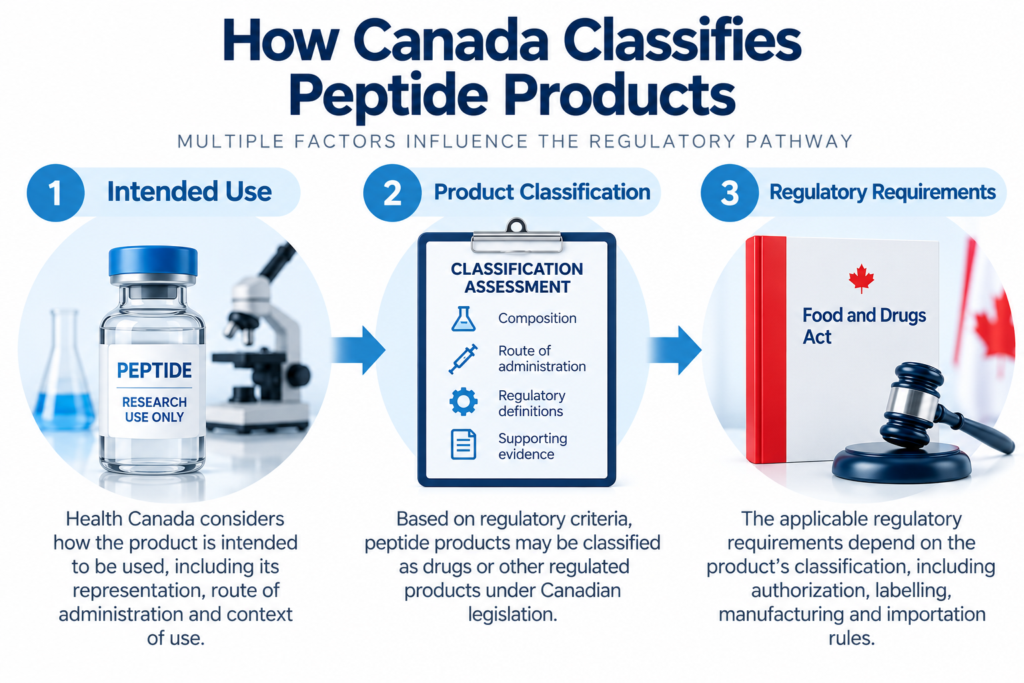
Health Canada identifies product classification as the first step in determining the applicable regulatory pathway.
Its peptide-specific guidance explains that classification can depend on:
- The product’s intended use.
- Its composition and ingredients.
- Its route of administration.
- The applicable regulatory definitions and supporting evidence.
Health Canada states that injectable peptide products are classified as drugs rather than natural health products because of the risks associated with that route of administration.
This classification is especially relevant to commercially distributed peptide preparations marketed or presented in forms associated with injection.
Authorized Drugs Versus Laboratory Research Materials
An authorized drug has undergone a defined regulatory review process for the particular product and its approved use.
For example, some peptide-based active ingredients are used in authorized prescription medicines. That authorization applies to the regulated medicinal product, not automatically to every material containing the same peptide.
A laboratory research material may be studied for molecular, biochemical or experimental purposes without being an authorized therapeutic product. However, describing a material as a laboratory reagent does not conclusively determine its legal classification.
The distinction between scientific purpose and regulatory authorization is essential. Researchers should not infer that a molecule’s scientific relevance, a supplier’s disclaimer or a laboratory’s intended experiment establishes the legality of a particular commercial product.
For further information, see Health Canada’s peptide classification and enforcement guidance.
What Does “Research Use Only” Mean for Peptides in Canada?
Research Use Only (RUO) describes an intended research purpose. It is not a general Canadian regulatory authorization or exemption.
In scientific contexts, research-use materials are intended for controlled laboratory activities rather than treatment or administration to people or animals.
Such activities can include analytical chemistry, receptor-binding investigations, assay development and other legitimate experimental applications.
However, Health Canada has specifically addressed products bearing research-use labels. Its guidance states that these labels do not make products automatically lawful to import or sell.
What an RUO Label Communicates
An RUO designation can communicate that a supplier is positioning a material for laboratory research rather than clinical use.
It does not independently establish:
- That Health Canada has approved the product.
- That its commercial sale is lawful.
- That importation is permitted.
- That the material satisfies pharmaceutical manufacturing requirements.
- That the product is sterile or suitable for administration.
- That a supplier is exempt from applicable drug legislation.
The actual regulatory status requires consideration of the complete product and transaction.
Why Product Presentation Matters
Regulators may examine how a product is represented, including promotional claims and contextual information.
For example, a product described as a laboratory reagent while simultaneously being promoted for personal treatment creates a materially different regulatory context from an analytical reference material used exclusively in an institutional experiment.
Nevertheless, research-only positioning alone does not resolve all classification questions.
Health Canada’s research and clinical trials guidance should be consulted directly when evaluating these distinctions.
Are Research Peptides Legal in Canada in 2026?
There is no reliable universal yes-or-no answer covering every peptide, preparation, research activity, sale and importation.
The more precise question is whether a particular activity involving a particular product complies with the Canadian requirements that apply to it.
Scientific research involving peptides can occur through legitimate laboratory programs, institutional activities and authorized clinical investigations.
That does not mean all peptide products advertised for research are authorized for commercial sale.
Three Different Regulatory Questions
1. May a laboratory study this compound?
The answer depends on the proposed activity, the material and any applicable institutional, biosafety, ethics or regulatory requirements.
2. May a company commercially sell this preparation?
This requires separate consideration of product classification, authorization and applicable commercial requirements.
3. May this shipment be imported into Canada?
Import admissibility depends on the product, importer, documentation and relevant Canadian border and health-product rules.
These questions should not be collapsed into a single claim that all research peptides are either legal or illegal.
For commercial suppliers, the consequences of incorrect classification can be significant. The appropriate response is product-specific regulatory due diligence rather than reliance on generalized internet claims.
How Are Peptides Used in Clinical Trials Regulated?
Human clinical trials involving investigational drugs follow a separate regulatory pathway from ordinary non-clinical laboratory research.
In Canada, clinical trials involving drugs are generally governed by Part C, Division 5 of the Food and Drug Regulations.
Sponsors must meet applicable requirements and obtain the necessary authorization before conducting regulated clinical trial activities involving investigational drugs.
An investigational peptide drug used in an authorized trial is not equivalent to an ordinary research vial purchased through an online supplier.
Clinical Research Versus Preclinical Research
| Research context | Primary distinction |
|---|---|
| In-vitro research | Experiments conducted outside a living organism, such as cell-based assays. |
| Preclinical animal research | Research involving animal models and applicable animal-care, ethics and institutional requirements. |
| Human clinical trials | Studies involving human participants under the applicable clinical-trial regulatory framework. |
The research model matters because findings from isolated cells or animal studies cannot automatically be interpreted as established therapeutic effects in humans.
Similarly, regulatory permission for a particular clinical trial does not establish that an unrelated commercial research product is approved or suitable for human use.
How Does CBSA Regulate Peptide Imports Into Canada?
The Canada Border Services Agency administers border requirements and works with Health Canada concerning regulated health products entering Canada.
Its responsibilities include examining shipments and addressing suspected non-compliance with applicable legislation.
According to CBSA Memorandum D19-9-1, importers are responsible for ensuring imported goods meet relevant Canadian requirements and for maintaining required documentation.
What Happens When a Shipment Raises Regulatory Concerns?
Where a shipment is suspected of contravening applicable health-product requirements, CBSA may detain it and refer the matter to Health Canada.
Depending on the circumstances, a shipment may be refused entry, detained or seized.
Importers should not assume that a customs declaration describing a peptide as a research chemical guarantees admissibility.
Documentation and Importer Responsibilities
Depending on the product and applicable regulatory pathway, documentation may include product identification, relevant licences or authorizations, labels and other required records.
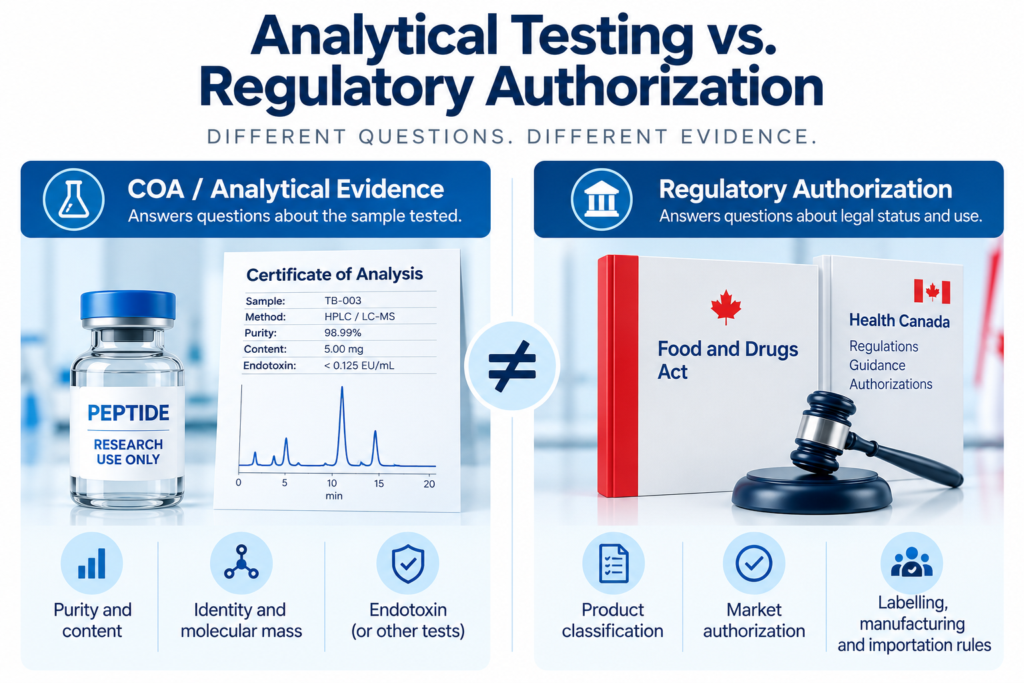
Analytical documentation can help identify and characterize a material, but it does not replace legally required import permissions.
For example, a certificate of analysis reporting chromatographic purity does not establish that the tested product may lawfully be imported or commercially distributed.
Does a Small Quantity Change the Rules?
Small shipment size does not automatically create a regulatory exemption.
Canadian import rules distinguish among product categories, importer types and circumstances. Personal-importation provisions applicable to certain authorized or non-prescription health products should not be assumed to apply to unauthorized injectable peptides.
Importers should confirm the applicable requirements before shipment rather than treating successful customs clearance as proof of legal authorization.
What Enforcement Actions Can Health Canada Take Against Unauthorized Peptides?
Health Canada monitors the Canadian marketplace for unauthorized health products and can take enforcement action where products or activities do not comply with applicable requirements.
Potential measures include:
- Product seizures and recalls.
- Requests or orders to stop sales.
- Orders concerning advertising and promotion.
- Court injunctions.
- Other compliance and enforcement measures authorized by law.
A Documented 2026 Enforcement Example
On July 29, 2026, Health Canada announced that the Superior Court of Québec had granted a permanent injunction against Canlab Research and its representatives on June 11, 2026.
According to Health Canada’s announcement, the injunction prevents the company and its representatives from engaging in specified activities involving unauthorized injectable peptides, following earlier enforcement actions.
This case demonstrates that research-oriented branding does not necessarily prevent a peptide product or its commercial distribution from being subject to drug-regulatory enforcement.
It should not, however, be interpreted as a legal determination concerning every peptide supplier or every laboratory research transaction in Canada.
Source: Health Canada’s July 2026 enforcement announcement.
What Documentation Should Researchers Review When Evaluating Peptide Materials?
Regulatory compliance and analytical quality are separate considerations, but both can matter to responsible laboratory procurement.
Researchers evaluating a peptide sample should examine the evidence available for the actual material under consideration.
Certificate of Analysis (COA)
A certificate of analysis may report specific analytical findings for a submitted sample or batch.
Relevant details include the sample identifier, reporting laboratory, test date, methods and results.
However, the meaning of a COA depends on which tests were performed and what those methods can establish.
HPLC Purity
High-performance liquid chromatography can separate sample components and support method-defined purity or content measurements.
A reported chromatographic purity percentage does not independently establish molecular identity, sterility, absence of every contaminant or regulatory authorization.
Mass Spectrometry
Mass spectrometry can provide evidence concerning molecular mass and, depending on the analytical method, additional structural information.
A mass measurement should not be presented as comprehensive proof of every aspect of peptide identity or quality.
Content and Other Testing
Content assays, endotoxin testing and sterility testing address different analytical questions.
Results should be described only when the relevant tests were actually performed and documented.
| Evidence | What it addresses |
|---|---|
| HPLC | Method-defined chromatographic separation, purity or content. |
| Mass spectrometry | Molecular-mass evidence and method-dependent structural information. |
| Content assay | Measured quantity of an analyte under the specified method. |
| Endotoxin testing | Endotoxin-related findings for the tested sample. |
| Regulatory authorization | Whether a defined product or activity has the authorization required under applicable law. |
No individual analytical result should be mistaken for Health Canada approval.
For researchers seeking a deeper explanation, see our educational resources on peptide analytical testing and certificate-of-analysis interpretation.
Does Buying From a Canadian Supplier Change Regulatory Obligations?
Domestic procurement and international importation involve different logistical considerations.
Ordering from a supplier already operating within Canada may eliminate the need for the purchasing laboratory to arrange a direct international shipment for that particular order.
However, domestic fulfilment does not establish that the supplier’s products are authorized, that their previous importation was compliant or that their commercial sale meets all applicable requirements.
Canadian researchers should therefore evaluate sourcing through two separate lenses:
- Regulatory suitability: Whether the particular product and proposed transaction meet applicable legal and institutional requirements.
- Scientific suitability: Whether the sample’s identity, analytical characteristics, traceability and documentation meet the laboratory’s experimental needs.
A supplier’s geographic location is not a substitute for either assessment.
Research Peptide Documentation at Researched Peptides
Researched Peptides positions its products for laboratory and scientific research and provides information about research materials and available independent analytical testing.
Researchers should examine the documentation associated with the relevant product and sample, rather than assuming that every report covers the same methods or attributes.
Research-only positioning and independent testing do not constitute Health Canada authorization or independently establish the legality of a particular sale or importation.
Readers can review the current Researched Peptides research catalogue for product information and should independently establish that any proposed procurement is appropriate under applicable requirements.
Frequently Asked Questions About Health Canada and Research Peptides
Canadian Peptide Regulations FAQ
The answer depends on the particular product, its classification and the transaction. A research-use label does not automatically authorize sale. Health Canada has stated that unauthorized peptide health products may be subject to enforcement.
No. Health Canada explicitly states that research-use labelling does not independently make a product legal to import or sell. Applicable regulatory requirements still apply.
Health Canada authorizes specific regulated health products through applicable pathways. A compound may also be studied in laboratory research or authorized clinical trials. Scientific investigation of a peptide does not mean every commercial preparation containing it is approved.
Yes. CBSA may detain shipments suspected of violating applicable requirements and refer them to Health Canada. Depending on the circumstances, imported products may be refused entry or seized.
Classification depends on the product and applicable criteria. Health Canada states that injectable peptide products are classified as drugs and has warned specifically about unauthorized injectable peptides.
No. A COA provides analytical information within the scope of the tests performed. It does not establish Health Canada authorization or legal compliance.
No. Domestic fulfilment may simplify some shipping arrangements, but it does not establish the regulatory status of a product or the legality of its commercial sale.
Researchers can consult Health Canada’s Drug Product Database for information about authorized drug products. A listed drug authorization applies to the specified regulated product, not to unrelated research preparations.
Conclusion: Understanding Canada’s Research Peptide Framework
Canadian peptide regulation is more complex than a simple distinction between products labelled for research and products labelled for medical use.
Health Canada considers product classification, intended use, regulatory authorization and applicable commercial activities. Its published guidance makes clear that research-use labelling does not independently exempt peptide products from Canadian requirements.
For laboratories, responsible evaluation involves understanding both the regulatory context and the actual analytical evidence available for the material being considered.
Clear documentation, accurate scientific terminology and careful separation of research findings from product claims help support informed research decisions. They do not replace regulatory compliance.
Official Canadian Regulatory References
- Government of Canada. Food and Drugs Act.
- Government of Canada. Food and Drug Regulations.
- Health Canada. Peptides: Regulations and Enforcement.
- Health Canada. Peptides: Research and Clinical Trials.
- Canada Border Services Agency. Memorandum D19-9-1: Administration of Health Canada Acts and Regulations Relating to Certain Regulated Goods.
- Health Canada. Think Twice Before Injecting Peptides Bought Online. April 9, 2026.
- Health Canada. Permanent Injunction Concerning Unauthorized Injectable Peptides. July 29, 2026.
Explore Research Peptide Information
Review laboratory research materials, product details and available analytical documentation. Confirm applicable regulatory requirements before procurement.