Tesamorelin Research: The Quick Answer
Tesamorelin is a synthetic analogue of growth hormone-releasing hormone (GHRH), a naturally occurring signalling peptide involved in regulating pituitary growth hormone secretion. By activating the GHRH receptor, tesamorelin stimulates endogenous growth hormone release and can influence downstream insulin-like growth factor-1 (IGF-1) signalling.
Tesamorelin has been investigated extensively in clinical research involving HIV-associated abdominal fat accumulation. Published studies have also examined its effects on visceral adipose tissue, liver fat, endocrine biomarkers and metabolic outcomes. These findings concern defined pharmaceutical interventions and study populations, not general weight-loss applications or research-use peptide products.
This guide examines how tesamorelin works, what major clinical studies actually found, and how researchers can interpret the available evidence while distinguishing biological findings from product-specific analytical quality.
Key Takeaways
- Mechanism: Tesamorelin acts through the GHRH receptor to stimulate endogenous growth hormone secretion.
- IGF-1: Growth hormone signalling can increase circulating IGF-1, an important biomarker in tesamorelin research.
- Clinical evidence: Randomized trials have investigated visceral adipose tissue in adults with HIV-associated abdominal fat accumulation.
- Emerging research: Selected clinical studies have examined liver fat and metabolic outcomes, with important population and study-design limitations.
- Laboratory materials: Published pharmaceutical findings do not establish the identity, purity, sterility or clinical suitability of independently supplied research peptides.
What Is Tesamorelin?
Tesamorelin is a modified peptide derived from the 44-amino-acid sequence of human growth hormone-releasing hormone. It contains a modification at the amino terminus that distinguishes it from native GHRH and was developed to increase resistance to enzymatic degradation.
GHRH is a hypothalamic hormone that communicates with specialized cells in the anterior pituitary gland known as somatotrophs. These cells synthesize and secrete growth hormone (GH), which participates in endocrine regulation and metabolic physiology.
Tesamorelin is of scientific interest because it acts upstream of growth hormone secretion. Rather than supplying growth hormone directly, it stimulates the receptor system involved in endogenous GH release.
This mechanism distinguishes tesamorelin from compounds that act directly at the growth hormone receptor or through different receptor families.
Tesamorelin at a Glance
| Research attribute | Scientific description |
|---|---|
| Compound class | Synthetic growth hormone-releasing hormone analogue |
| Primary receptor | Growth hormone-releasing hormone receptor (GHRHR) |
| Primary endocrine response | Stimulation of endogenous growth hormone secretion |
| Downstream signalling | Growth hormone and IGF-1-related endocrine pathways |
| Studied outcomes | Visceral adipose tissue, selected metabolic biomarkers, body composition and hepatic fat |
| Research evidence | Mechanistic evidence and controlled human clinical studies |
How Does Tesamorelin Work? Understanding the GHRH–GH–IGF-1 Pathway
To understand tesamorelin’s mechanism of action, it helps to examine the endocrine signalling pathway that normally regulates growth hormone secretion.
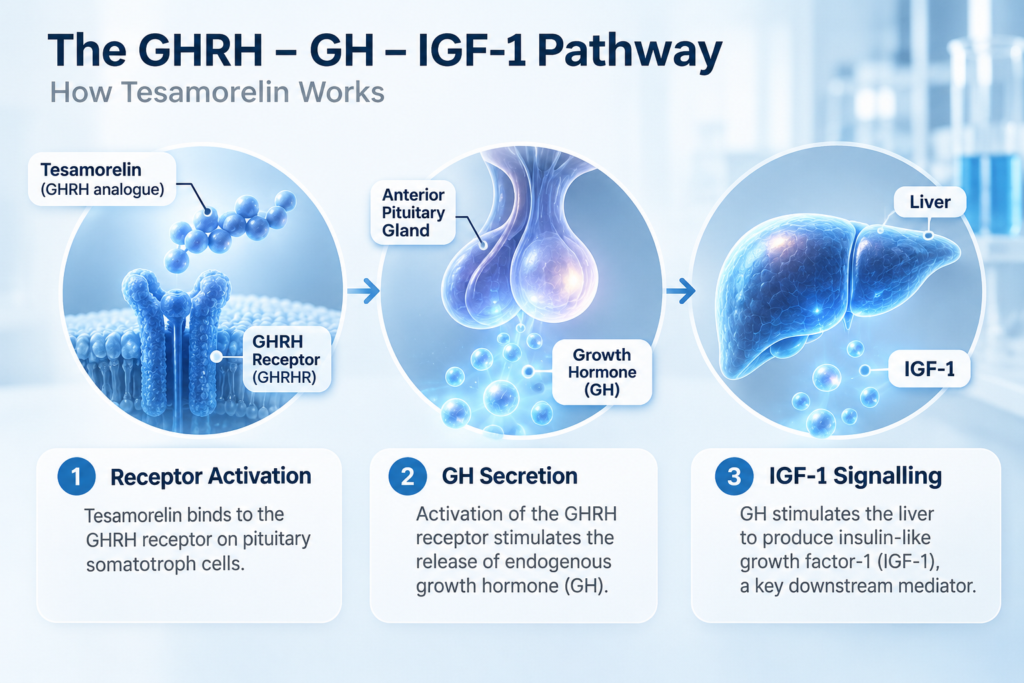
1. GHRH Receptor Activation
Growth hormone-releasing hormone binds to GHRH receptors expressed on somatotroph cells in the anterior pituitary gland. Tesamorelin interacts with this same receptor system.
The GHRH receptor belongs to the G-protein-coupled receptor family. Receptor activation stimulates intracellular signalling involving cyclic adenosine monophosphate (cAMP) and protein kinase A, contributing to growth hormone synthesis and secretion.
2. Endogenous Growth Hormone Secretion
Following GHRH receptor stimulation, the pituitary releases endogenous growth hormone. GH secretion is normally pulsatile and influenced by several regulatory signals, including hypothalamic GHRH, somatostatin and metabolic feedback mechanisms.
Tesamorelin has been investigated because it stimulates this physiological secretion pathway rather than replacing GH directly.
3. Downstream IGF-1 Signalling
Growth hormone acts on multiple tissues and stimulates IGF-1 production, particularly in the liver. IGF-1 participates in downstream endocrine signalling and also contributes to feedback regulation of the growth hormone axis.
In clinical tesamorelin studies, circulating IGF-1 concentrations have been measured to assess endocrine responses. However, an increase in IGF-1 is a biological observation, not independent evidence of improved health, safety or broader therapeutic benefit.
Why This Mechanism Matters in Research
The GHRH–GH–IGF-1 pathway connects hypothalamic and pituitary signalling with processes involved in lipid metabolism, body composition and endocrine regulation.
This makes tesamorelin useful in research examining the relationship between upstream hormone signalling and downstream physiological outcomes. Nevertheless, a mechanistic pathway does not establish that every proposed metabolic effect occurs in every experimental model or population.
What Has Tesamorelin Been Studied For?
Published tesamorelin research has concentrated on several related, but distinct, scientific questions. Understanding these research areas separately helps prevent broad claims from being drawn from narrowly designed studies.
Growth Hormone and IGF-1 Responses
One major research area concerns how GHRH receptor stimulation influences endogenous GH secretion and circulating IGF-1.
These outcomes provide measurable indicators of endocrine activity. They also help researchers examine relationships between hormone signalling, feedback regulation and metabolic responses.
Visceral Adipose Tissue
Visceral adipose tissue (VAT) refers to fat located within the abdominal cavity around internal organs. It is distinct from subcutaneous adipose tissue, which lies beneath the skin.
Several clinical trials investigated whether pharmaceutical tesamorelin could change visceral fat measurements in adults with HIV-associated abdominal fat accumulation.
The distinction between visceral and subcutaneous fat is important: a change in one fat compartment does not necessarily imply the same change in another or establish a comparable change in overall body weight.
Liver Fat and Metabolic Research
Researchers have also investigated tesamorelin in relation to hepatic fat accumulation, including studies involving people with HIV and nonalcoholic fatty liver disease (NAFLD), a term used in the original published literature.
These studies examined endpoints such as liver fat fraction, visceral fat, liver histology and selected metabolic biomarkers. Their results should be interpreted within the defined clinical populations rather than generalized to all metabolic conditions.
Body Composition
Body composition research evaluates the distribution of fat and lean tissue rather than relying only on total body weight.
Tesamorelin trials have examined abdominal fat compartments, lean body mass and related measurements. The findings are not interchangeable with claims about general weight loss, athletic performance or muscle development.
What Have Published Tesamorelin Clinical Studies Found?
Tesamorelin has been evaluated in randomized controlled trials. These studies provide stronger evidence for their specified populations and outcomes than a mechanistic hypothesis alone, but they do not establish universal effects or validate independently supplied research material.
2007 NEJM Trial: Visceral Fat and Endocrine Responses
In a randomized, placebo-controlled trial published in the New England Journal of Medicine, Falutz and colleagues studied 412 adults with HIV-associated abdominal fat accumulation over 26 weeks.
The primary endpoint was the percentage change in visceral adipose tissue measured using computed tomography.
Key Findings — Falutz et al., 2007
Study population: 412 adults with HIV and abdominal fat accumulation.
Duration: 26 weeks.
Visceral adipose tissue: Decreased by 15.2% in the tesamorelin group versus an increase of 5.0% in the placebo group.
IGF-1: Increased by 81.0% in the tesamorelin group versus a 5.0% decrease with placebo.
Evidence limitation: These are group-level results from a defined clinical population receiving a pharmaceutical intervention under a controlled study protocol.
The investigators also reported changes in selected lipid measures. However, the study did not demonstrate significant differences in measured glycemic outcomes between groups, and more tesamorelin participants discontinued because of adverse events.
These details matter because an endocrine or body-composition response should not be summarized as a universal metabolic improvement.
What Have Published Tesamorelin Clinical Studies Found?
Tesamorelin has been evaluated in randomized controlled trials. These studies provide stronger evidence for their specified populations and outcomes than a mechanistic hypothesis alone, but they do not establish universal effects or validate independently supplied research material.
2007 NEJM Trial: Visceral Fat and Endocrine Responses
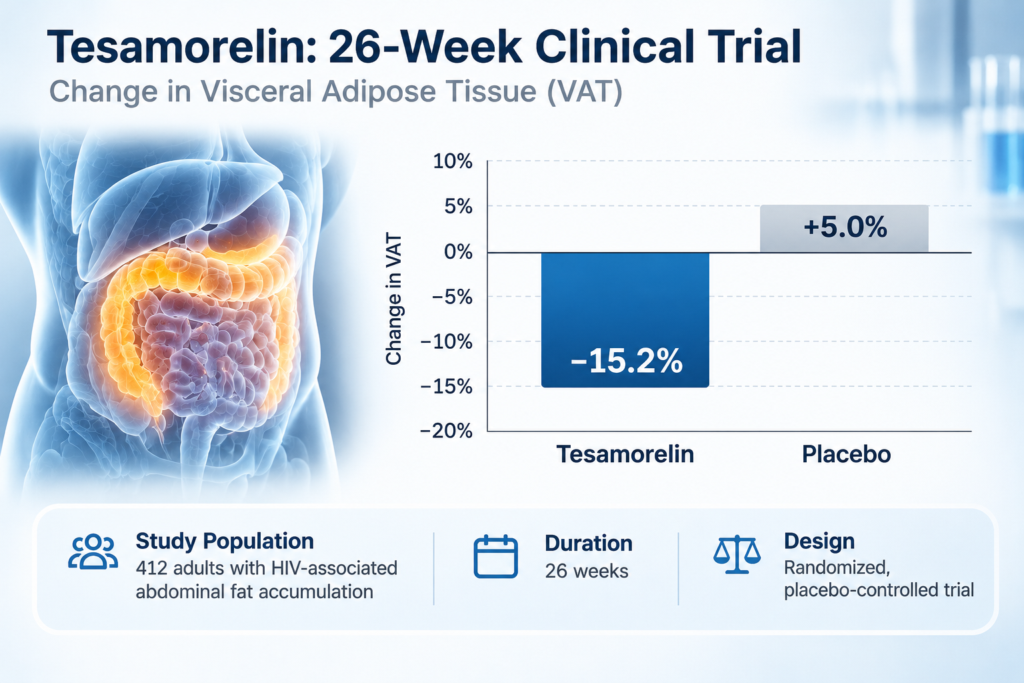
In a randomized, placebo-controlled trial published in the New England Journal of Medicine, Falutz and colleagues studied 412 adults with HIV-associated abdominal fat accumulation over 26 weeks.
The primary endpoint was the percentage change in visceral adipose tissue measured using computed tomography.
Key Findings — Falutz et al., 2007
Study population: 412 adults with HIV and abdominal fat accumulation.
Duration: 26 weeks.
Visceral adipose tissue: Decreased by 15.2% in the tesamorelin group versus an increase of 5.0% in the placebo group.
IGF-1: Increased by 81.0% in the tesamorelin group versus a 5.0% decrease with placebo.
Evidence limitation: These are group-level results from a defined clinical population receiving a pharmaceutical intervention under a controlled study protocol.
The investigators also reported changes in selected lipid measures. However, the study did not demonstrate significant differences in measured glycemic outcomes between groups, and more tesamorelin participants discontinued because of adverse events.
These details matter because an endocrine or body-composition response should not be summarized as a universal metabolic improvement.
2014 JAMA Trial: Visceral and Liver Fat
A 2014 randomized clinical trial published in JAMA investigated tesamorelin in people with HIV and abdominal fat accumulation, including measurements of visceral adipose tissue and hepatic fat.
Over six months, researchers reported a mean change in visceral adipose tissue of approximately −34 cm² in the tesamorelin group versus +8 cm² with placebo, corresponding to a between-group treatment effect of approximately −42 cm².
The study also reported a reduction in measured liver fat relative to placebo. These findings supported further investigation of connections between the growth hormone axis, visceral adiposity and hepatic fat metabolism.
The trial was not evidence that tesamorelin produces the same outcome in people without HIV or that a laboratory research vial has comparable clinical properties.
2019 Lancet HIV Trial: Liver Fat and Histological Findings
Stanley and colleagues conducted a randomized, double-blind, multicentre trial examining pharmaceutical tesamorelin in people with HIV and NAFLD.
In the primary analysis, 26 participants receiving tesamorelin and 28 receiving placebo were evaluated for hepatic fat fraction. Over 12 months, the researchers reported an absolute between-group treatment effect of −4.1 percentage points in hepatic fat fraction.
At the end of the study, 35% of participants in the tesamorelin group versus 4% in the placebo group had a hepatic fat fraction below 5%.
The investigators also observed less fibrosis progression in the tesamorelin group, but the study did not demonstrate significant improvement of existing fibrosis. The trial was relatively small, and further research was identified as necessary to clarify long-term clinical implications.
How Do These Studies Compare?
| Study | Main research question | Important limitation |
|---|---|---|
| Falutz et al., 2007 | Visceral fat, IGF-1 and metabolic measures over 26 weeks | Adults with HIV-associated abdominal fat accumulation |
| Stanley et al., 2014 | Visceral and hepatic fat measurements | Small, specialized clinical study population |
| Stanley et al., 2019 | Hepatic fat fraction and liver histological endpoints | People with HIV and NAFLD; limited long-term evidence |
These studies investigate related biological processes, but they differ in duration, participant selection, endpoints and analytical methods. Their numerical findings should not be directly combined without accounting for those differences.
What Are the Limitations of Tesamorelin Research?
The published clinical evidence is substantial enough to establish tesamorelin as a meaningful subject of endocrine and body-composition research. However, several boundaries remain essential when interpreting the findings.
Clinical Results Are Population-Specific
Much of the key evidence comes from studies involving adults with HIV-associated fat accumulation or liver disease. These findings should not automatically be extended to healthy individuals, athletes, other metabolic conditions or different clinical populations.
Changes in Fat Distribution Are Not the Same as General Weight Loss
Visceral fat, subcutaneous fat, total fat mass and total body weight represent different endpoints. A trial reporting reduced visceral fat does not necessarily demonstrate a comparable reduction in total body weight.
Endocrine Activity Requires Careful Interpretation
Growth hormone and IGF-1 are biologically active signalling components. Changes in their concentrations are not universally beneficial outcomes, and clinical studies must consider endocrine and metabolic safety alongside the measured primary endpoints.
Long-Term Effects and Withdrawal Matter
Follow-up research has indicated that reductions in visceral fat can diminish following treatment withdrawal. Consequently, short-term study findings do not establish permanent physiological changes.
Commercial Research Materials Are Not Clinical Trial Products
Clinical trials use defined pharmaceutical formulations manufactured and evaluated for their study protocols. Research-use peptides supplied separately are not interchangeable with those formulations.
Even when a commercial research sample has analytical documentation, such reports address the tests performed on that sample. They do not establish clinical equivalence, human-use safety or therapeutic efficacy.
How Does Tesamorelin Compare With Other GHRH Analogues?
Tesamorelin is sometimes discussed alongside other compounds investigated for their interactions with growth hormone-related signalling systems.
For example, CJC-1295 (No DAC), commonly associated with modified GRF(1-29), is also studied in the context of growth hormone-releasing hormone receptor activity.
However, tesamorelin and modified GRF(1-29) are structurally distinct peptides with different sequences and development histories. They should not be assumed to have identical pharmacokinetics, receptor responses, study outcomes or clinical evidence.
Likewise, ipamorelin is a growth hormone secretagogue investigated through the ghrelin receptor (GHSR1a), rather than a GHRH analogue acting primarily through GHRHR.
Research Pathway Comparison
| Compound | Primary research pathway | Key distinction |
|---|---|---|
| Tesamorelin | GHRH receptor | Modified full-length GHRH analogue with published clinical trials |
| CJC-1295 (No DAC) | GHRH receptor | Shorter modified GRF analogue; distinguish from DAC-linked variants |
| Ipamorelin | Ghrelin receptor (GHSR1a) | Different receptor family and signalling entry point |
These distinctions can inform experimental questions about receptor pathways. They do not establish that one compound is superior or that combining compounds produces additive or synergistic effects.
Tesamorelin Research in Canada: Product Documentation and Analytical Quality
For Canadian laboratories evaluating tesamorelin as a research material, it is important to distinguish scientific evidence about the molecule from analytical evidence about a particular supplied sample.
Clinical research, product authorization and laboratory research procurement are separate considerations. An authorized pharmaceutical product is not interchangeable with a material labelled for laboratory research. Health Canada also warns that research-use labelling does not make an unauthorized drug suitable for human use.
Evaluating a Certificate of Analysis
A certificate of analysis (COA) can provide useful information about a submitted sample, depending on the procedures performed and the scope of the report.
Researchers should review the sample identifier, reported methods, test date, findings and any stated analytical limitations.
| Analytical attribute | What it can help establish |
|---|---|
| HPLC purity | Chromatographic purity under the reported method |
| Mass spectrometry | Molecular identity or characterization evidence appropriate to the method |
| Content / assay | Measured analyte amount in the submitted sample |
| Endotoxin analysis | Endotoxin-related findings where testing was performed |
These analytical categories answer different questions. High chromatographic purity alone does not establish sterility, clinical suitability or absence of every possible contaminant.
Research Peptide Documentation at Researched Peptides
Researched Peptides provides laboratory research materials in Canada and uses independent third-party analytical testing. The tests performed and results reported vary by the applicable laboratory documentation.
Researchers should evaluate the documentation associated with the material under consideration rather than assuming that a result obtained for another compound, sample or batch applies universally.
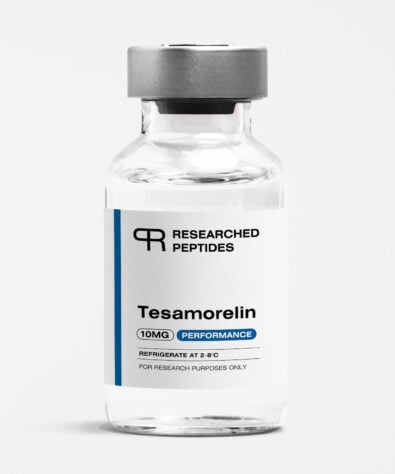
Performance & Endurance
$90.99
Research-use products are intended for laboratory and scientific investigation only. They are not authorized pharmaceutical substitutes and are not intended for human or veterinary use.
Frequently Asked Questions About Tesamorelin Research
Answers to common questions about tesamorelin’s mechanism, scientific evidence and research context.
Tesamorelin Research FAQ
Tesamorelin is a synthetic analogue of growth hormone-releasing hormone (GHRH). It acts through the GHRH receptor to stimulate endogenous growth hormone secretion and influence downstream IGF-1 signalling.
No. Tesamorelin is a GHRH analogue, not growth hormone itself. It stimulates the endocrine pathway involved in endogenous growth hormone release.
Controlled clinical studies have reported increases in circulating IGF-1 following pharmaceutical tesamorelin administration. The magnitude of the response depends on the study population, formulation, protocol and measurement conditions.
Several randomized studies in adults with HIV-associated abdominal fat accumulation reported reductions in visceral adipose tissue compared with placebo. These findings concern defined clinical populations and do not establish general weight-loss effects.
Yes. Clinical research involving people with HIV and hepatic fat accumulation has reported changes in measured liver fat. Further research is required to determine the durability, broader applicability and long-term clinical significance of these findings.
Both are investigated in relation to GHRH receptor signalling, but they are structurally distinct peptides. Tesamorelin is a modified full-length GHRH analogue, whereas CJC-1295 (No DAC) is commonly associated with modified GRF(1-29). Their evidence bases and experimental characteristics should be assessed independently.
No. Tesamorelin acts through the GHRH receptor, while ipamorelin is investigated as a ghrelin receptor agonist. Although both relate to growth hormone signalling, they use different receptor pathways.
No. Analytical reports address specified characteristics of submitted samples under particular laboratory methods. They do not independently establish clinical safety, sterility, efficacy or suitability for human administration.
No. Pharmaceutical tesamorelin products and laboratory research materials have different intended uses and regulatory considerations. Findings from clinical trials cannot be transferred automatically to separately supplied research vials.
Conclusion: Understanding Tesamorelin Through Scientific Evidence
Tesamorelin offers an important example of how GHRH receptor signalling can be investigated through both endocrine biomarkers and clinical research endpoints.
Published trials have examined growth hormone-related signalling, IGF-1 responses, visceral adipose tissue and hepatic fat in defined populations. These studies provide valuable scientific evidence, but their results must be interpreted in the context of study design, measured outcomes and clinical limitations.
For laboratory researchers, understanding the mechanism is only one part of the evaluation. The identity, analytical characterization and documentation of a particular research material are separate questions requiring sample-specific evidence.
Meaningful peptide research begins with accurate mechanisms, appropriately interpreted studies and transparent analytical information.
Scientific and Regulatory References
- Falutz J, et al. Metabolic Effects of a Growth Hormone-Releasing Factor in Patients with HIV. New England Journal of Medicine. 2007;357:2359–2370. doi:10.1056/NEJMoa072375.
- Falutz J, et al. Effects of Tesamorelin, a Growth Hormone-Releasing Factor, in HIV-Infected Patients With Abdominal Fat Accumulation: A Randomized Placebo-Controlled Trial With a Safety Extension. Journal of Acquired Immune Deficiency Syndromes. 2010. PubMed record.
- Stanley TL, et al. Effect of Tesamorelin on Visceral Fat and Liver Fat in HIV-Infected Patients With Abdominal Fat Accumulation: A Randomized Clinical Trial. JAMA. 2014. PubMed record.
- Stanley TL, et al. Effects of Tesamorelin on Nonalcoholic Fatty Liver Disease in HIV: A Randomized, Double-Blind, Multicenter Trial. Lancet HIV. 2019;6:e821–e830. doi:10.1016/S2352-3018(19)30338-8.
- U.S. Food and Drug Administration. EGRIFTA WR Prescribing Information. Mechanism of Action and Clinical Studies sections. FDA prescribing information.
- Health Canada. Health Canada Warns About Contaminated Unauthorized Injectable Peptides and Non-Peptide Drugs. November 6, 2026. Official advisory.
Explore Tesamorelin for Laboratory Research
Discover Tesamorelin 10mg at Researched Peptides, including product specifications, independent laboratory testing and available analytical documentation.