
Peptide Stacks in Research: The Quick Answer
A peptide stack is an informal term for two or more peptides investigated together within an experimental system. Scientists may study combinations to examine interactions between molecular pathways, compare individual and combined responses, or investigate whether one compound changes the observed activity of another.
However, combining peptides does not automatically produce stronger results. A scientifically meaningful multi-compound peptide protocol requires appropriate controls, clear hypotheses, validated measurements and evidence that distinguishes individual compound activity from combination effects.
This guide explains how peptide stacks are studied, what makes a combination experiment reliable, and how research categories involving BPC-157, TB-500, GHK-Cu, CJC-1295 and ipamorelin illustrate different experimental questions.
Key Takeaways
- Research purpose: Peptide combinations help investigate interactions between biological pathways.
- Evidence: Findings for individual peptides do not establish the effects of their combination.
- Study design: Individual-compound groups and suitable controls are essential for interpreting results.
- Synergy: A combined response must be evaluated against an appropriate interaction model.
- Analytical quality: Identity, purity and content require distinct supporting evidence.
What Are Peptide Stacks in Scientific Research?
The phrase peptide stacking is widely used in commercial and online discussions, but it is not a standardized scientific classification. In laboratory research, more precise terms include combination treatment, multi-agent experiment, co-exposure study and combination pharmacology.
A peptide combination experiment involves studying two or more compounds within a defined experimental system. Depending on the research question, investigators may examine simultaneous exposure, separate treatment conditions, pathway interactions or changes in measurable biological responses.
For example, a researcher studying cellular migration might investigate two compounds associated with different signalling processes. Another laboratory may compare two agents that interact with different receptors within the same endocrine system.
In either case, the scientific objective is not simply to combine compounds. It is to determine whether the combination produces a measurable response that differs from appropriate comparison conditions.
Peptide Stacks Versus Single-Compound Research
| Research feature | Single compound | Combination study |
|---|---|---|
| Primary question | What does one compound do? | How do compounds behave together? |
| Interpretation | Individual response | Individual and interaction effects |
| Controls | Vehicle and relevant comparators | Vehicle, each compound and combination |
| Complexity | Fewer experimental factors | Additional interactions and variables |
Combination studies can provide information that isolated compound experiments cannot, but they also introduce additional uncertainty. More compounds do not necessarily mean more informative results.
Why Do Scientists Study Multiple Peptides Together?
Researchers investigate multi-compound systems for several distinct reasons. Each requires a different experimental hypothesis and interpretation framework.
1. Investigating Different Biological Pathways
Two peptides may interact with different molecular targets that contribute to a broader biological process. Researchers can investigate whether simultaneous modulation changes a measurable response.
For example, tissue-research models may examine cellular migration, extracellular matrix regulation and inflammatory signalling. These processes are related, but they are not interchangeable.
Evidence that separate compounds influence different processes does not establish that combining them improves tissue repair.
2. Studying Receptor-Level Interactions
Some combination experiments examine agents acting on different receptors within a shared physiological system.
A relevant example involves growth hormone-releasing hormone (GHRH) receptor signalling and ghrelin/growth hormone secretagogue receptor signalling.
Researchers may investigate whether activating these receptor systems together changes endocrine responses relative to individual stimulation.
3. Investigating Additive or Interactive Responses
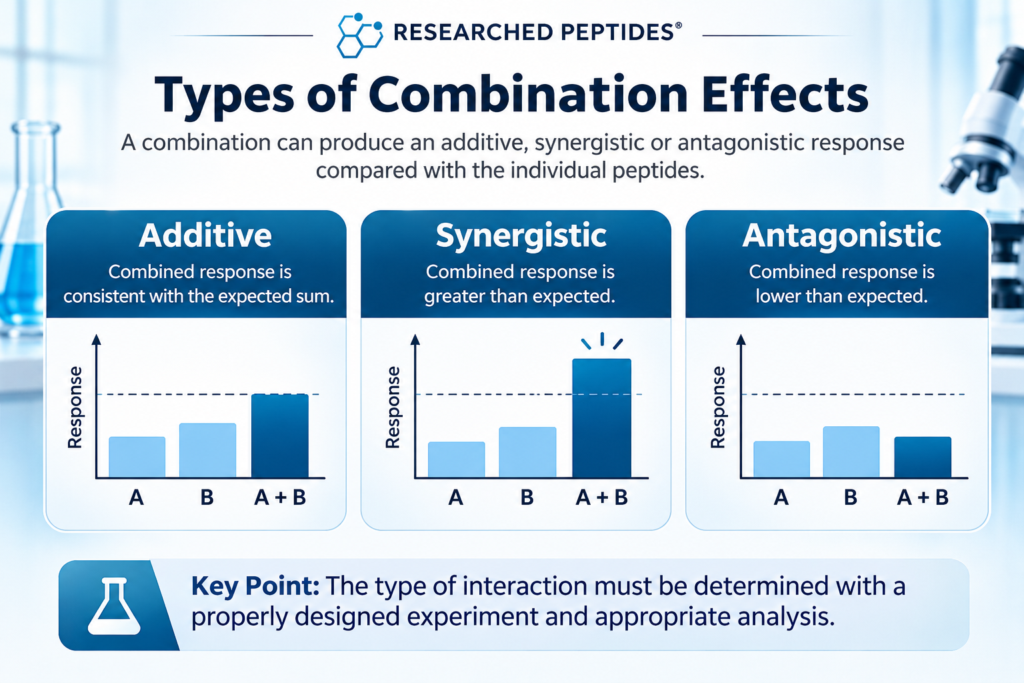
A combination may produce an observed response greater than, equal to or smaller than the responses expected under a specified model.
Possible interpretations include additive activity, synergistic interaction or antagonistic interaction. These terms have distinct meanings and require appropriate quantitative analysis.
4. Understanding Biological Complexity
Many biological processes involve interconnected signalling networks rather than a single isolated pathway.
Combination experiments can help researchers investigate this complexity, but they must account for confounding variables, assay limitations and the possibility of unexpected interactions.
How Do Scientists Design Multi-Compound Peptide Experiments?
A reliable peptide combination study begins with a clearly defined question, not a predetermined assumption that the compounds will work better together.
Establishing the Experimental Hypothesis
Researchers first identify the biological endpoint of interest. This might involve receptor activation, gene expression, cell migration, protein production or another measurable outcome.
The hypothesis should specify what difference the investigators expect to detect and which comparison would support or contradict that expectation.
Using Appropriate Control Groups
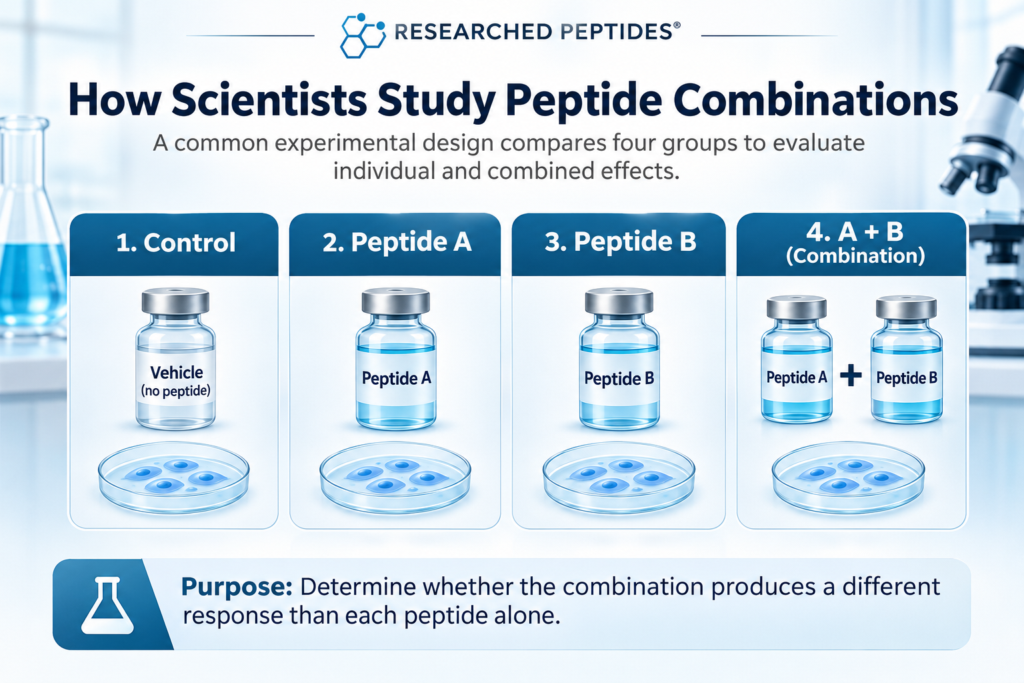
For a basic two-compound experiment, a common design includes four conditions:
- Control: The experimental system without either active compound, using an appropriate vehicle condition.
- Compound A: The first compound investigated independently.
- Compound B: The second compound investigated independently.
- Combination A + B: Both compounds evaluated under the defined experimental conditions.
This structure helps researchers distinguish an observed combination response from effects attributable to either component alone.
More complex investigations may require concentration-response matrices, additional controls, repeated measurements or factorial experimental designs. A single combination condition is generally insufficient to establish a robust interaction profile.
Controlling Experimental Variables
Researchers must also consider factors such as sample identity, measured content, experimental timing, assay conditions, biological model and measurement variability.
These variables matter because apparent differences between experimental groups may arise from inconsistencies unrelated to the intended biological interaction.
Replication and Statistical Interpretation
Biological and technical replication help determine whether observations are reproducible. Statistical models should match the study design, including whether interaction terms are being tested.
A statistically significant difference between a combination group and a control group does not automatically demonstrate synergy. The comparison must address the specific interaction hypothesis.
Which Peptide Combinations Are Investigated in Research?
Peptide combinations are often grouped according to their proposed research applications. However, these categories are organizational descriptions rather than evidence that particular combinations produce established outcomes.
BPC-157 and TB-500: Tissue-Related Research
BPC-157 is a synthetic peptide investigated primarily in preclinical models involving tissue responses, gastrointestinal injury and cellular signalling.
TB-500 is commercially associated with thymosin beta-4-related research. Scientific studies involving full-length thymosin beta-4 must not automatically be treated as direct evidence for every TB-500 preparation, fragment or commercial formulation.
Thymosin beta-4 has been studied in relation to actin regulation, cellular migration and tissue-associated processes. BPC-157 has a separate experimental literature involving injury models and proposed signalling mechanisms.
Researchers may be interested in investigating these compounds together because their respective research histories involve overlapping biological questions.
However, overlapping research interests are not evidence of additive activity or synergy. Direct combination experiments are required to establish what happens when the compounds are studied together.
For further context, see the Wolverine Blend research material, which contains BPC-157 and TB-500.
GHK-Cu, BPC-157 and TB-500: Multi-Pathway Tissue Research
GHK-Cu is a copper-binding tripeptide studied in relation to extracellular matrix biology, fibroblast activity and wound-associated processes.
Researchers have investigated GHK-Cu in experimental systems involving collagen-related pathways and cellular responses. Its research profile differs from that of BPC-157 and thymosin beta-4-related compounds.
These differences provide a rationale for asking whether multiple pathways can be examined in one experimental model. They do not establish that a three-component blend produces superior tissue outcomes.
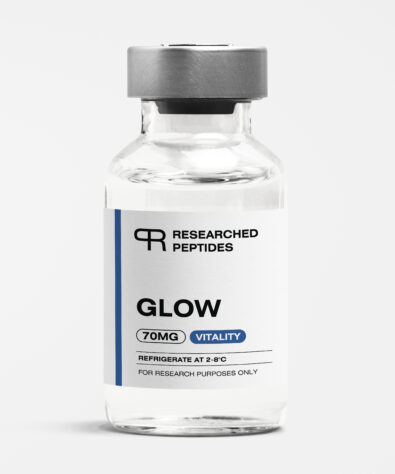
The GLOW research blend brings together GHK-Cu, BPC-157 and TB-500 as a defined multi-component material. Its composition is relevant to experimental questions involving all three compounds, while published findings for the individual ingredients must remain separate from claims about the blend.
KLOW: Investigating an Additional Peptide Component
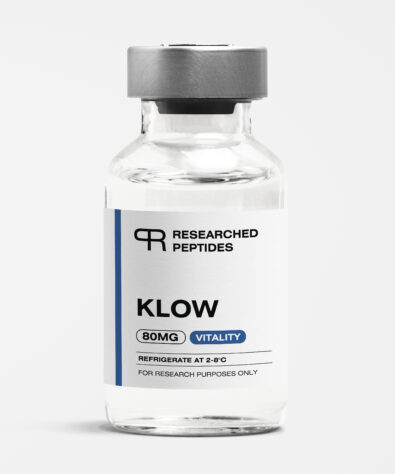
KLOW contains GHK-Cu, BPC-157, TB-500 and KPV.
KPV is a tripeptide sequence investigated in preclinical inflammatory signalling research, including experimental work involving intestinal inflammation.
Adding another compound creates additional experimental questions rather than automatically providing broader biological benefits.
Researchers considering four-component systems must account for the increased difficulty of identifying which component, or interaction between components, contributes to an observed result.
CJC-1295 (No DAC) and Ipamorelin: Endocrine Signalling Research
CJC-1295 (No DAC) is a modified GHRH-related peptide used in research discussions involving GHRH receptor signalling. It should be distinguished from DAC-containing CJC-1295 preparations, which have different molecular characteristics.
Ipamorelin is a growth hormone secretagogue receptor agonist investigated for its activity within endocrine signalling systems.
These compounds are associated with different receptor mechanisms. Their combination therefore presents a mechanistically relevant question about receptor interaction and endocrine response.
However, published studies of related GHRH analogues or growth hormone secretagogues do not automatically establish the effects of the exact CJC-1295 (No DAC) and ipamorelin combination.
Researchers should distinguish receptor-level rationale, direct compound-specific evidence and results from actual combination experiments.
Does Combining Peptides Create Synergy?
Not necessarily. Synergy is a defined experimental relationship, not a general synonym for combining compounds.
A combination may produce a larger observed response than either compound alone without qualifying as synergistic under an appropriate interaction model.
Additive Effects
An additive interaction occurs when the observed combined response is consistent with the expectation defined by an appropriate additivity model.
The correct expectation depends on the assay, biological endpoint, concentration-response relationships and assumptions of the selected model.
Synergistic Effects
Synergy is supported when a combination produces a response exceeding the model-defined expectation, with adequate experimental and statistical support.
Researchers use approaches such as Bliss independence, Loewe additivity and related interaction frameworks in suitable combination studies. These models are not universally interchangeable.
Antagonistic Effects
Antagonism occurs when the observed combined response is below the expectation established by the chosen interaction framework.
Two compounds may interfere with each other’s measured activity, affect overlapping regulatory systems or produce other interactions that change the experimental response.
Why Individual Studies Cannot Prove Combination Effects
Suppose one published experiment reports a cellular response involving peptide A, while a separate experiment reports a different response involving peptide B.
Those findings cannot simply be combined to predict the result of A + B. The studies may differ in biological model, assay conditions, measured endpoints and experimental methods.
Even when the two studies investigate the same endpoint, a direct combination experiment is needed to characterize the interaction reliably.
This is particularly important when evaluating commercial peptide blends, where individual-component research is sometimes incorrectly presented as evidence for the complete formulation.
What Are the Main Limitations of Peptide Stack Research?
Multi-compound experiments can be informative, but their conclusions are constrained by the available evidence and experimental design.
Limited Direct Combination Evidence
Many peptide combinations discussed online have substantially more literature about their individual components than about the exact combination.
Researchers should identify whether evidence comes from a direct combination experiment, a related compound, a mechanistic hypothesis or an entirely different biological model.
Differences Between Research Models
Results from isolated cells, animal models and human clinical studies answer different questions.
Findings from one model cannot automatically be generalized to another. Preclinical observations do not establish clinical benefits in humans.
Increasing Experimental Complexity
Adding compounds increases the number of possible interactions and makes causal interpretation more difficult.
For example, a four-component experiment may require more than four individual-compound comparisons to identify meaningful interaction patterns.
Researchers may need systematic experimental designs that evaluate selected combinations and interactions without confusing the effects of individual components.
Analytical and Formulation Uncertainty
When multiple compounds are present in one preparation, analytical separation, identification and measurement can become more challenging.
Compatibility and stability cannot be assumed simply because each compound can be studied separately.
Validated analytical procedures and appropriate experimental controls are necessary to support reliable interpretation.
How Should Researchers Evaluate Peptide Stack Quality?
For Canadian laboratories evaluating peptide stacks, the first priority is establishing what material is being studied and which analytical evidence is available.
Compound Identity
Identity testing provides evidence about the analyte present in a sample. Depending on the method, mass spectrometry may support molecular-mass characterization, while additional techniques may be needed to establish other structural attributes.
For multi-component preparations, the ability to distinguish individual analytes is especially important.
Purity Testing
High-performance liquid chromatography can separate sample components and provide method-defined chromatographic information.
However, a reported HPLC purity percentage is not automatically proof of complete identity, measured peptide content or absence of all possible contaminants.
Content and Composition
Measured content addresses how much analyte was found under a specified analytical procedure.
In a peptide blend, researchers may need to understand the quantity of each constituent rather than relying only on the total nominal amount.
Certificates of Analysis
A certificate of analysis should be interpreted according to the specific sample, methods and reported results.
Researchers should review the sample identifier, testing laboratory, report date, analytical methods, reported measurements and relevant limitations.
For a deeper explanation, consult our guide to HPLC peptide testing and how researchers interpret purity data.
Independent analytical documentation can help laboratories evaluate research materials, but no single test establishes suitability for every experimental application.
Peptide Combination Research Materials at Researched Peptides
Researched Peptides offers individual research peptides and defined multi-component blends for laboratory and scientific research.
Three examples relevant to combination research are:
- Wolverine Blend: BPC-157 and TB-500, with 10 mg of each component in the catalogued 20 mg formulation.
- GLOW: GHK-Cu 50 mg, BPC-157 10 mg and TB-500 10 mg, totalling 70 mg.
- KLOW: GHK-Cu 50 mg, BPC-157 10 mg, TB-500 10 mg and KPV 10 mg, totalling 80 mg.
These compositions represent different experimental inputs. They should not be interpreted as evidence that one formulation is more effective, synergistic or biologically superior to another.
Researchers should evaluate the intended experimental question, available documentation and analytical requirements before selecting research materials.

Tissue Repair & Recovery
Longevity & Vitality
$125.99
Longevity & Vitality
$132.99
Frequently Asked Questions About Peptide Stacks
Peptide Stacks Research FAQ
A peptide stack is an informal term for a combination of two or more peptides investigated within an experimental system. Scientific literature more commonly uses terms such as combination treatment or multi-agent study.
No general conclusion can be made. Combination effects depend on the exact compounds, model, endpoint and experimental conditions. Direct comparative evidence is required to establish whether a specific combination produces an additive, synergistic or antagonistic response.
A peptide blend generally refers to multiple compounds contained in one preparation. A peptide stack describes the broader concept of investigating or using multiple compounds together. Neither term establishes biological effectiveness or synergy.
The compounds are associated with different areas of preclinical tissue-related research. Investigating them together can address questions about combined experimental responses, but individual-component evidence cannot establish the effect of the combination.
It refers to investigations involving GHRH-related signalling and growth hormone secretagogue receptor signalling. A mechanistic rationale exists for studying the receptor systems together, but findings involving related compounds must not be presented as direct proof for the exact combination.
No. Adding compounds increases experimental complexity and may introduce interactions that cannot be predicted from individual-compound research. More ingredients do not establish greater effectiveness.
Researchers need suitable individual-compound comparisons, a defined experimental endpoint, appropriate concentration-response data and an interaction model. A combination outperforming a control group alone is not sufficient evidence of synergy.
Only to the extent supported by the specific analytical methods and results. A report should identify which components or attributes were tested. A general purity statement does not automatically establish the identity, content or purity of every constituent.
Conclusion: Stronger Combination Research Requires Stronger Evidence
Peptide stacks provide a framework for investigating interactions between multiple compounds and biological pathways. Their scientific value depends on the quality of the research question, experimental controls, analytical methods and interpretation.
Individual peptide findings can help generate hypotheses, but they cannot establish the effects of a combination. Claims of synergy, additive benefit or superior performance require direct experimental support.
For researchers evaluating multi-compound systems, the most useful approach is to distinguish established mechanisms from hypotheses, inspect the evidence for the exact combination and ensure that the available analytical documentation supports the intended laboratory work.
Scientific References
- Chou TC. Theoretical Basis, Experimental Design, and Computerized Simulation of Synergism and Antagonism in Drug Combination Studies. Pharmacol Rev. 2006;58(3):621–681. DOI: 10.1124/pr.58.3.10.
- Foucquier J, Guedj M. Analysis of drug combinations: current methodological landscape. Pharmacol Res Perspect. 2015;3(3):e00149. DOI: 10.1002/prp2.149.
- Greco WR, Bravo G, Parsons JC. The Search for Synergy: A Critical Review from a Response Surface Perspective. Pharmacol Rev. 1995;47(2):331–385. PubMed record.
- Goldstein AL, Hannappel E, Kleinman HK. Thymosin beta-4: actin-sequestering protein moonlights to repair injured tissues. Trends Mol Med. 2005;11(9):421–429. DOI: 10.1016/j.molmed.2005.07.004.
- Pickart L, Margolina A. Regenerative and Protective Actions of the GHK-Cu Peptide in the Light of the New Gene Data. Int J Mol Sci. 2018;19(7):1987. DOI: 10.3390/ijms19071987.
- Raun K, Hansen BS, Johansen NL, et al. Ipamorelin, the first selective growth hormone secretagogue. Eur J Endocrinol. 1998;139(5):552–561. DOI: 10.1530/eje.0.1390552.
- ICH. Q2(R2): Validation of Analytical Procedures. International Council for Harmonisation. ICH Quality Guidelines.
Explore Peptide Combination Research Materials
Review defined research-blend compositions and available product information for laboratory studies.