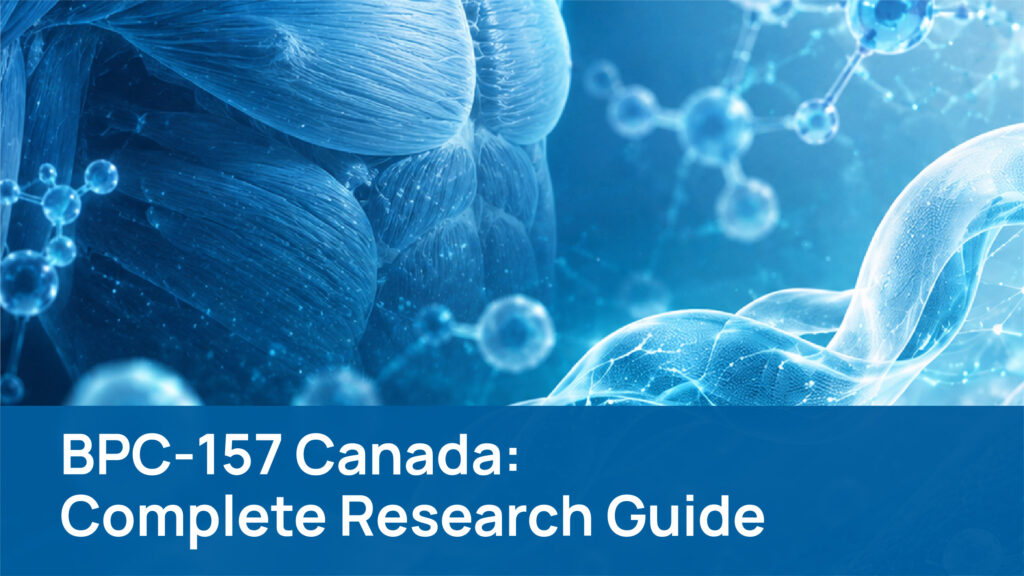
In the domain of preclinical wound healing and tissue engineering, accelerating the structural repair of poorly vascularized matrices remains a primary challenge for modern biochemistry. Conventional recovery intervals for dense connective tissues—such as tendons, ligaments, and osteochondral junctions—are heavily restricted by limited blood supply and complex localized cellular signaling cascades. Recently, laboratory investigators focused on metabolic tissue remodeling have oriented their research toward BPC-157 Canada models, seeking to map how this unique gastric-derived pentadecapeptide modulates soft-tissue repair at a cellular level.
This technical guide evaluates the primary biochemical mechanisms of BPC-157, breaks down its tissue-specific angiogenic pathways, details precise laboratory reconstitution configurations, and establishes quality control benchmarks critical for validating experimental data sets.
The Molecular Profile of BPC-157
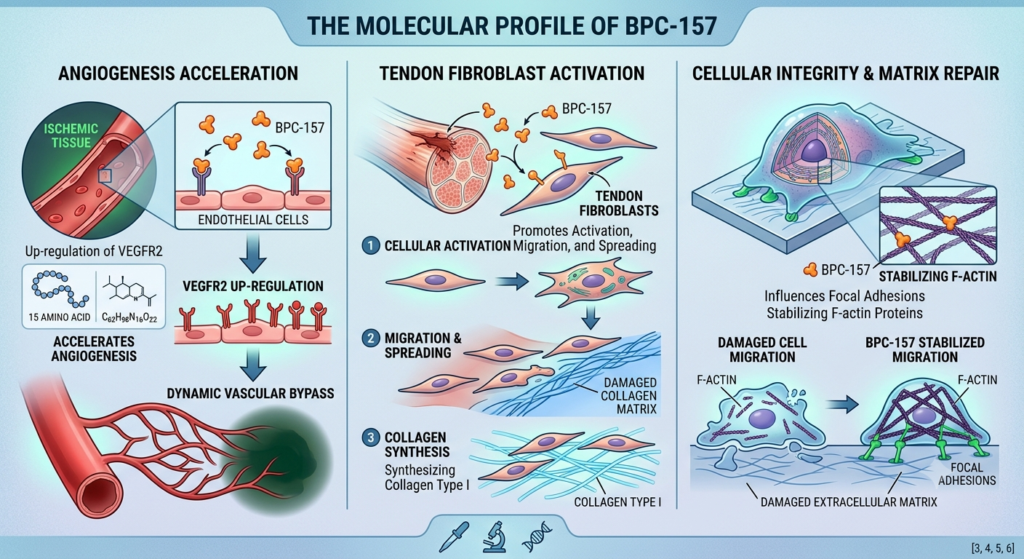
BPC-157 is a synthetic pentadecapeptide composed of 15 amino acids derived from a naturally occurring protective partial sequence isolated from human gastric juice protein1. Its molecular formula is expressed as C62H98N16O22 with a precise molecular weight of 1419.54 Da2.
In vitro and in vivo BPC-157 research models consistently demonstrate that the peptide modulates several overlapping pathways crucial to localized wound healing and structural matrix repair3:
- Up-regulation of VEGFR2: It accelerates angiogenesis (the formation of new blood vessels) by up-regulating Vascular Endothelial Growth Factor Receptor 2 (VEGFR2), establishing a dynamic vascular bypass to ischemic tissues4.
- Fibroblast Migration: It significantly promotes the activation, migration, and spreading of tendon fibroblasts, which are the main cellular components responsible for synthesizing collagen type I frameworks5.
- F-Actin Stabilization: At a cellular level, it influences the formation of focal adhesions by stabilizing F-actin proteins, crucial for structural cellular integrity during migration across damaged extracellular matrices6.
We Have Everything You Need To Get Started.
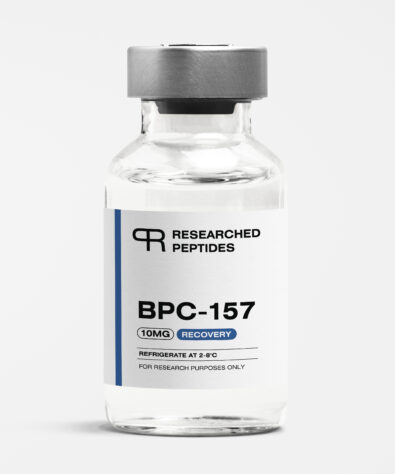
Tissue Repair & Recovery
Price range: $41.24 through $71.24
Research Supplies
Price range: $3.74 through $14.99
Angiogenic Vector Dynamics and Cellular Motility
The primary therapeutic merit of BPC-157 stems from its documented ability to orchestrate tissue healing without inducing chaotic, non-functional scar matrices. When a connective target suffers severe mechanical trauma, the resulting micro-tears rapidly drop local oxygen tension, creating an ischemic cellular environment. Under normal conditions, this hypoxic state stalls regular extracellular matrix cellular turnover. BPC-157 helps bypass this operational wall by modulating transcriptional regulators like early growth response protein-1 (EGR-1), which triggers a cascade of rapid endothelial migration and cytoskeletal organization3.
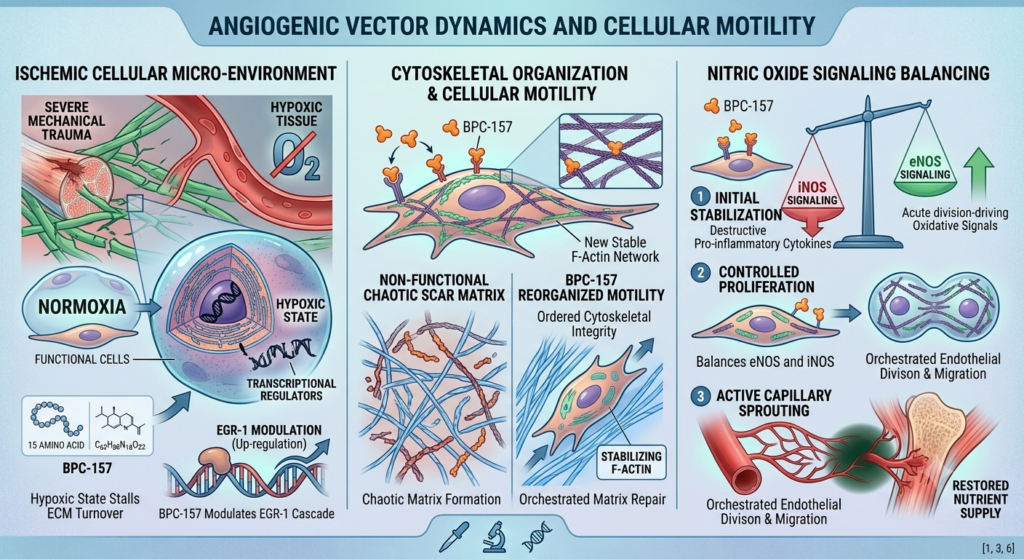
Simultaneously, the peptide’s interplay with the endogenous nitric oxide (NO) system acts as a master stabilizer1. By properly balancing endothelial nitric oxide synthase (eNOS) and inducible nitric oxide synthase (iNOS) signaling, BPC-157 down-regulates destructive pro-inflammatory cytokines without neutralizing the acute, necessary oxidative signals needed to command cellular division6. This careful regulation allows newly organized endothelial cells to actively sprout capillary buds directly into areas of poor vascular density, restoring cellular nutrient supply to damaged bone-to-tendon junction points.
Standardizing the Laboratory BPC-157 Dosing Protocol
To preserve tight experimental control and ensure data reproducibility across repetitive assay models, meticulous preparation protocols are critical. Subtle shifts in target concentrations can introduce unwanted baseline drift in cellular responses, meaning that establishing a precise, standardized BPC-157 dosing protocol is a mandatory prerequisite for any formal study design.
Lyophilized peptide cakes must be carefully brought to a liquid state using an appropriate sterile diluent. For extended observational studies, the industry standard is Bacteriostatic Water (0.9% Benzyl Alcohol), which provides an effective anti-microbial barrier to inhibit bacterial growth over multi-week testing cycles. The table below provides a comprehensive breakdown of concentration mapping within a baseline 5mg lyophilized vial structure:
| Vial Total (Mass) | Reconstitution Liquid Volume | Resulting Core Concentration | Standard Micro-Dose Aliquot |
|---|---|---|---|
| 5 mg (5,000 mcg) | 1.0 mL | 5,000 mcg / mL | 250 mcg per 0.05 mL unit |
| 5 mg (5,000 mcg) | 2.0 mL | 2,500 mcg / mL | 250 mcg per 0.10 mL unit |
| 5 mg (5,000 mcg) | 2.5 mL | 2,000 mcg / mL | 250 mcg per 0.125 mL unit |
Analytical Validation: Purity Controls for Sourcing
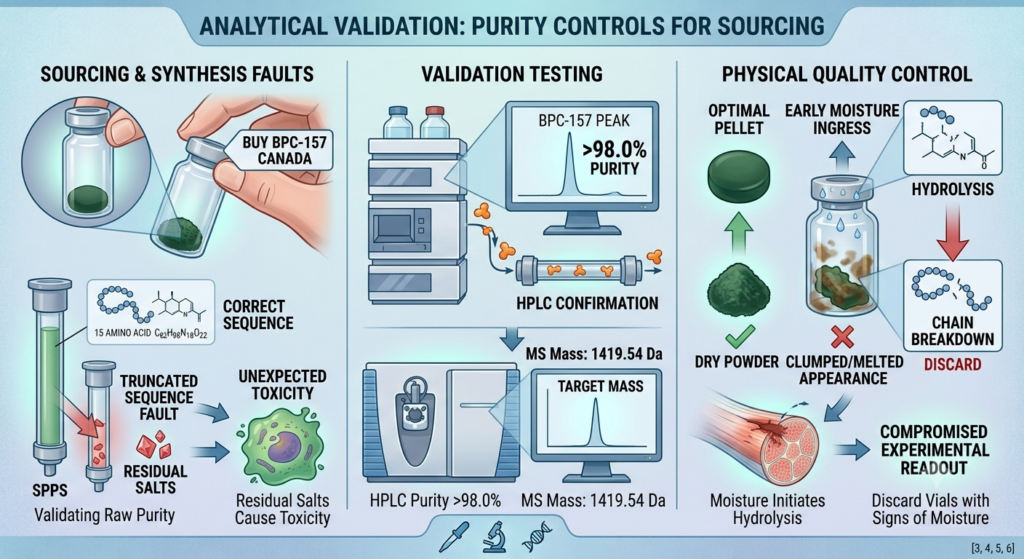
When domestic research bodies arrange to buy BPC-157 Canada compounds, validating raw material purity represents the primary safeguard against compromised experimental readouts. Minor faults during solid-phase peptide synthesis can yield truncated amino acid sequences or residual salts, which can induce unexpected cell toxicity or cross-react with secondary receptors in live assays.
Every genuine batch of BPC-157 must be validated by independent testing using High-Performance Liquid Chromatography (HPLC) to confirm a chemical purity rating exceeding 98.0%. Simultaneously, Mass Spectrometry (MS) analysis should be used to confirm that the observed mass matches the theoretical profile of 1419.54 Da. Vials that reveal signs of early moisture ingress—such as a sticky, clumped, or melted appearance of the dry powder pellet—should be discarded immediately, as unchecked moisture initiates hydrolysis and breaks down the main peptide chain.
Storage Conditions & Handling SOPs
Preserving the foundational structural integrity of synthesized peptide solutions requires strict, continuous adherence to established cold-chain protocols to prevent enzymatic degradation or unintended unfolding:
- Lyophilized Powder Maintenance: Prior to reconstitution, dry chemical vials should be held at a stable temperature of -20°C. Keeping the vials deep-frozen insulates the crystal structures from fluctuating humidity levels and ambient light degradation.
- Fluid Transfer Technique: During fluid introduction, the diluent must be introduced slowly down the interior glass wall of the vial. Violent mechanical agitation should be completely avoided; instead, use smooth, slow swirling motions to transition the lyophilized pellet into solution without shearing the peptide chain.
- Post-Reconstitution Care: Once in liquid state, the solution must be continuously stored at temperatures between 2°C and 8°C. Experimental protocols should ensure the solution is completely utilized within a 30-day window to prevent baseline potency decay.
Conclusion: Preclinical Horizons in Incretin and Repair Assays
While empirical anecdotal feedback in private forums frequently highlights the efficiency of BPC-157 in tissue repair models, human clinical testing remains strictly outside current scientific parameters. The preclinical evidence compiled in animal models, however, offers a highly dependable, reproducible dataset demonstrating accelerated soft tissue remodeling, localized capillary formation, and cellular matrix organization. For development teams pushing the boundaries of regenerative bio-engineering, strict control over sourcing validation, reconstitution math, and cold storage settings is critical to obtaining authoritative, peer-review-quality research outcomes.
Tissue Repair & Recovery
Price range: $41.24 through $71.24
Research Supplies
Price range: $3.74 through $14.99
References
- Sikiric, P., et al. (2020). Stable gastric pentadecapeptide BPC 157, Robert’s stomach cytoprotection/adaptive cytoprotection/organoprotection, and Selye’s stress coping response: Progress, achievements, and the future. Gut and Liver, 14(1), 153-167. https://doi.org/10.5009/gnl18490
- Józwiak, M., Bauer, M., Kamysz, W., & Kleczkowska, P. (2025). Multifunctionality and possible medical application of the BPC 157 peptide—Literature and patent review. Pharmaceuticals, 18(2), 185. https://doi.org/10.3390/ph18020185
- Seiwerth, S., et al. (2021). Stable gastric pentadecapeptide BPC 157 and wound healing. Frontiers in Pharmacology, 12, 627533. https://doi.org/10.3389/fphar.2021.627533
- Wiegmann, A. L., et al. (2024). A review of evidence on regenerative peptide supplementation and potential in aesthetic plastic surgery. Aesthetic Surgery Journal. https://doi.org/10.1093/asj/sjag020
- Chang, C. H., Tsai, W. C., Hsu, Y. H., & Pang, J. H. (2014). Pentadecapeptide BPC 157 enhances the growth hormone receptor expression in tendon fibroblasts. Molecules, 19(11), 19066-19077. https://doi.org/10.3390/molecules191119066
- Yuan, C., et al. (2024). From regeneration to analgesia: The role of BPC-157 in tissue repair and pain management. Biomedicine & Pharmacotherapy.