
Retatrutide Phase 3 Trials: The Quick Answer
In 2026, the TRIUMPH Phase 3 program reported substantial changes in body weight across several populations, and TRIUMPH-1 results were published in a peer-reviewed journal. Retatrutide (LY3437943) is an investigational triple agonist targeting GIP, GLP-1, and glucagon receptors. The results are promising within their studied settings, but interpretation depends on the individual trial, endpoint, analysis method, and safety findings.
Importantly, the widely quoted 28.3% TRIUMPH-1 figure comes from a sponsor-reported efficacy analysis; the published trial’s treatment-regimen analysis reported a different result. This guide explains both rather than treating them as interchangeable.
Key Takeaways
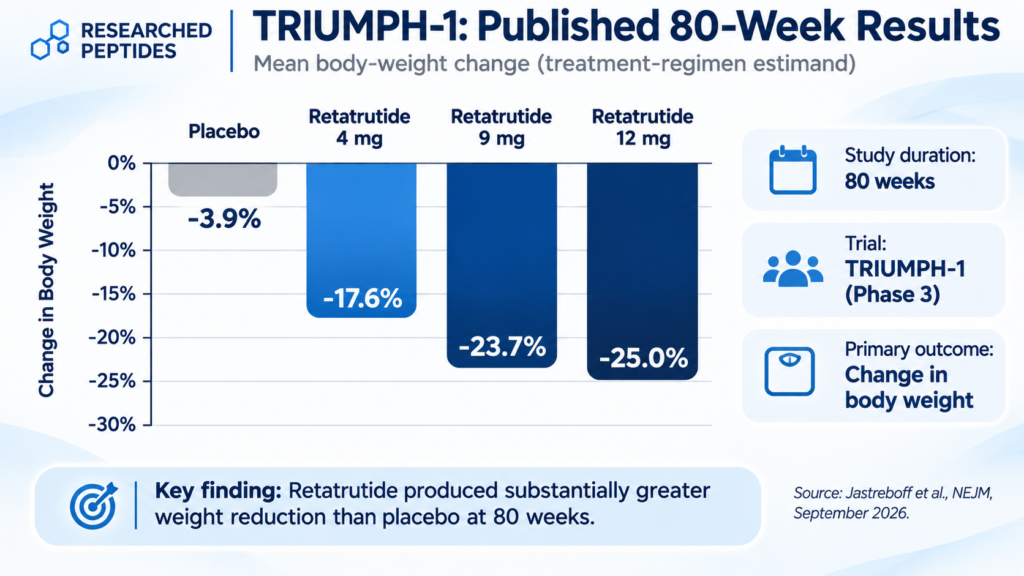
- TRIUMPH-1: the published 80-week treatment-regimen analysis reported a mean 25.0% reduction in weight for the 12 mg group versus 3.9% with placebo.
- The sponsor’s 28.3% figure for the same dose reflects a different efficacy estimand.
- TRIUMPH-2 and TRIUMPH-3 topline results covered populations with type 2 diabetes and established cardiovascular disease, respectively.
- Gastrointestinal adverse events were commonly reported; larger weight changes do not eliminate safety questions.
- None of these pharmaceutical trials tested retail research-use peptide vials.
What Is Retatrutide (LY3437943)?
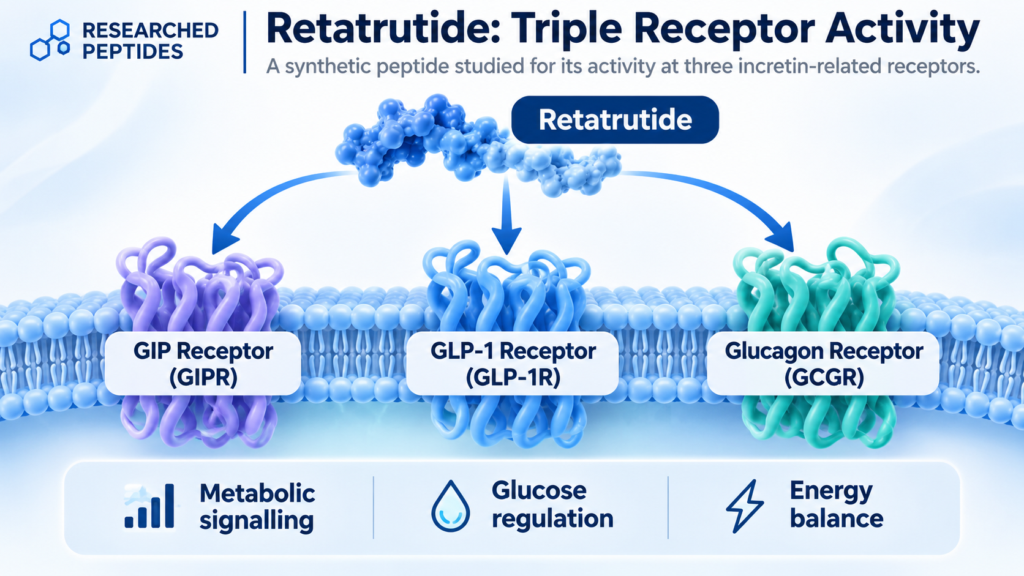
Retatrutide is an investigational peptide designed to activate three related G-protein-coupled receptors: the glucose-dependent insulinotropic polypeptide receptor (GIPR), glucagon-like peptide-1 receptor (GLP-1R), and glucagon receptor (GCGR). Its pharmacology differs from single-receptor GLP-1 agonists and dual GIP/GLP-1 agonists because it incorporates glucagon-receptor activity.
These receptor systems participate in metabolic signalling, but a three-receptor mechanism does not by itself establish superior clinical outcomes. Those outcomes require direct clinical testing with defined comparators and populations. The TRIUMPH program was designed to provide that evidence for the investigational pharmaceutical formulation.
Three Receptor Targets, Three Distinct Research Questions
| Target | Research context |
|---|---|
| GIPR | Nutrient-responsive incretin and metabolic signalling |
| GLP-1R | Glucose-dependent endocrine signalling and appetite-related pathways |
| GCGR | Hepatic glucose regulation and energy-metabolism pathways |
The net clinical effect of combined receptor activation cannot be calculated simply by adding the effects of three isolated pathways.
Which TRIUMPH Phase 3 Trials Reported Results in 2026?
TRIUMPH is a family of trials, not one study. Its protocols include different eligibility criteria and outcomes. That distinction matters when interpreting search results for “retatrutide phase 3 trials” or “retatrutide TRIUMPH trial results 2026.”
| Study | Population | 2026 evidence |
|---|---|---|
| TRIUMPH-1 | Obesity without diabetes | Peer-reviewed 80-week publication and sponsor reports |
| TRIUMPH-2 | Obesity/overweight with type 2 diabetes | Sponsor topline announcement in July |
| TRIUMPH-3 | Severe obesity with established cardiovascular disease | Sponsor topline announcement in July |
| TRIUMPH-4 | Obesity/overweight with knee osteoarthritis | Sponsor-reported findings announced before 2026 |
Other analyses, including obstructive sleep apnea substudies, also contributed to the 2026 evidence base. Their endpoints should be considered separately from the main body-weight comparisons.
What Did the Published TRIUMPH-1 Trial Show?
The TRIUMPH-1 paper, published in the New England Journal of Medicine on September 29, 2026, reported a randomized, double-blind, placebo-controlled Phase 3 trial involving 2,339 randomized participants. The trial investigated retatrutide at three assigned dose levels against placebo over 80 weeks in adults with obesity without diabetes. Read the peer-reviewed study.
Published 80-Week Body-Weight Results
| Randomized group | Mean change in body weight |
|---|---|
| Retatrutide 4 mg | −17.6% |
| Retatrutide 9 mg | −23.7% |
| Retatrutide 12 mg | −25.0% |
| Placebo | −3.9% |
Source: TRIUMPH-1 peer-reviewed publication; treatment-regimen estimand. These are group averages under the trial protocol, not individual predictions or results for research-use material.
Why Did Lilly Also Report 28.3%?
In its May 21, 2026 announcement, Lilly reported 28.3% average weight reduction for the 12 mg group under an efficacy estimand, compared with 2.2% for placebo. This is not necessarily a contradiction: an estimand specifies the clinical question being estimated and how events such as discontinuation are handled. Different estimands can produce different numerical summaries from the same trial.
For a careful scientific summary, report the estimand alongside the number. Quoting the largest available percentage without its analysis context can mislead readers about what was measured.
What About the 104-Week Extension?
Lilly also described a 104-week extension among participants meeting specific baseline BMI criteria, reporting up to 30.3% mean reduction in the referenced extension group. This is a selected extension population and should not be represented as the main randomized 80-week result for every participant.
What Did TRIUMPH-2, TRIUMPH-3, and TRIUMPH-4 Report?
TRIUMPH-2: Participants With Type 2 Diabetes
In a July 23, 2026 topline release, Lilly reported mean weight changes at 80 weeks of −12.7%, −19.1%, and −20.8% for the 4 mg, 9 mg, and 12 mg groups, respectively, in TRIUMPH-2. The sponsor also reported average HbA1c reductions of up to 1.6 percentage points. These findings come from a population with type 2 diabetes and should not be merged with the TRIUMPH-1 results as though they arose from the same cohort.
TRIUMPH-3: Severe Obesity and Established Cardiovascular Disease
The same July announcement reported up to 22.6% mean weight reduction at 80 weeks in TRIUMPH-3, involving adults with severe obesity and established cardiovascular disease, with or without type 2 diabetes. A study population selected for existing cardiovascular disease does not, on its own, establish a reduction in cardiovascular events. Such a claim would require appropriate clinical endpoint evidence.
TRIUMPH-4: Knee Osteoarthritis
TRIUMPH-4 enrolled participants with obesity or overweight and knee osteoarthritis. Lilly’s sponsor-reported efficacy-estimand analysis described mean weight reductions of 26.4% and 28.7% in the 9 mg and 12 mg groups, respectively, compared with 2.1% for placebo at 68 weeks. The announcement also reported improvements in knee pain measures. Because the study population, timepoint, and endpoint framework differ from TRIUMPH-1, the two trials should not be treated as a direct head-to-head comparison.
Some pain-percentage summaries were post hoc, and certain secondary comparisons were not multiplicity-controlled. Those qualifiers are essential when describing the strength of the evidence.
What About Sleep Apnea?
A separate peer-reviewed publication dated October 20, 2026 reported results from TRIUMPH-1-OSA and TRIUMPH-2-OSA substudies involving adults with moderate-to-severe obstructive sleep apnea, with and without type 2 diabetes, respectively. These were defined clinical cohorts with sleep-apnea endpoints; their findings should not be generalized to all people with obesity or all retatrutide preparations. See the OSA study.
What Do the Phase 3 Safety Findings Show?
The published TRIUMPH-1 study identified gastrointestinal adverse events among the most common reported events. Safety interpretation requires more than listing the most frequent symptoms: investigators also consider severity, treatment discontinuation, serious adverse events, and whether results differ across study populations or exposure periods.
A Phase 3 result is not a declaration that a medicine is risk-free. The 2026 findings contribute evidence for regulatory assessment of an investigational pharmaceutical product. They do not independently establish long-term outcomes beyond the observed follow-up, nor do they validate an unrelated research-use preparation.
How Should Researchers Interpret the 2026 Data?
1. Distinguish Peer-Reviewed Publications From Topline Releases
A peer-reviewed article typically provides more methodological detail than a company announcement. Topline releases are useful for timely updates, but readers should identify their source and avoid assuming that every supporting analysis has already undergone full independent publication.
2. Match Every Percentage to Its Estimand
The TRIUMPH-1 25.0% and 28.3% figures answer related but different analysis questions. The distinction matters for comparisons with other trials and for summaries circulated online.
3. Do Not Compare Trials Without Accounting for Population Differences
Baseline diabetes status, severity of obesity, established cardiovascular disease, study duration, treatment discontinuation, and endpoint definitions can all influence the reported outcome. A higher percentage in one trial does not prove the drug worked better in that population.
4. Separate Weight-Change Findings From Other Clinical Endpoints
Changes in body weight, HbA1c, knee pain, and apnea-hypopnea index measure different outcomes. Evidence for one endpoint is not automatic evidence for another, and surrogate markers do not replace clinical event data.
5. Keep Mechanism Separate From Clinical Causation
Retatrutide’s GIP/GLP-1/glucagon activity is a pharmacological characteristic. The observed trial outcome reflects the entire intervention and study context; it does not precisely quantify the contribution of each receptor pathway.
What Do TRIUMPH Findings Mean for Retatrutide Research Materials?
The clinical studies evaluated a specific investigational pharmaceutical intervention manufactured and administered within controlled trials. Their results cannot be used to infer that separately supplied laboratory retatrutide has equivalent composition, exposure, quality, safety, or clinical performance.
For laboratory procurement, a certificate of analysis should be evaluated on its own terms. Chromatographic purity, molecular identity evidence, measured content, endotoxin testing, and sterility are different analytical questions. A reported result for one attribute does not prove the others.
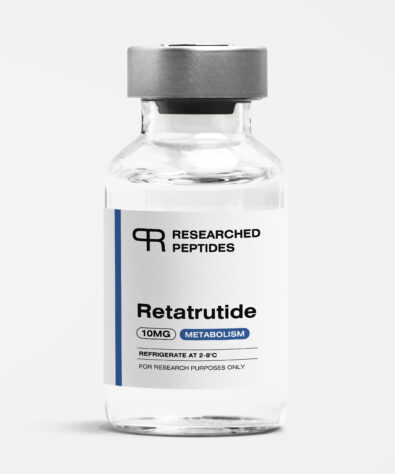
Researched Peptides lists retatrutide for laboratory and scientific research. Researchers should review current product details and the applicable analytical documentation for the material under consideration, rather than treating published clinical outcomes as product-level evidence.
Metabolic Support
Price range: $69.99 through $139.99
Frequently Asked Questions
Retatrutide Phase 3 FAQ
TRIUMPH-1 reported substantial average weight reduction over 80 weeks. The peer-reviewed treatment-regimen analysis found −25.0% in the 12 mg group versus −3.9% with placebo. A separate sponsor efficacy-estimand analysis reported −28.3% versus −2.2%.
No. It is a sponsor-reported efficacy-estimand figure. The peer-reviewed treatment-regimen analysis gives a different estimate. Both require their analysis labels to be interpreted correctly.
LY3437943 is the investigational compound identifier for retatrutide, a triple GIP, GLP-1, and glucagon receptor agonist.
No. Evidence status differs by trial and analysis. TRIUMPH-1 had a peer-reviewed publication in September 2026, while several other program findings were initially communicated through sponsor releases.
No. These clinical trials studied an investigational pharmaceutical product, not retail laboratory research materials. Analytical documentation for a research sample does not confer authorization or clinical suitability.
No. Retatrutide targets GIP, GLP-1, and glucagon receptors; tirzepatide targets GIP and GLP-1 receptors. Their trial results should not be compared as if they were randomized against one another unless a direct comparative study supports that conclusion.
Conclusion: The Evidence Is Stronger When the Details Stay Visible
The 2026 TRIUMPH findings advanced the clinical evidence base for investigational retatrutide across obesity and related conditions. The central scientific lesson is not simply the largest headline percentage. It is the combination of defined study populations, analysis methods, efficacy endpoints, safety reporting, and independent publication.
For laboratory researchers, the published pharmacology and clinical literature can inform scientific questions, while product identity and quality must be assessed through separate sample-specific analytical evidence.
Scientific References
- Jastreboff AM, et al. Retatrutide, a Triple Hormone Receptor Agonist, for Treatment of Obesity. N Engl J Med. Published September 29, 2026. doi:10.1056/NEJMoa2604169.
- Eli Lilly. TRIUMPH-1 topline results. May 21, 2026.
- Eli Lilly. TRIUMPH-2 and TRIUMPH-3 topline results. July 23, 2026.
- Eli Lilly. TRIUMPH-4 results announcement.
- Grunstein RR, et al. Retatrutide Once Weekly for Treatment of Obstructive Sleep Apnea. N Engl J Med. Published October 20, 2026. doi:10.1056/NEJMoa2611477.
- ClinicalTrials.gov. TRIUMPH-2, NCT05929079; TRIUMPH-4, NCT05931367.
Explore Retatrutide for Laboratory Research
Review research-product information and available analytical documentation separately from the clinical trial evidence.