
GLOW Peptide Blend: The Quick Answer
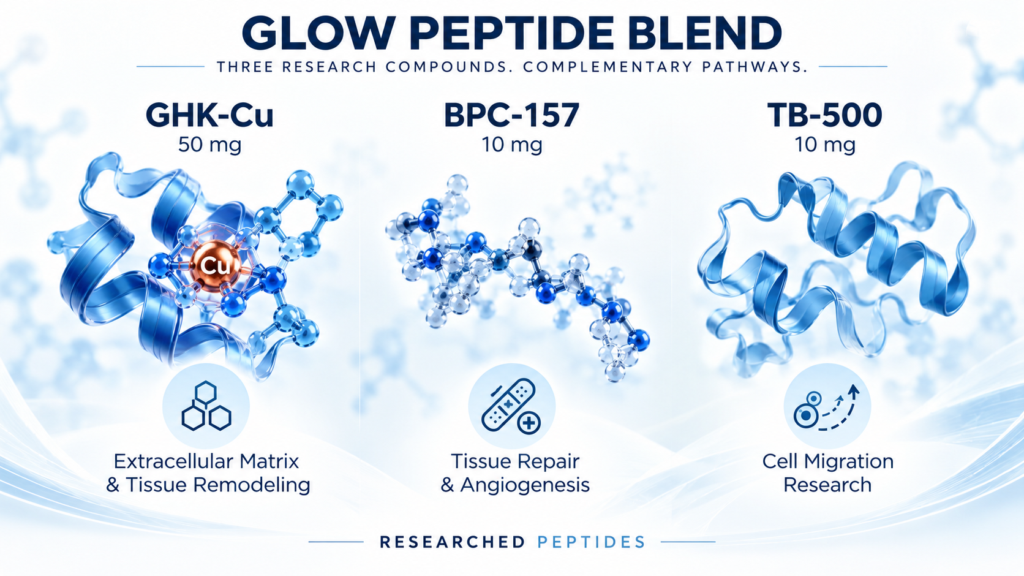
GLOW is a three-component research peptide blend containing GHK-Cu, BPC-157 and TB-500. The Researched Peptides formulation contains 50 mg GHK-Cu, 10 mg BPC-157 and 10 mg TB-500, for a total nominal content of 70 mg. Each component is discussed in experimental literature related to tissue biology, but the strength and scope of that evidence vary considerably.
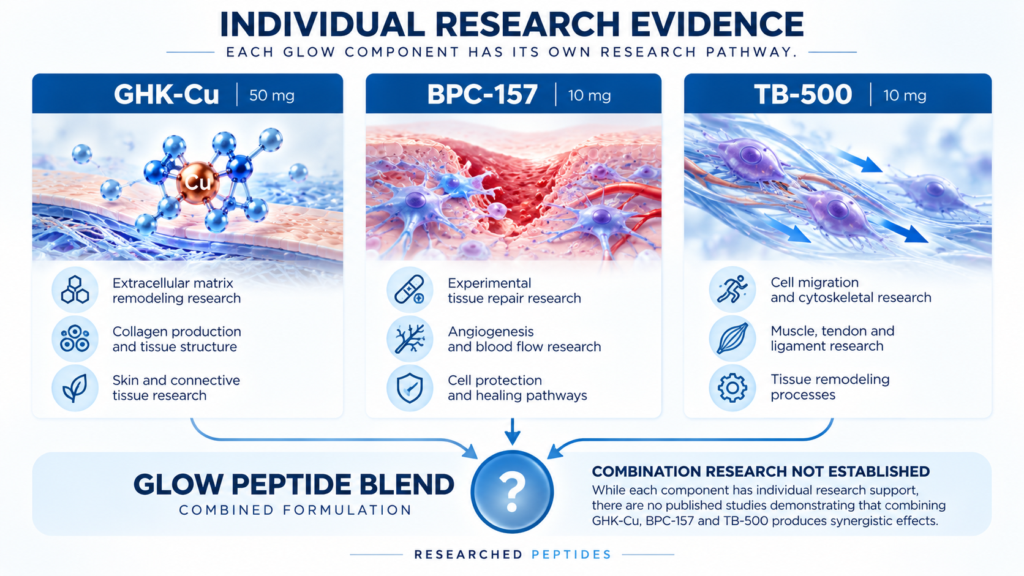
The central scientific distinction is between evidence for individual molecules and evidence for their combined formulation. Studying three related research areas in one preparation does not establish synergy, superior tissue repair or clinical efficacy. This guide explains the components, research models, limitations and analytical questions relevant to Canadian laboratories.
Key Takeaways
- Composition: GHK-Cu 50 mg + BPC-157 10 mg + TB-500 10 mg.
- GHK-Cu: Studied in extracellular matrix and collagen-related research.
- BPC-157: Investigated mainly in preclinical tissue-injury models.
- TB-500: Its exact identity matters; full-length thymosin beta-4 studies are not automatically TB-500 studies.
- Blend evidence: Component-level observations do not demonstrate that GLOW itself produces additive or synergistic effects.
What Is the GLOW Peptide Blend?
GLOW is a named combination of three distinct research materials, not a single newly discovered peptide. Its components have different molecular structures and are investigated in overlapping but non-identical areas of tissue biology. The word “GLOW” is a product or formulation name rather than a standardized scientific designation for a validated treatment.
| Component | Nominal amount | Research context |
|---|---|---|
| GHK-Cu | 50 mg | Matrix remodeling and copper-peptide biology |
| BPC-157 | 10 mg | Experimental injury and repair models |
| TB-500 | 10 mg | Thymosin-related research; identity must be established |
The nominal milligram values describe the approved catalog composition, not an independently verified assay result for a particular vial. Those are separate questions and should be evaluated using the applicable analytical report.
What Does Each GLOW Component Contribute to Research?
GHK-Cu: Copper-Peptide and Extracellular Matrix Research
GHK is the tripeptide glycyl-L-histidyl-L-lysine. It binds copper ions to form the GHK-Cu complex. This relationship makes the molecule relevant to research on copper coordination, extracellular matrix components and cellular responses associated with tissue remodeling.
In a rat wound-chamber experiment, researchers reported concentration-dependent increases in collagen and other matrix-related measurements following exposure to GHK-Cu. The study measured experimental wound-chamber tissue, not outcomes from the GLOW formulation. Read the original rat study.
Broader reviews discuss GHK-related effects on fibroblasts, matrix turnover and skin biology. Some human cosmetic investigations exist, but these involve specific topical formulations and do not validate laboratory peptide blends or other routes of exposure. A research discussion should therefore distinguish the molecule’s biochemical interest from claims about finished-product performance.
BPC-157: Experimental Injury and Angiogenesis Models
BPC-157 is a synthetic pentadecapeptide studied in experimental models involving tissue injury, vascular responses and gastrointestinal biology. Its name is commonly expanded as Body Protection Compound 157, but that label is not itself evidence of a protective effect.
A published rat investigation evaluated BPC-157 in skin incisions, colon anastomoses and an implanted-sponge angiogenesis model. Investigators reported differences in histological and other repair-related measures compared with controls. These are animal findings with model-specific methods and endpoints, not proof of human efficacy or of an effect from combining BPC-157 with other peptides. Read the BPC-157 study.
Proposed signalling explanations should also be handled carefully: observing a tissue-level outcome in an animal does not establish a single, fully resolved molecular mechanism. Researchers need to distinguish measured endpoints from mechanistic hypotheses.
TB-500: Why the Thymosin Beta-4 Distinction Matters
TB-500 is frequently discussed alongside thymosin beta-4 (Tβ4), a naturally occurring 43-amino-acid protein involved in actin-associated cellular processes. Research on full-length Tβ4 has investigated cell movement, tissue responses and wound-related pathways. However, the label TB-500 has been used inconsistently for thymosin-related materials, including peptide fragments.
Consequently, a paper studying full-length Tβ4 cannot automatically substantiate claims about an unspecified TB-500 preparation. Sequence, molecular identity and analytical documentation are essential to making that comparison. A 2026 scoping review found that much of the published evidence concerned Tβ4 rather than TB-500 itself.
This distinction is particularly important in blended materials: an assay that is sensitive to one thymosin-related entity may not be suitable for another. Laboratories should identify exactly which analyte is represented by a report before applying external findings.
Why Are GHK-Cu, BPC-157 and TB-500 Studied Together?
The rationale for investigating a triple peptide research formulation is that its components are associated with different experimental questions in tissue biology. GHK-Cu has been examined in matrix-related processes, BPC-157 in preclinical injury models, and thymosin-related molecules in actin and cell-migration biology. These areas may be relevant to a multi-analyte research design, but biological overlap does not prove that the compounds cooperate.
A combination study would need to distinguish the effect of the blend from the effects of each constituent. For example, appropriate experimental controls could include the individual components, a vehicle control and the combination, with predefined outcomes and methods capable of identifying each analyte. The exact design depends on the laboratory’s question and approved protocols.
Important: A three-component blend is not automatically more effective than a single compound. Without directly applicable controlled evidence, claims of enhanced repair, faster recovery or synergy remain unestablished.
Why the Ratio Does Not Prove Biological Superiority
The 50:10:10 mg composition describes the nominal mass distribution. It does not tell a researcher that GHK-Cu contributes five times the biological activity of either other component. The three compounds differ in molecular mass, chemistry, potential assay behaviour and relevant biological endpoints. Milligram ratios should never be presented as a validated potency ratio.
What Does the Published Evidence Actually Establish?
The strongest available approach is to examine each evidence stream separately. A GHK-Cu animal experiment may support a specific conclusion about extracellular matrix measurements; a BPC-157 rat experiment may support conclusions about its defined injury models; and a Tβ4 paper may inform thymosin biology. None of these automatically evaluates the exact GLOW formulation.
| Evidence stream | What was studied | Limit |
|---|---|---|
| GHK-Cu | Rat wound-chamber matrix measurements | Not a triple-blend study |
| BPC-157 | Rat injury and angiogenesis models | Animal endpoints do not establish human outcomes |
| Thymosin beta-4 | Actin and tissue-related biological research | Not necessarily evidence for a specific TB-500 entity |
| GLOW combination | Named three-component formulation | Direct controlled efficacy evidence is not established by the cited component studies |
Researchers should also avoid assuming that published results transfer across tissue types. Skin, intestinal, vascular and musculoskeletal models can differ substantially in their cellular environment, experimental methods and endpoints. A study measuring collagen accumulation is not interchangeable with a study measuring functional recovery.
Recent reviews continue to describe substantial evidence gaps. The 2026 GHK-Cu review emphasizes the limitations of the human clinical evidence, while the 2026 thymosin scoping review distinguishes evidence on Tβ4 from evidence specifically involving TB-500. These limitations matter more, not less, when extrapolating to a blend.
How Should Researchers Evaluate GLOW Blend Purity and Testing?
For a triple peptide research formulation, a single generic “purity” percentage can conceal important analytical distinctions. Laboratories need to know what the test measured and whether the analytical method can resolve the individual components and relevant impurities.
Identity: Are the Expected Analytes Present?
Identity testing asks whether the sample contains material consistent with the claimed analyte or analytes. Mass spectrometry may provide molecular-mass evidence, depending on the method and data. For a blend, the ability to distinguish GHK-Cu, BPC-157 and the exact TB-500 entity is especially important. A mass result alone does not necessarily prove every aspect of sequence or composition.
Purity: What Did the Chromatographic Method Resolve?
High-performance liquid chromatography (HPLC) can separate compounds under specified conditions. However, one chromatographic peak or a reported area percentage does not necessarily establish the purity of all three components independently. Co-elution, detector response and method suitability matter. Laboratories should inspect the scope of the report rather than infer full characterization from the phrase “HPLC tested.”
Content: Does the Report Quantify Each Component?
Purity and content are different. An assay for component content asks how much of each analyte was measured under the reported procedure. The nominal 50 mg, 10 mg and 10 mg composition is a product specification; it should not be represented as independently measured content unless a corresponding report supports that claim.
Other Attributes and Documentation
Endotoxin, microbial or sterility testing—where actually performed—address different attributes. None should be assumed from an unrelated purity report. A certificate of analysis should be reviewed for the tested sample, laboratory, date, method, analyte identification, results and stated limitations. No generic “research grade” phrase replaces that review.
A Practical COA Checklist
- Does the report identify the relevant sample or batch?
- Which of the three components were actually identified or quantified?
- Does the method distinguish the components and their impurities?
- Are reported purity and measured content clearly separated?
- Are additional tests claimed only when results are documented?
GLOW Peptide Blend Research Materials in Canada
Canadian laboratories searching for a GLOW peptide blend should begin with the intended experimental question and the evidence required for that work. Domestic procurement can simplify communication and ordering logistics, but Canadian fulfillment is not itself proof of identity, purity or suitability for a particular assay.
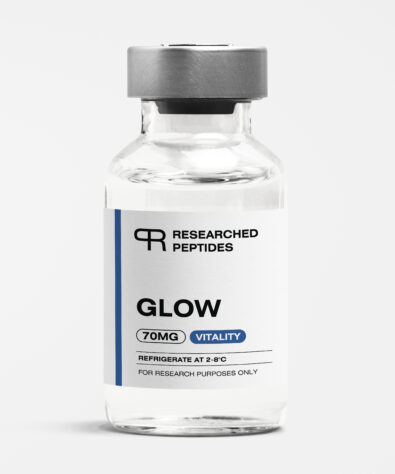
Researched Peptides’ GLOW research blend is listed as a 70 mg combination containing GHK-Cu 50 mg, BPC-157 10 mg and TB-500 10 mg. Researchers should consult the current product listing and any applicable sample-specific analytical documentation rather than assume that a general testing statement covers every analyte or method.
Researchers interested in component-level comparisons can also review GHK-Cu, BPC-157 and TB-500 research listings. Separate materials may be relevant to experimental designs intended to distinguish individual-component observations from blend-level results.
Longevity & Vitality
$125.99
Frequently Asked Questions About GLOW Peptide Research
GLOW Research FAQ
The approved Researched Peptides composition is 50 mg GHK-Cu, 10 mg BPC-157 and 10 mg TB-500, totaling 70 mg nominally.
No. GLOW contains three components, including GHK-Cu. The Wolverine Blend is a separate BPC-157/TB-500 formulation. Their compositions and experimental questions should not be conflated.
Not on the basis of the individual-component studies discussed here. Demonstrating synergy requires directly applicable combination experiments and appropriate controls.
Not necessarily. TB-500 nomenclature is used inconsistently, and studies of full-length thymosin beta-4 cannot automatically be treated as studies of every TB-500 preparation. Exact molecular identity matters.
No. Chromatographic purity, molecular identity and measured content are separate analytical questions. A blend requires methods suitable for its particular components.
No. Researched Peptides supplies these materials strictly for laboratory and scientific research, not for human or veterinary use.
Conclusion: Evaluate the Components, Then Evaluate the Blend
GLOW combines three materials of scientific interest, but the rationale for studying their different pathways is not evidence of a superior combined outcome. GHK-Cu, BPC-157 and thymosin-related peptides each have distinct research histories, models and limitations. The most credible approach is to keep those distinctions visible and evaluate the actual blended material using methods appropriate to its composition.
For Canadian researchers, transparent product identification, relevant analytical documentation and clear experimental controls provide a stronger foundation than broad claims about tissue repair or peptide synergy.
Scientific References
- Maquart FX, et al. In vivo stimulation of connective tissue accumulation by the tripeptide-copper complex GHK-Cu in rat experimental wounds. J Clin Invest. 1993. doi:10.1172/JCI116842.
- Pickart L. The human tri-peptide GHK and tissue remodeling. J Biomater Sci Polym Ed. 2008. doi:10.1163/156856208784909435.
- Seiwerth S, et al. BPC 157’s effect on healing. PubMed PMID: 9403790.
- Goldstein AL, Hannappel E, Kleinman HK. Thymosin beta4: actin-sequestering protein moonlights to repair injured tissues. Trends Mol Med. 2005. doi:10.1016/j.molmed.2005.07.004.
- McGuire F, et al. Thymosin Beta-4 and TB-500 in Tissue Healing, Regeneration, and Musculoskeletal Repair: A Scoping Review. Applied Sciences. 2026. doi:10.3390/app16126202.
- A Systematic Review of the Mechanisms and Therapeutic Applications of GHK-Cu in Topical Microneedle Delivery. 2026. Full text.
Explore GLOW for Laboratory Research
Review the three-component formulation and current research-product information.