KLOW Peptide Blend: The Quick Answer
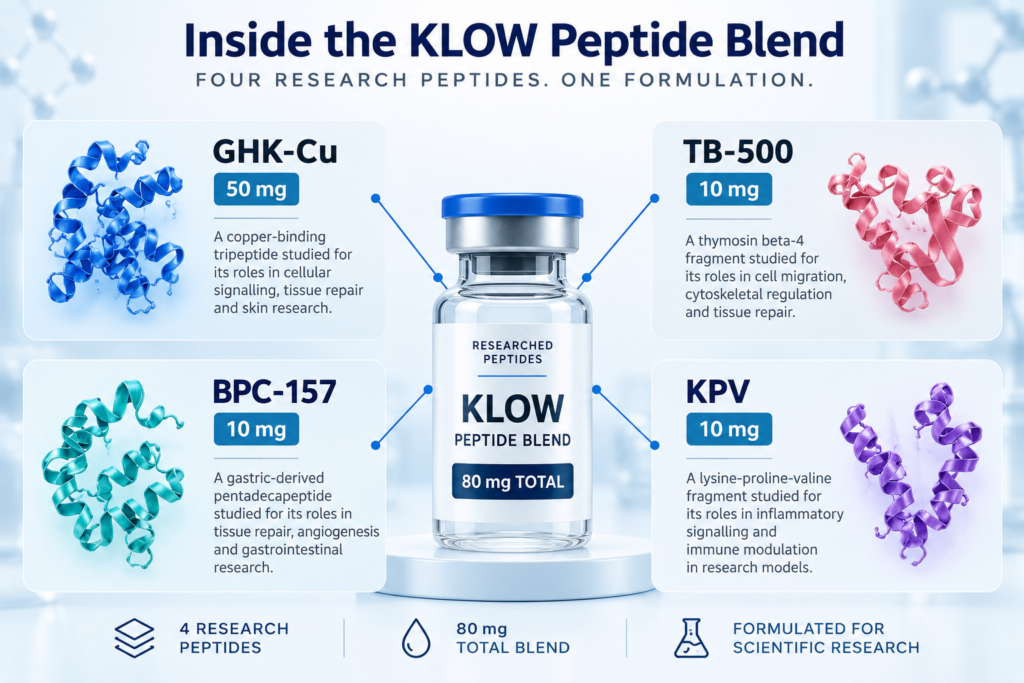
KLOW is a four-component research peptide blend containing GHK-Cu, TB-500, BPC-157 and KPV. Researched Peptides lists an 80 mg formulation comprising 50 mg GHK-Cu and 10 mg each of TB-500, BPC-157 and KPV. These components are associated with different experimental questions involving extracellular matrix biology, cellular migration, tissue responses and inflammatory signalling.
Importantly, evidence for one ingredient is not evidence for the complete mixture. This guide explains the composition, research rationale, evidence limitations and analytical questions that Canadian laboratories should consider when evaluating a multi-peptide preparation.
Key Takeaways
- Composition: KLOW combines four specified ingredients in an 80 mg total formulation.
- GHK-Cu: Investigated for copper coordination, extracellular matrix and cellular responses.
- TB-500 and BPC-157: Discussed in tissue-related preclinical research, but their evidence and identities must be evaluated separately.
- KPV: A melanocortin-derived tripeptide studied in inflammatory signalling models.
- Evidence gap: Separate ingredient findings cannot establish the efficacy, synergy or safety of the full blend.
What Is the KLOW Peptide Blend?
KLOW is a defined multi-component research formulation rather than the name of a single peptide. The formulation sold by Researched Peptides contains four distinct ingredients. Their separate scientific backgrounds are relevant when designing controlled laboratory experiments, but the presence of several studied compounds does not by itself demonstrate a stronger biological effect.
| Ingredient | Listed quantity | Research context |
|---|---|---|
| GHK-Cu | 50 mg | Copper-binding peptide, matrix and cell biology |
| TB-500 | 10 mg | Thymosin-beta-4-related research; exact identity matters |
| BPC-157 | 10 mg | Experimental tissue-response models |
| KPV | 10 mg | Inflammatory signalling and epithelial models |
The quantities above describe the approved catalog formulation, not independently verified analytical measurements for every individual vial. Those questions require relevant sample-specific reports.
What Does Each KLOW Ingredient Do in Research?
GHK-Cu: Copper Peptide and Extracellular Matrix Research
GHK is a naturally occurring tripeptide that can bind copper(II), forming GHK-Cu. Experimental studies have investigated GHK-related compounds in fibroblast behaviour, extracellular matrix remodelling, inflammatory responses and tissue biology. These pathways help explain why GHK-Cu is studied in skin and collagen-related experimental models.
GHK-Cu is also a chemically specific coordination complex: copper binding state, formulation and analytical conditions can affect interpretation. A 2026 evidence-mapping review emphasized that promising preclinical observations should not be mistaken for established clinical efficacy. Read the GHK-Cu evidence review.
TB-500: Thymosin-Beta-4-Related Research
Thymosin beta-4 is a naturally occurring peptide studied in actin regulation, cell migration and tissue-response models. However, the designation TB-500 is used inconsistently across the peptide marketplace, sometimes referring to a fragment rather than full-length thymosin beta-4. Therefore, experiments on full-length thymosin beta-4 must not automatically be presented as direct evidence for every product labelled TB-500.
For rigorous experimental design, researchers should establish the exact molecular identity and sequence of the material under investigation before interpreting literature on a related molecule.
BPC-157: Experimental Tissue-Response Research
BPC-157 is a synthetic 15-amino-acid peptide studied in several animal and laboratory models involving tissue responses and repair-related signalling. Although these experiments have generated scientific interest, human evidence remains sparse and uncertain. A 2026 systematic review identified three small human studies involving a total of 30 participants and assessed the overall certainty as very low. Review the human evidence assessment.
These studies do not establish clinical efficacy or safety for BPC-157, and they do not test the KLOW mixture.
KPV: Melanocortin-Derived Inflammatory Signalling Research
KPV stands for lysine-proline-valine, a tripeptide derived from the C-terminal portion of alpha-melanocyte-stimulating hormone. Cell experiments have examined its effects on NF-kappaB and MAP kinase inflammatory signalling, while mouse colitis models have investigated intestinal inflammatory responses. Some experiments implicate the peptide transporter PepT1 in cellular uptake. See the PepT1/KPV study.
These findings concern particular cell systems and animal models; they do not demonstrate an established human therapeutic effect or a validated result for KLOW.
Why Combine GHK-Cu, TB-500, BPC-157 and KPV?
The experimental rationale for a multi-peptide blend is that its ingredients have been investigated in different, sometimes overlapping biological contexts. GHK-Cu appears in extracellular matrix and copper-peptide literature; thymosin-beta-4-related compounds in cell migration literature; BPC-157 in preclinical tissue-response models; and KPV in inflammatory signalling research.
That makes a combined formulation a possible subject for controlled mixture research. It does not demonstrate that the ingredients cooperate, that any outcome improves, or that an observed effect can be assigned to a particular component.
What Would a Proper Combination Study Need?
At minimum, a carefully designed study would compare the complete blend against appropriate controls and relevant individual-component groups, using verified material identities and quantities. Researchers would also need to account for concentration, assay interference, compatibility, time-dependent changes and the chosen biological model.
Where interactions are being investigated, a factorial design or other suitable combination-analysis framework may help distinguish independent effects from interactions. Without these controls, even a positive experimental observation cannot establish synergy.
Is KLOW the Same as GLOW?
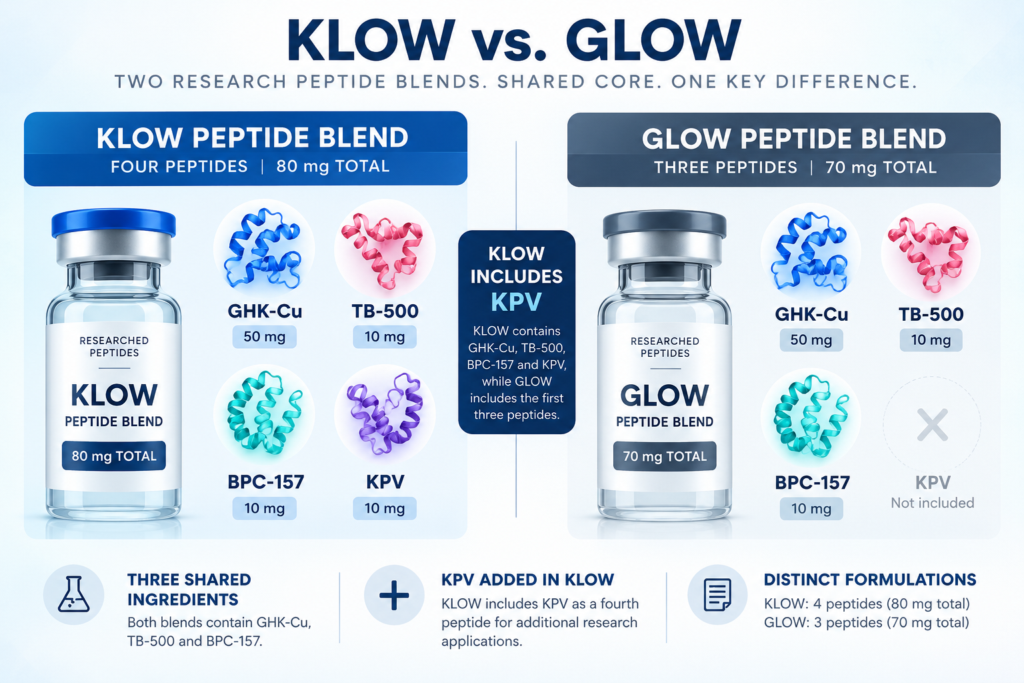
No. Researched Peptides lists GLOW as a three-component blend of GHK-Cu, BPC-157 and TB-500 (70 mg total). KLOW contains those three ingredients plus 10 mg KPV (80 mg total). This is a composition difference, not evidence that one mixture is superior.
What Does Published Research Actually Establish?
Research evidence must be separated into three categories: experiments on a specific ingredient, experiments on related molecules, and experiments directly testing the exact multi-component formulation. Those categories cannot be treated as interchangeable.
Evidence for Individual Components
GHK-Cu has a substantial preclinical literature, but recent reviews identify significant gaps in clinical translation and formulation characterization. KPV has been investigated in cell-based signalling experiments and mouse inflammatory models. BPC-157 has a preclinical literature and very limited, low-certainty human evidence. For TB-500, a central challenge is distinguishing studies of thymosin beta-4 from those of the exact compound represented by the TB-500 designation.
Evidence for the Four-Ingredient KLOW Blend
The cited ingredient studies do not directly evaluate this exact 50:10:10:10 mg KLOW formulation. They cannot establish that the mixture produces enhanced collagen synthesis, skin repair, reduced inflammation or any other specific outcome. Such claims would require direct, appropriately controlled blend-specific evidence.
Likewise, no combination can be considered safe or experimentally suitable merely because its individual components have been studied separately. Mixing compounds introduces additional questions about compatibility, measurement, stability and biological interactions.
How Should Researchers Evaluate KLOW Purity and Testing?
Multi-component preparations require more careful interpretation than a single-peptide sample. A reported purity percentage, even when obtained using HPLC, may not identify or quantify all four ingredients separately. A method that resolves one peptide well may not adequately resolve another, and the interpretation depends on the analytical procedure.
Identity, Purity and Content Are Different Questions
Identity concerns whether the tested material is consistent with the intended chemical entity. Purity concerns the proportion of detected material attributed to the target under a specified method. Content concerns how much of an analyte is measured. These are related but distinct attributes.
Mass spectrometry may provide molecular-mass evidence; chromatographic methods may support separation, identification and quantification when appropriately developed. Neither technique should be described as proving sterility or comprehensive biological safety.
Why Blend-Specific Methods Matter
A meaningful KLOW analytical assessment should consider whether the method can distinguish GHK-Cu, TB-500, BPC-157 and KPV, whether their measured amounts can be reported individually, and whether relevant impurities or degradation products can be detected under the stated conditions. For GHK-Cu, copper coordination and sample preparation may introduce additional analytical considerations.
Researchers should examine the actual certificate of analysis for the relevant material, checking the sample identifier, testing laboratory, report date, methods, analytes and results. Do not assume that an ingredient-specific COA validates a finished mixture, or that every KLOW batch has undergone the same test panel.
KLOW Peptide Blend Research Material in Canada
For Canadian laboratories exploring KLOW blend research, the central procurement questions are straightforward: What is the stated composition? Which sample-specific analytical results are available? Can the supplier explain what those results establish and what they do not? Is the material clearly positioned for laboratory use rather than personal treatment?
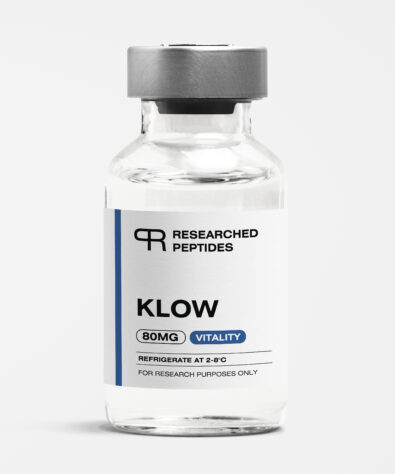
Researched Peptides lists KLOW Peptide Blend as an 80 mg research formulation. Researchers can review current product details and any available analytical documentation through the product listing. The listing’s nominal formulation should not be confused with independent analytical confirmation of a particular sample.
Longevity & Vitality
$132.99
Frequently Asked Questions About KLOW
KLOW Research FAQ
KLOW contains GHK-Cu, TB-500, BPC-157 and KPV. The approved Researched Peptides formulation lists 50 mg GHK-Cu and 10 mg of each remaining ingredient, totalling 80 mg.
Both formulations list GHK-Cu, BPC-157 and TB-500. KLOW additionally contains KPV. This does not establish that KLOW is more effective than GLOW.
It is a multi-peptide research blend that includes GHK-Cu, a compound investigated in extracellular matrix and collagen-related biology. That ingredient-level literature does not prove that the complete KLOW mixture increases collagen in any particular model.
The ingredient studies discussed here do not provide clinical validation of the complete four-component KLOW formulation. Separate ingredient findings cannot establish safety or efficacy for the blend.
Not necessarily. Quantifying all four components requires an analytical method suitable for those analytes. Chromatographic purity, molecular identity and individual component content should be evaluated separately.
Not necessarily. The name TB-500 is used inconsistently, including for thymosin-beta-4-related fragments. Exact sequence and molecular identity must be confirmed before transferring findings from one material to another.
Conclusion: KLOW Research Requires Component-Level Evidence
KLOW brings together four ingredients with different research histories. That composition makes it relevant to controlled laboratory questions involving peptide mixtures, but the scientific value of a blend cannot be inferred from the number of ingredients or the appeal of their individual mechanisms.
For sound research, begin with verified identities, appropriate controls, clearly defined endpoints and sample-specific analytical evidence. The distinction between individual-component findings and direct combination evidence is essential.
Scientific References
- GHK-Cu as a Bioactive Metallopeptide and Drug-Delivery Cargo: Coordination Chemistry, Formulation Science, Therapeutic Evidence, and a Translational Roadmap. 2026 evidence-mapping review.
- The human tri-peptide GHK and tissue remodeling. Review of GHK-related biology.
- Human evidence for BPC-157 in orthopaedic and regenerative medicine: a systematic review of efficacy and safety. 2026.
- PepT1-mediated tripeptide KPV uptake reduces intestinal inflammation. Experimental cell and mouse models.
- Melanocortin-derived tripeptide KPV has anti-inflammatory potential in murine models of inflammatory bowel disease. Animal research.
Explore KLOW for Laboratory Research
Review the four-component formulation, current product information and available analytical documentation.