CJC-1295 Canada: The Quick Answer
CJC-1295 (No DAC) is a modified growth hormone-releasing hormone (GHRH) fragment, commonly described as modified GRF (1–29). It is investigated for its relationship to GHRH-receptor signalling and pituitary growth hormone (GH) secretion. The term “No DAC” distinguishes it from a longer-acting, albumin-binding CJC-1295 construct used in published human studies.
For researchers searching for CJC-1295 in Canada, that distinction is essential: the frequently quoted multi-day half-life and sustained GH/IGF-1 findings belong to DAC-containing CJC-1295, not to the No DAC research material. This guide explains the pathway, compares the two forms, reviews the evidence and outlines meaningful laboratory quality checks.
Key Takeaways
- Target: Modified GRF (1–29) is associated with GHRH-receptor signalling.
- DAC matters: Albumin-binding technology changes the pharmacokinetic profile.
- Evidence: Published human CJC-1295 trials studied the long-acting DAC form.
- Ipamorelin: It acts through a different secretagogue receptor pathway; this does not prove combination synergy.
- Quality: A COA must be interpreted by its specific sample, method and reported result.
What Is CJC-1295 (No DAC)?
GHRH is a hypothalamic peptide signal that helps regulate GH release from the anterior pituitary. Modified GRF (1–29) is a synthetic analogue of the biologically active N-terminal region of GHRH. It contains amino-acid substitutions intended to alter the peptide’s susceptibility to degradation while retaining the research interest of GHRH-receptor activation.
In research-supplier terminology, CJC-1295 (No DAC) and modified GRF (1–29) are often used interchangeably. However, naming conventions across vendors and publications are not always consistent. Researchers should confirm the actual chemical identity, sequence or specification instead of relying on the label alone.
The phrase GHRH analog peptide Canada describes a research category, not a standardized analytical grade or regulatory designation. Product suitability must be established against the requirements of the intended experiment.
At a Glance
| Attribute | Research context |
|---|---|
| Common name | CJC-1295 (No DAC); modified GRF (1–29) |
| Compound type | Modified GHRH-fragment peptide |
| Primary pathway | GHRH receptor → pituitary GH signalling |
| Key distinction | Does not contain the albumin-binding DAC modification |
| Evidence limitation | No established peer-reviewed human clinical efficacy evidence for the No DAC form |
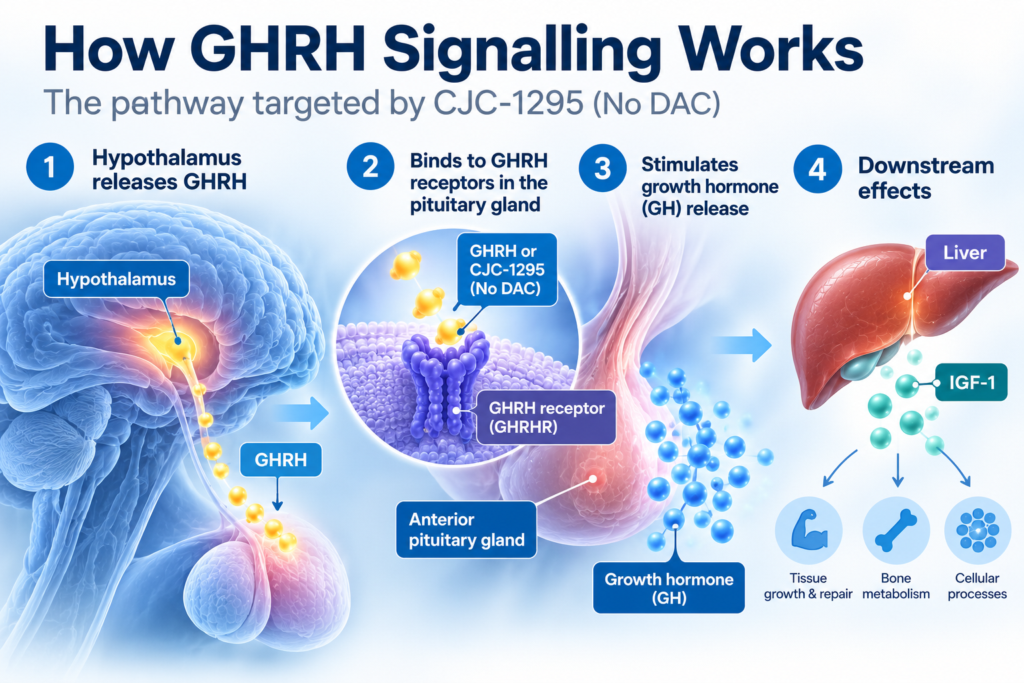
How Does the GHRH Signalling Pathway Work?
Under normal physiology, the hypothalamus releases GHRH, which binds to receptors on pituitary somatotroph cells. GHRH receptors are G-protein-coupled receptors that activate signalling involving cyclic AMP (cAMP) and protein kinase A. This contributes to GH synthesis and secretion. GH can subsequently influence IGF-1 production, including in the liver, although GH and IGF-1 are regulated by multiple feedback mechanisms.
GH secretion is naturally pulsatile. Somatostatin, sleep-associated physiology and other signals influence the timing and amplitude of secretion. A simplified receptor diagram therefore explains the pathway, but cannot predict the outcome of administering a particular synthetic peptide in an organism.
For CJC-1295 No DAC research, experimental questions may include receptor engagement, cell-signalling responses, peptide degradation, and how a modified GHRH fragment differs from native GHRH under defined laboratory conditions. Such experiments require their own controls and analytical characterization.
CJC-1295 With DAC vs. No DAC: What Is the Difference?
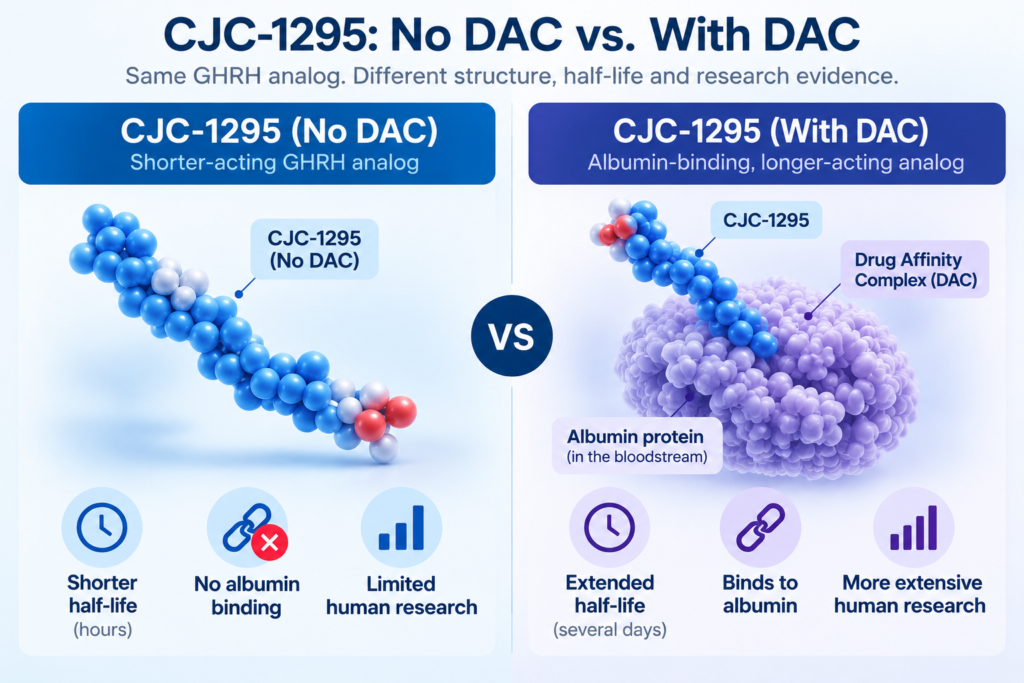
DAC stands for Drug Affinity Complex. The DAC-containing CJC-1295 construct was developed to bind circulating albumin, thereby prolonging exposure compared with a short-acting GHRH analogue. The No DAC material lacks that albumin-binding component.
| Question | No DAC | With DAC |
|---|---|---|
| Albumin-binding modification? | No | Yes |
| Expected exposure | Shorter acting; exact human half-life not established in peer-reviewed direct studies | Long-acting; measured half-life around 5.8–8.1 days in a small human study |
| Direct published human CJC-1295 evidence | Very limited or absent for this distinct form | Early pharmacokinetic/pharmacodynamic studies |
| Can results be transferred? | No automatic transfer from DAC studies | Results apply to the studied DAC formulation and participants |
Important: A multi-day half-life reported for DAC-containing CJC-1295 must not be used as the measured half-life of CJC-1295 (No DAC). Similarly, shorter duration should not automatically be described as more physiological, safer or more effective without direct comparative evidence.
What Does Published CJC-1295 Research Actually Show?
Human pharmacology: the DAC-containing compound
In a 2006 publication, Teichman and colleagues reported two randomized, placebo-controlled, double-blind ascending-dose studies involving healthy adults. The trials assessed pharmacokinetics and endocrine markers for long-acting CJC-1295. The investigators reported an estimated half-life of 5.8–8.1 days and increases in mean GH and IGF-1 concentrations over several days after exposure. These were early human pharmacology studies, not demonstrations of long-term clinical benefit. Read the original study.
A separate 2006 study evaluated GH secretion patterns following the long-acting, albumin-binding construct. It found increased basal and mean GH secretion while pulsatile secretion remained observable in the studied participants. Again, these findings concern DAC-containing CJC-1295 and cannot be assumed for the No DAC version. Read the pulsatility study.
What is known about No DAC?
Modified GRF (1–29) is scientifically plausible as a GHRH-receptor research compound based on its design and related GHRH-fragment pharmacology. But mechanistic rationale is not the same as direct clinical validation. Available literature does not establish human efficacy, long-term safety, or a validated human pharmacokinetic half-life for the distinct No DAC material. A recent evidence review likewise identifies this gap.
Claims involving muscle growth, recovery, anti-aging, body composition or performance should not be presented as established human outcomes for CJC-1295 (No DAC). Laboratory findings, results with related molecules, and claims from non-peer-reviewed sources cannot fill that evidentiary gap.
How to read the evidence correctly
Evidence boundary: The 2006 human trials support statements about long-acting CJC-1295 with DAC in the populations and conditions studied. They do not establish the same half-life, endocrine profile, safety or clinical benefits for CJC-1295 (No DAC) research vials.
Why Is CJC-1295 Often Discussed With Ipamorelin?
Searches for a CJC-1295 ipamorelin stack reflect interest in two distinct routes to GH-secretagogue signalling. CJC-1295 (No DAC) is discussed as a GHRH-receptor analogue, while ipamorelin is a growth hormone secretagogue that acts through the ghrelin/secretagogue receptor pathway, generally termed GHS-R1a.
In a 1998 study, Raun and colleagues characterized ipamorelin using rat pituitary cells and animal models. The investigators reported GH-secretagogue activity and a degree of selectivity in the experimental systems examined. These findings are not direct evidence that pairing ipamorelin with CJC-1295 (No DAC) improves any human outcome. Read the ipamorelin study.
Two compounds targeting different receptors can motivate a controlled combination experiment, but different pathways do not prove synergy. Demonstrating an additive or synergistic response would require experiments comparing each compound alone, the combination and appropriate controls, with predefined endpoints and suitable statistical analysis.
GHRH Analogue vs. Growth Hormone-Releasing Peptide
The phrase growth hormone releasing peptide Canada can refer broadly to compounds investigated for GH secretion, but GHRH analogues and ghrelin-receptor agonists are not interchangeable classes. Distinguishing the receptor target helps researchers select appropriate assay systems and interpret observations without conflating mechanisms.
How Should Canadian Laboratories Evaluate CJC-1295 Research Materials?
When sourcing a research peptide, a clear chemical identity and interpretable analytical documentation matter more than generic descriptions such as “high purity” or “research grade.” Canadian laboratories should evaluate the sample against their own experimental acceptance criteria.
1. Confirm the actual peptide identity
Because the DAC and No DAC labels refer to materially different constructs, a product listing should make the intended form clear. Molecular-mass evidence, sequence-related documentation where available and appropriate analytical methods can support identity assessment. Mass spectrometry alone does not necessarily establish every aspect of sequence or structural identity.
2. Separate purity from content
HPLC-UV can provide method-dependent chromatographic purity information, while an assay or content result addresses the quantity of analyte measured. A high HPLC area percentage does not automatically prove that the labelled mass is present, that all impurities were detected or that a material is sterile.
3. Read the specific certificate of analysis
Review the sample identifier, test date, testing laboratory, methods and numerical results. An independent laboratory report applies to the sample described, not automatically to every vial, batch or future shipment. If endotoxin or sterility is not reported, do not infer that those attributes were tested.
4. Assess research suitability, not marketing language
Experimental requirements differ among receptor-binding assays, cell-based systems and analytical method development. Laboratories should decide which attributes are essential for their model, including traceability, sample handling and relevant assay interferences. A COA is one part of this evaluation, not a universal suitability certification.
5. Keep procurement distinct from therapeutic use
Research-use CJC-1295 is not an authorized prescription growth-hormone treatment. Its sale as a laboratory material does not establish clinical approval, safety for administration or suitability as a substitute for a regulated medicine.
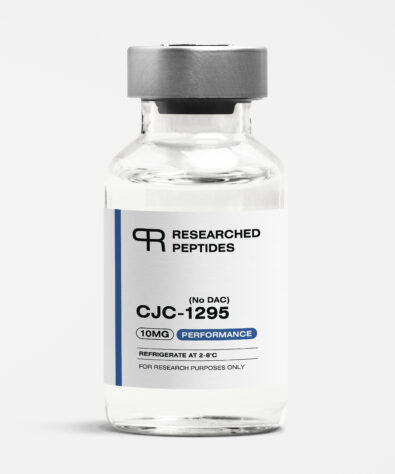
CJC-1295 (No DAC) Research Materials at Researched Peptides
Researched Peptides lists CJC-1295 (No DAC) for laboratory research in Canada. Researchers can review the current product information and available analytical documentation to assess whether the material aligns with their experimental requirements. The relevant COA should be evaluated for the exact methods and sample reported; no general testing statement substitutes for that review.
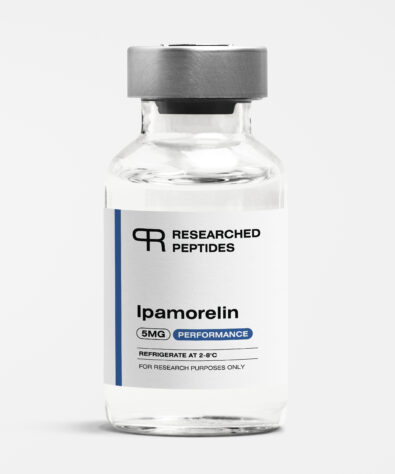
For related receptor-pathway research, ipamorelin research material provides a separate compound for investigating GH-secretagogue signalling. Their different mechanisms explain their scientific relationship; they do not establish a clinically beneficial combination.
Performance & Endurance
Price range: $41.99 through $69.99
Performance & Endurance
Price range: $41.99 through $69.99
Frequently Asked Questions About CJC-1295 in Canada
CJC-1295 Research FAQ
These names are commonly used interchangeably in research-product catalogues. Because naming is not fully consistent across sources, confirm the actual compound specification and analytical identity.
No such human half-life has been established for the distinct No DAC form. The commonly quoted approximately one-week half-life comes from studies of long-acting DAC-containing CJC-1295.
CJC-1295 (No DAC) is described as a modified GHRH fragment. GHRPs such as ipamorelin act through a different growth-hormone-secretagogue receptor pathway.
No. The available evidence does not establish these human outcomes for the distinct No DAC material. Mechanistic hypotheses and studies involving DAC-containing CJC-1295 are insufficient to make those claims.
Different receptor targets provide a rationale for studying the combination, but do not prove synergy. A direct, controlled combination study is required to demonstrate additive or synergistic effects for a defined endpoint.
Check the material identity, sample or batch identifier, laboratory, date, analytical methods, reported purity and any separate content, identity or contamination-related results. Do not infer tests that are absent from the report.
Conclusion: Start With the Right Compound and the Right Evidence
CJC-1295 (No DAC) is relevant to research into GHRH-receptor signalling, but its scientific interpretation depends on separating it from the long-acting DAC-containing compound. The best-known human studies evaluated the latter. Ipamorelin introduces a distinct GH-secretagogue pathway, yet its mechanistic relationship does not establish a proven combination benefit.
For Canadian laboratories, the practical priorities are unambiguous compound identification, careful reading of the scientific literature, and sample-specific analytical documentation. Those checks make research conclusions more defensible than extrapolating from a familiar peptide name or an unsupported purity claim.
Scientific References
- Teichman SL, et al. Prolonged stimulation of growth hormone (GH) and insulin-like growth factor I secretion by CJC-1295, a long-acting analog of GH-releasing hormone, in healthy adults. J Clin Endocrinol Metab. 2006;91(3):799–805. doi:10.1210/jc.2005-1536.
- Pulsatile secretion of growth hormone (GH) persists during continuous stimulation by CJC-1295, a long-acting GH-releasing hormone analog. J Clin Endocrinol Metab. 2006. PubMed PMID:17018654.
- Raun K, et al. Ipamorelin, the first selective growth hormone secretagogue. Eur J Endocrinol. 1998;139(5):552–561. doi:10.1530/eje.0.1390552.
- US Food and Drug Administration. December 2024 Pharmacy Compounding Advisory Committee materials concerning CJC-1295. FDA briefing document.
Explore CJC-1295 (No DAC) for Laboratory Research
Review current research-product details and available analytical documentation.