Tirzepatide Canada: The Quick Answer
Tirzepatide is a synthetic peptide studied for its activity at two metabolic hormone receptors: glucose-dependent insulinotropic polypeptide (GIP) and glucagon-like peptide-1 (GLP-1). Its dual-receptor mechanism has made it a major subject of metabolic research, including the SURPASS and SURMOUNT clinical trial programs. In Canada, tirzepatide is also the active ingredient in authorized prescription medicines. These pharmaceutical products are distinct from tirzepatide sold strictly as laboratory research material.
For Canadian researchers assessing tirzepatide material, the most useful questions concern compound identity, analytical documentation, reported purity, sample content, traceability and whether the available evidence supports the intended laboratory experiment. This guide explains the underlying science, what published trials actually found, and how to evaluate research peptide documentation without confusing analytical quality with clinical approval.
Key Takeaways
- Mechanism: Tirzepatide activates both GIP and GLP-1 receptors, not GLP-1 alone.
- Evidence: SURMOUNT trials studied pharmaceutical tirzepatide in controlled clinical settings.
- Canada: Authorized medicines and laboratory research materials have distinct regulatory statuses.
- Testing: Purity, identity, content and endotoxin results answer different analytical questions.
- COAs: Check the sample identifier, methods, reported results and limitations.
What Is Tirzepatide?
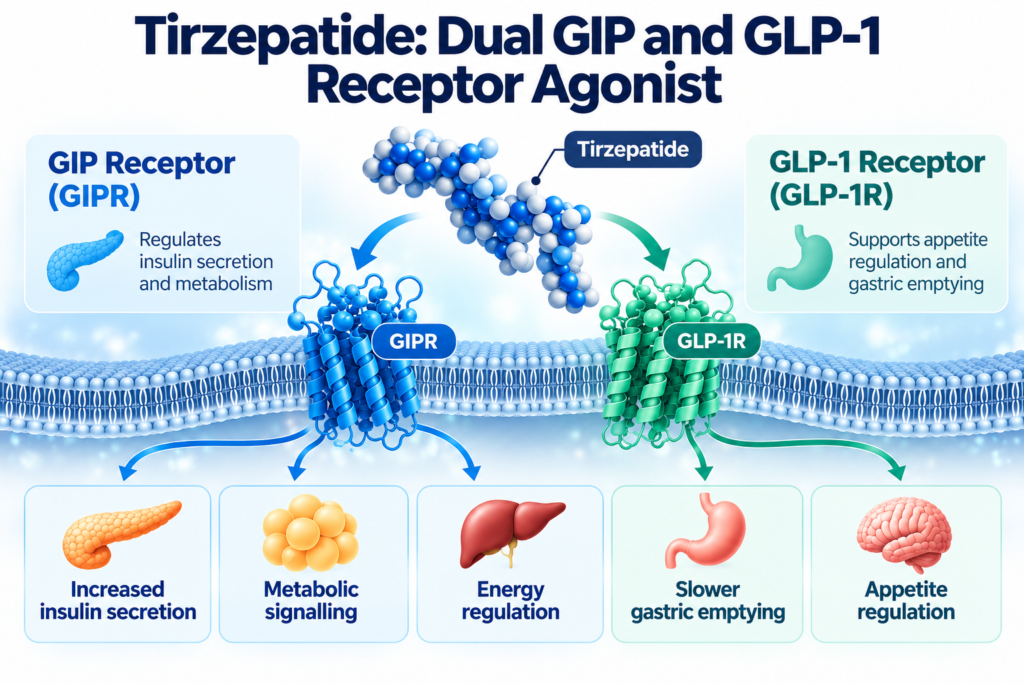
Tirzepatide is a modified peptide engineered to interact with two members of the incretin hormone receptor family. Incretins are signals associated with nutrient intake and metabolic regulation. The two receptors relevant to tirzepatide are the GIP receptor (GIPR) and the GLP-1 receptor (GLP-1R).
These receptors belong to the broader family of G-protein-coupled receptors (GPCRs). Their activation influences intracellular signalling networks involved in glucose regulation, endocrine responses and energy balance. Tirzepatide is scientifically interesting because one molecular entity can engage both receptor systems.
Although tirzepatide is commonly discussed alongside GLP-1 receptor agonists, calling it only a “GLP-1 peptide” omits an essential part of its pharmacology. Its GIP activity is central to the rationale for studying it as a dual agonist.
Tirzepatide at a Glance
| Research attribute | Explanation |
|---|---|
| Compound class | Synthetic peptide; dual incretin-receptor agonist |
| Primary receptor targets | GIPR and GLP-1R |
| Key research areas | Incretin signalling, glucose homeostasis, metabolic regulation and receptor pharmacology |
| Notable clinical programs | SURPASS (type 2 diabetes research) and SURMOUNT (obesity and weight-management research) |
| Research material evaluation | Identity, purity, content, sample traceability and relevant analytical methods |
How Does Tirzepatide’s Dual GIP/GLP-1 Mechanism Work?
To understand tirzepatide research, it helps to separate the two receptor pathways before considering their combined pharmacology.
GLP-1 Receptor Signalling
GLP-1 is an incretin hormone associated with glucose-dependent insulin secretion and other physiological responses to nutrient intake. In experimental and clinical contexts, GLP-1 receptor activation has been studied in relation to pancreatic signalling, gastric function, appetite regulation and central nervous system pathways. The magnitude and relevance of any response depend on the model, exposure and study design.
GIP Receptor Signalling
GIP is another nutrient-responsive incretin hormone. Its receptor is involved in insulin-related signalling and is expressed in multiple tissues relevant to metabolic research. GIP receptor biology is complex: effects observed in isolated cells, animal models and clinical populations are not interchangeable. This complexity is part of why dual agonism remains an active area of investigation.
Why Combine Both Receptor Activities?
Tirzepatide provides researchers with a way to study the biological consequences of engaging GIPR and GLP-1R through one compound. Preclinical work contributed to the rationale for investigating this approach, while subsequent clinical trials assessed outcomes in specific human populations. Importantly, an observed clinical effect does not, by itself, establish how much each receptor contributes to that effect.
What Did the SURMOUNT Tirzepatide Trials Find?
The SURMOUNT program investigated pharmaceutical tirzepatide in clinical settings. These studies are valuable evidence about the tested medicine, study populations and trial protocols. They do not validate the identity, quality, sterility, safety or clinical suitability of any separately supplied research peptide.
SURMOUNT-1: A 72-Week Randomized Trial
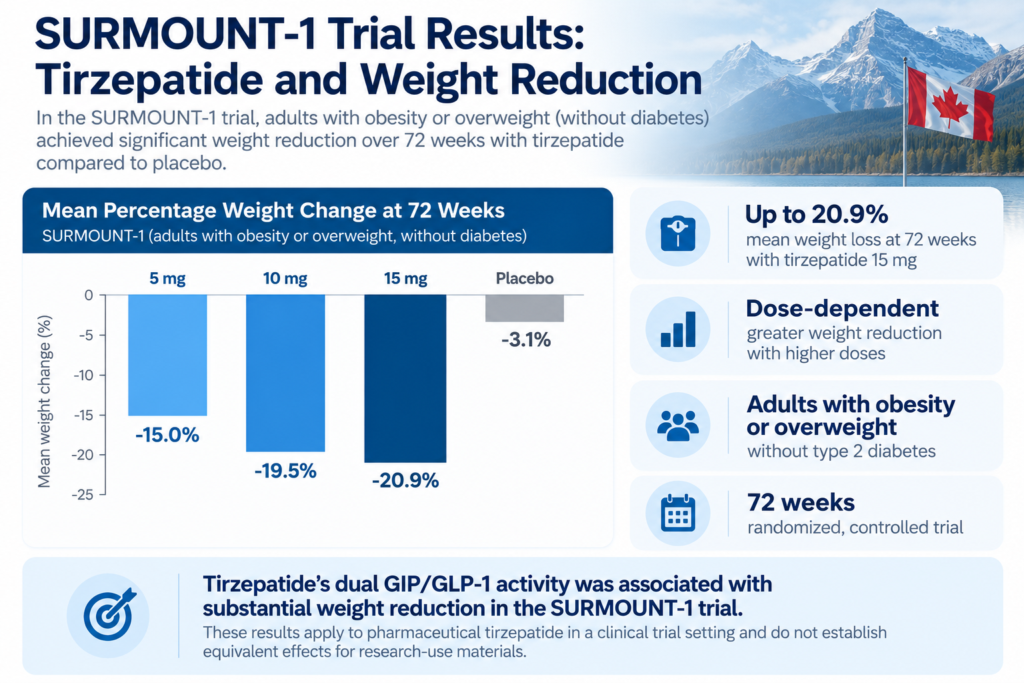
In SURMOUNT-1, published in the New England Journal of Medicine in 2022, researchers randomized 2,539 adults with obesity, or overweight plus a weight-related complication, without diabetes. Participants received pharmaceutical tirzepatide at assigned trial doses or placebo over 72 weeks, including a dose-escalation period.
The trial reported substantial mean percentage changes in body weight across the tirzepatide groups relative to placebo. At week 72, the reported mean changes were approximately −15.0%, −19.5% and −20.9% in the 5 mg, 10 mg and 15 mg groups, respectively, compared with −3.1% with placebo. These are group-level outcomes from a controlled clinical trial, not predictions for an individual and not performance claims for research-use products.
The investigators also documented adverse events, with gastrointestinal events commonly reported. Trial results must be interpreted together with inclusion criteria, treatment protocols, discontinuations and safety findings.
SURMOUNT-4: What Happened After Treatment Withdrawal?
SURMOUNT-4, published in JAMA, investigated maintenance of weight reduction following an initial open-label period. After 36 weeks of pharmaceutical tirzepatide, 670 eligible participants were randomized either to continue the medicine or switch to placebo for another 52 weeks.
From randomization to week 88, the continuing-treatment group had a mean weight change of −5.5%, while the placebo-switch group had a mean change of +14.0%. This trial supports a conclusion about weight maintenance and withdrawal in the studied population. It does not establish a general biological “reset,” permanent effect or laboratory research-vial equivalence.
How Should These Findings Be Interpreted?
| Study | Research question | Important limitation |
|---|---|---|
| SURMOUNT-1 | Outcomes over 72 weeks versus placebo in adults without diabetes meeting study criteria | Results apply to the studied pharmaceutical intervention and trial population |
| SURMOUNT-4 | Maintenance of prior weight reduction after continuation versus withdrawal | Randomization occurred after a 36-week open-label lead-in; the trial does not test research-use products |
| SURPASS-1 | Glycemic outcomes in adults with type 2 diabetes | Different study population and primary endpoints from SURMOUNT obesity trials |
Researchers should also distinguish primary endpoints from exploratory analyses and avoid combining figures from different trials as if they arose from one directly comparable experiment.
Is Tirzepatide Approved in Canada?
Yes, specific prescription medicines containing tirzepatide have been authorized by Health Canada. For example, Health Canada’s Drug Product Database lists Mounjaro as an approved prescription medicine containing tirzepatide. Authorization applies to the particular regulated drug products and their approved indications, formulations and labelling; it is not a blanket approval of all material marketed under the molecule’s name.
Health Canada also issued a warning about unauthorized and counterfeit GLP-1 medicines in January 2026. The distinction matters: a laboratory reagent must not be represented as a substitute for a prescription medicine.
Canadian laboratories studying tirzepatide should therefore separate three questions: whether the molecular target is scientifically relevant, whether a particular research sample is supported by adequate analytical documentation, and whether the intended activity complies with applicable institutional and regulatory requirements.
How Can Researchers Evaluate Tirzepatide Purity and Analytical Testing?
Searches for tirzepatide purity research grade often lead to simple percentages. However, a purity figure alone cannot answer every quality question. Research laboratories need to understand the analytical method, what was measured, and the limits of the result.
HPLC: Separation and Reported Purity
High-performance liquid chromatography (HPLC) separates components of a sample under specified analytical conditions. Depending on the validated method and detector, the report may provide information about chromatographic purity or content. An HPLC area percentage is not automatically equivalent to a complete mass-balance assessment, identity confirmation, sterility test or guarantee that no unmeasured contaminants are present.
Mass Spectrometry: Molecular Identity Evidence
Mass spectrometry can provide evidence consistent with an analyte’s molecular mass. The exact level of identity confidence depends on the method and data collected. A mass measurement does not, by itself, prove full sequence identity or establish a sample’s sterility or potency in a biological assay.
Content Testing: How Much Analyte Was Measured?
Measured content and reported purity are distinct. A report may show a high chromatographic purity result while measuring a different amount of analyte than the nominal label claim. Both results matter when a laboratory is evaluating experimental inputs and reproducibility.
Endotoxin and Other Tests
Where performed, an endotoxin test addresses a particular contamination-related attribute. It should not be described as a universal safety or sterility certification. Similarly, a COA that reports only HPLC data should not be presented as evidence of mass spectrometry, endotoxin or sterility testing.
| Reported test | What it may help establish | What it does not establish by itself |
|---|---|---|
| HPLC / HPLC-UV | Chromatographic separation and method-defined purity or content | Complete identity, sterility or absence of all impurities |
| Mass spectrometry | Molecular-mass evidence under the method used | Every aspect of molecular identity, content or sterility |
| Content / assay | Measured analyte quantity in the tested sample | Purity, clinical suitability or uniformity across every vial |
| Endotoxin test | Endotoxin-related result for the tested sample | General sterility or safety for human use |
A credible supplier should make it possible to review the specific report rather than substituting a generic statement such as “lab tested” or “99% pure.” Results should be read in the context of their sample identifier, report date, testing laboratory, analytical method and stated scope.
What Should a Canadian Laboratory Look for When Sourcing Tirzepatide?
For searches such as buy tirzepatide Canada or GLP-1 GIP agonist peptide Canada, the first distinction is intended use. Individuals seeking treatment should consult licensed healthcare professionals and pharmacies about authorized medicines. The considerations below concern legitimate laboratory procurement and scientific research only.
1. Clear Research-Only Product Positioning
The product page should accurately identify the compound and make its intended laboratory-use status unmistakable. It should not promise therapeutic outcomes, recommend self-administration or imply interchangeability with an approved prescription formulation.
2. Accessible, Sample-Specific Documentation
Review the available certificate of analysis and determine whether it corresponds to the relevant sample or batch. Check the test methods, reported results, dates and any limitations. If documentation is not available for the material under consideration, do not assume the results of another sample apply.
3. Transparent Terminology
Identity, purity, assay/content and endotoxin should be described separately. Marketing terms such as “research grade” are not substitutes for documented analytical specifications.
4. Traceability and Fulfilment Information
Reliable procurement involves accurate product identification, clear ordering information and an appropriate process for handling documentation questions. A Canadian fulfilment origin may be relevant to purchasing logistics, but it is not itself evidence of analytical quality.
5. Appropriate Experimental Planning
Laboratories should establish acceptance criteria based on their actual assays and institutional procedures. No single supplier-side purity number can determine suitability for every experimental method.
Tirzepatide Research Materials at Researched Peptides
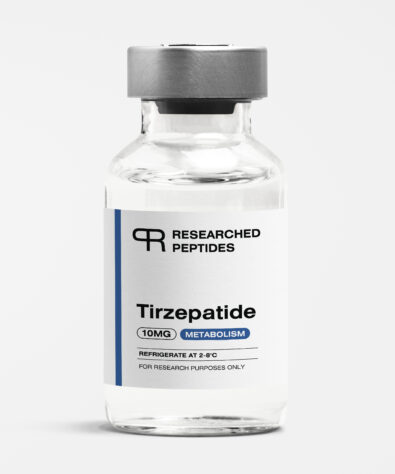
Researched Peptides offers tirzepatide for laboratory and scientific research in Canada. The company uses independent third-party analytical testing; however, the methods and results depend on the specific report. Researchers should review the documentation available for the relevant material and verify product details directly on the current product page.
The objective is straightforward: provide enough information for a laboratory to assess the compound, the available analytical evidence and the practical fit for its research requirements. A research-use product is not an authorized prescription tirzepatide medicine and must not be used as one.
Metabolic Support
Price range: $52.49 through $87.49
Frequently Asked Questions About Tirzepatide Research in Canada
Tirzepatide Research FAQ
It is both. Tirzepatide is a dual agonist that acts at the GIP and GLP-1 receptors. Describing it only as a GLP-1 agonist leaves out an important component of its mechanism.
Tirzepatide activates both GIPR and GLP-1R, while semaglutide is a GLP-1 receptor agonist. Differences in clinical outcomes require interpretation of appropriately designed studies; they should not be inferred solely from receptor count or from a supplier’s marketing description.
In a 72-week randomized trial involving adults with obesity or overweight meeting specified criteria and without diabetes, pharmaceutical tirzepatide groups had greater mean weight reductions than placebo. The study did not evaluate research-use tirzepatide vials.
No. HPLC results address defined analytical attributes under the reported method. They do not independently establish sterility, absence of all contaminants, suitability for human use or clinical safety.
No. An authorized prescription medicine is a regulated finished drug product. A research-use peptide is intended for laboratory and scientific work and should not be represented or used as a treatment substitute.
Check the sample identifier, report date, laboratory, analytical methods, reported purity, any identity or content results, and the limits of the testing. Confirm that the documentation relates to the material being evaluated.
No. The phrase does not replace specific analytical results, appropriate method descriptions or laboratory acceptance criteria.
Conclusion: Better Tirzepatide Research Starts With Better Evidence
Tirzepatide is an important research compound because it connects GIP and GLP-1 receptor pharmacology with an expanding body of experimental and clinical evidence. The SURMOUNT studies provide meaningful findings about authorized pharmaceutical tirzepatide in defined populations, but those findings should not be transferred to unrelated research materials.
For Canadian laboratories, the practical next step is to evaluate the intended research question alongside the actual analytical documentation available for a specific sample. Clear methods, accurate terminology and traceable evidence matter more than an unsupported quality slogan.
Scientific and Regulatory References
- Jastreboff AM, et al. Tirzepatide Once Weekly for the Treatment of Obesity. N Engl J Med. 2022;387:205–216. doi:10.1056/NEJMoa2206038.
- Aronne LJ, et al. Continued Treatment With Tirzepatide for Maintenance of Weight Reduction in Adults With Obesity: The SURMOUNT-4 Randomized Clinical Trial. JAMA. 2024;331(1):38–48. doi:10.1001/jama.2023.24945.
- Rosenstock J, et al. Efficacy and safety of a novel dual GIP and GLP-1 receptor agonist tirzepatide in patients with type 2 diabetes (SURPASS-1). Lancet. 2021. PubMed record.
- Health Canada. Drug Product Database: Mounjaro product information.
- Health Canada. Warning concerning unauthorized and counterfeit GLP-1 drugs. January 21, 2026.
Explore Tirzepatide for Laboratory Research
Review current tirzepatide research-product information and available analytical documentation.