In contemporary endocrinology and metabolic research, the synthesis of long-acting incretin mimetics represents a major milestone in peptide engineering. Natural glucagon-like peptide-1 (GLP-1) possesses a rapid endogenous half-life of less than two minutes due to immediate enzymatic degradation by dipeptidyl peptidase-4 (DPP-4). To overcome these metabolic stability limitations in preclinical models, laboratories exploring metabolic regulation are prioritizing semaglutide research Canada protocols to analyze receptor binding kinetics and glycemic control vectors.
This technical guide evaluates the molecular modifications of Semaglutide, details its mechanism of action across metabolic pathways, provides standardized volumetric dilution metrics for 3mg research vials, and establishes essential quality control standards for trial validation.
Molecular Architecture & Structural Modifications
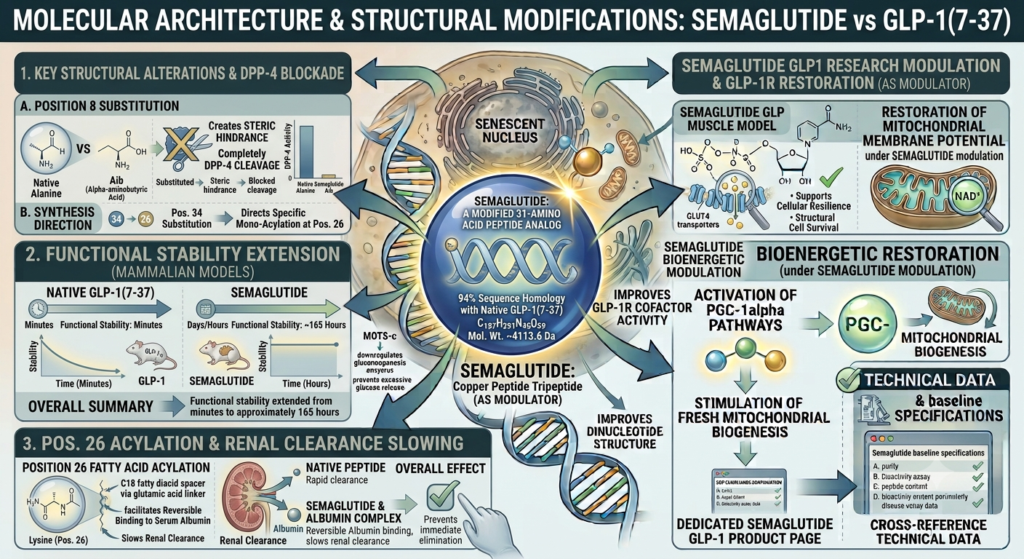
Semaglutide is a modified 31-amino acid peptide analog that shares 94% sequence homology with native human GLP-1(7-37). Its empirical formula is expressed as C187H291N45O59 with a baseline molecular weight of approximately 4113.6 Da.
Key structural alterations distinguish this compound in modern semaglutide GLP-1 research frameworks, extending its functional stability from minutes to approximately 165 hours in mammalian models:
- Position 8 Substitution: Native alanine is substituted with alpha-aminobutyric acid (Aib), creating steric hindrance that completely blocks cleavage by the DPP-4 enzyme.
- Position 26 Fatty Acid Acylation: Lysine at position 26 is conjugated to a C18 fatty diacid spacer via a glutamic acid linker, facilitating reversible binding to serum albumin and slowing renal clearance.
- Position 34 Substitution: Arginine replaces native lysine at position 34 to direct specific mono-acylation at position 26 during synthesis.
Metabolic Support
Price range: $89.99 through $431.96
Research Supplies
Price range: $3.74 through $14.99
Receptor Activation & Physiological Signaling Mechanisms
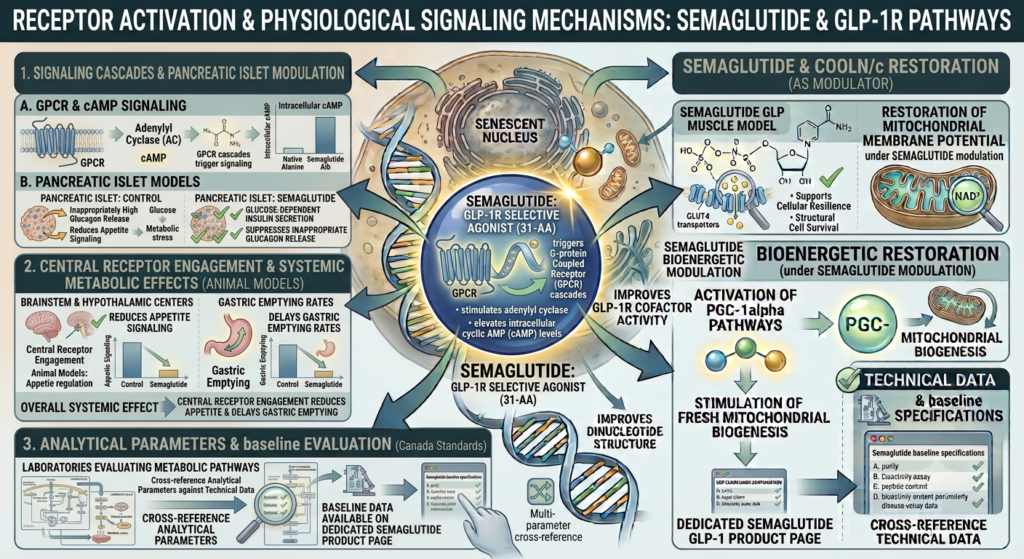
Semaglutide acts as a selective agonist at GLP-1 receptors, triggering G-protein coupled receptor (GPCR) cascades that stimulate adenylyl cyclase and elevate intracellular cyclic AMP (cAMP) levels. In pancreatic islet models, this signaling induces glucose-dependent insulin secretion while suppressing inappropriately high glucagon release under hyperglycemia.
Beyond pancreatic activity, central receptor engagement in brainstem and hypothalamic centers reduces appetite signaling and delays gastric emptying rates in animal models. Laboratories sourcing verified semaglutide vials Canada standards to evaluate these metabolic pathways cross-reference analytical parameters against data available on the dedicated Semaglutide product page.
Reconstitution & Dilution SOPs for 3mg Semaglutide Vials
To prevent baseline drift and ensure data reproducibility across repetitive assay models, meticulous preparation protocols are critical. Subtle shifts in target concentrations can introduce unwanted variation in cellular responses, meaning that establishing a precise, standardized reconstitution map is a mandatory prerequisite for any formal study design.
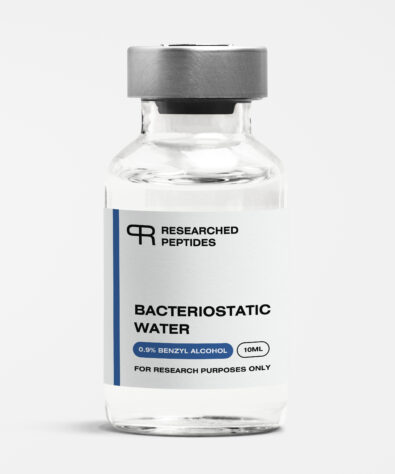
Lyophilized chemical cakes must be carefully brought to a liquid state using an appropriate sterile diluent. For extended observational studies, the industry standard is Bacteriostatic Water (0.9% Benzyl Alcohol), which provides an effective anti-microbial barrier to inhibit bacterial growth over multi-week testing cycles. The table below details standard dilution configurations across baseline 3mg laboratory vial structures:
| Vial Mass Total | Reconstitution Liquid Volume | Resulting Core Concentration | Standard Micro-Dose Aliquot |
|---|---|---|---|
| 3 mg (3,000 mcg) | 1.0 mL | 3,000 mcg / mL (3 mg/mL) | 300 mcg per 0.10 mL unit |
| 3 mg (3,000 mcg) | 1.5 mL | 2,000 mcg / mL (2 mg/mL) | 200 mcg per 0.10 mL unit |
| 3 mg (3,000 mcg) | 3.0 mL | 1,000 mcg / mL (1 mg/mL) | 100 mcg per 0.10 mL unit |
Analytical Purity Benchmarks & Quality Controls
When selecting chemical compounds for scientific evaluation, independent material verification serves as the ultimate safeguard against corrupted trial data. Unregulated or flawed solid-phase synthesis can lead to incomplete peptide sequences or the presence of leftover reagents, which can induce severe cell toxicity or create erratic cross-reactions across control groups.
Every genuine batch of Semaglutide must be validated by independent testing using High-Performance Liquid Chromatography (HPLC) to confirm a chemical purity rating exceeding 98.0%. Simultaneously, Mass Spectrometry (MS) analysis should be used to confirm that the observed mass matches the theoretical profile of 4113.6 Da. Vials that reveal signs of early moisture ingress—such as a sticky, clumped, or melted appearance of the dry powder pellet—should be discarded immediately, as unchecked moisture initiates hydrolysis and breaks down the main peptide chain.
Cold-Chain Management & GLP-1 Analog Storage SOPs
Semaglutide’s extended half-life relies on its hydrophobic C18 fatty diacid chain. Proper physical handling prevents protein aggregation and maintains uniform solution clarity:
- Dry Vial Preservation: Store un-reconstituted Semaglutide vials at -20°C to ensure long-term chemical purity and protect the solid peptide matrix against ambient humidity infiltration.
- Reconstitution Technique: Direct sterile Bacteriostatic Water slowly down the internal wall of the vial. Rotate the vial in smooth, circular motions to dissolve the cake. Avoid aggressive shaking, which can cause bubble formation and surface tension degradation of the lipid-conjugated sequence.
- Liquid Refrigeration Standards: Once reconstituted into liquid form, store the vial continuously at 2°C to 8°C. Maintain strict temperature stability and avoid re-freezing reconstituted liquid to prevent structural precipitation.
Summary: Preclinical Applications in Incretin Research
The engineering of Semaglutide demonstrates how targeted amino acid substitutions and fatty acid acylation can dramatically extend GLP-1 receptor activation in preclinical metabolic models. By offering extended half-life stability, this peptide enables researchers to study continuous glycemic control, glucose-dependent insulin secretion, and central appetite regulation without rapid enzymatic clearance. Achieving reproducible trial metrics requires rigid quality control—specifically verifying raw purity exceeding 98.0%, avoiding aggressive mechanical shear during fluid introduction, and keeping reconstituted solutions refrigerated at 2°C to 8°C.
Metabolic Support
Price range: $89.99 through $431.96
Metabolic Support
Price range: $71.24 through $108.74
Metabolic Support
Price range: $74.99 through $149.99
References
1. Lau, J., et al. (2015). Discovery of the once-weekly glucagon-like peptide-1 (GLP-1) analogue semaglutide. Journal of Medicinal Chemistry, 58(18), 7370-7380. https://doi.org/10.1021/acs.jmedchem.5b00726
2. Knudsen, L. B., & Lau, J. (2019). The discovery and development of liraglutide and semaglutide. Frontiers in Endocrinology, 10, 155. https://doi.org/10.3389/fendo.2019.00155
3. Gotfredsen, C. F., et al. (2014). Semaglutide lowers body weight in rodents via distributed neural pathways in the brainstem and hypothalamus. Diabetes, 63(Suppl 1), A247.