A peptide Certificate of Analysis (COA) can contain some of the most useful information available to a researcher evaluating a peptide sample—but only if the report is interpreted correctly.
A purity percentage alone does not answer every analytical question. Neither does the phrase “lab tested.” Depending on the report, a COA may provide information about chromatographic purity, molecular identity or characterization, measured peptide content, bacterial endotoxin, appearance or other attributes.
Those measurements are related to quality assessment, but they are not interchangeable.
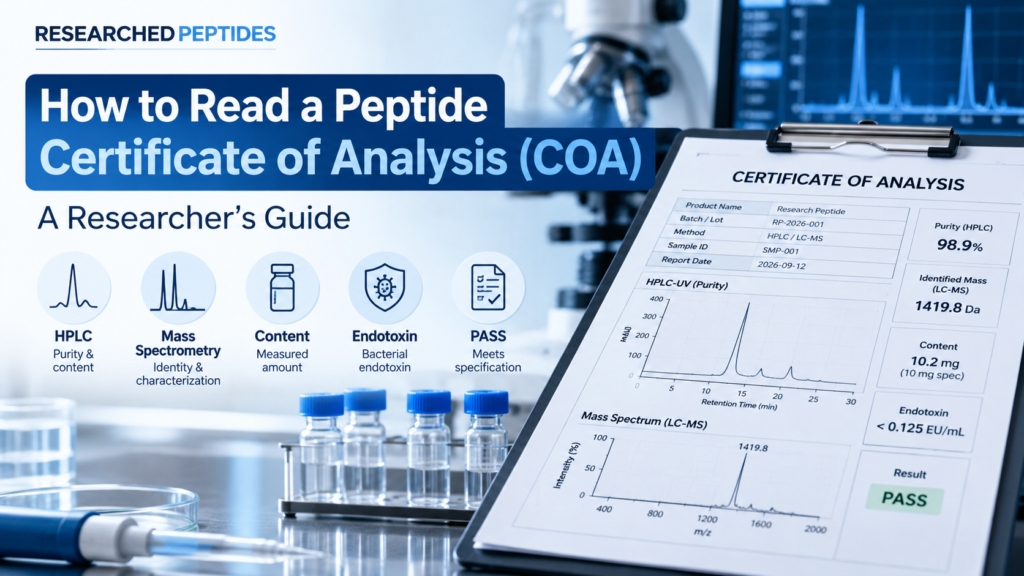
This guide explains how to read a peptide COA, what common methods such as HPLC and mass spectrometry can tell you, how to interpret purity and content results, and which conclusions should not be drawn from a test that was never performed.
What Is a Peptide Certificate of Analysis?
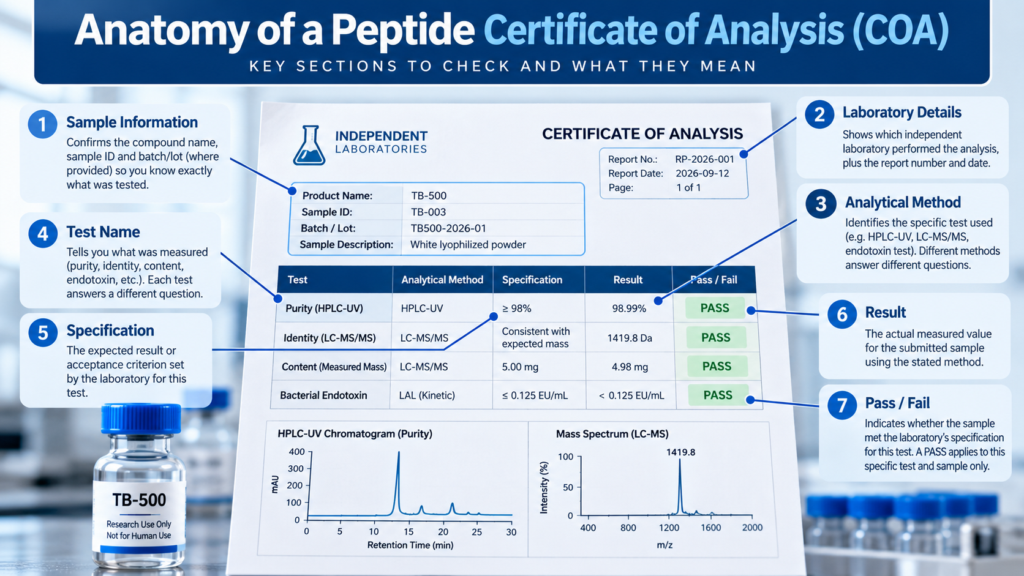
A Certificate of Analysis is a laboratory document reporting analytical information about a submitted sample. Depending on the laboratory, analytical method and purpose of the report, it may include the sample identifier, analytical procedure, specification or acceptance criterion, measured result and pass/fail determination.
The key word is specific.
A COA should be interpreted according to the sample tested and the analytical procedures actually listed on the report. A result from one sample should not automatically be extended to every future batch or vial, and a test that does not appear on the report should not be assumed to have been performed.
This is why careful COA interpretation begins with a simple question:
What analytical question was this particular test designed to answer?
That question is more useful than looking for a single large purity number and stopping there.
The Five Questions to Ask When Reading a Peptide COA
Before interpreting individual numbers, review the report as a whole. A useful first pass is to answer five questions.
1. What sample was actually tested?
Look for the compound name, sample identifier, batch or lot reference where provided, and any other information connecting the laboratory report to the material being evaluated.
A technically impressive report has limited value if it is unclear which sample the data represent.
2. Which analytical method was used?
Look for the actual method rather than relying on a generic “tested” label. Common peptide reports may reference techniques such as HPLC, HPLC-UV, LC-MS or LC-MS/MS, while separate reports or sections may address bacterial endotoxin or other attributes.
The analytical method matters because different procedures answer different questions.
3. What was measured?
Determine whether the reported value refers to purity, identity or characterization, measured content, endotoxin, or another analytical attribute.
Do not treat these terms as synonyms.
4. What specification or acceptance criterion was used?
Some reports compare the measured result with a stated specification. A laboratory may then report whether the submitted sample passed or failed that particular criterion.
A PASS therefore means the reported sample met the stated specification for the test shown. It should not be expanded into a broader claim about safety, sterility, regulatory approval or suitability for human use.
5. What was not tested?
This may be the most overlooked question on a COA.
If the report contains purity analysis but no bacterial endotoxin section, for example, the correct conclusion is that the displayed report provides a purity result. It is not evidence that an endotoxin test was performed.
Purity, Identity, Content, Endotoxin and Sterility Are Different
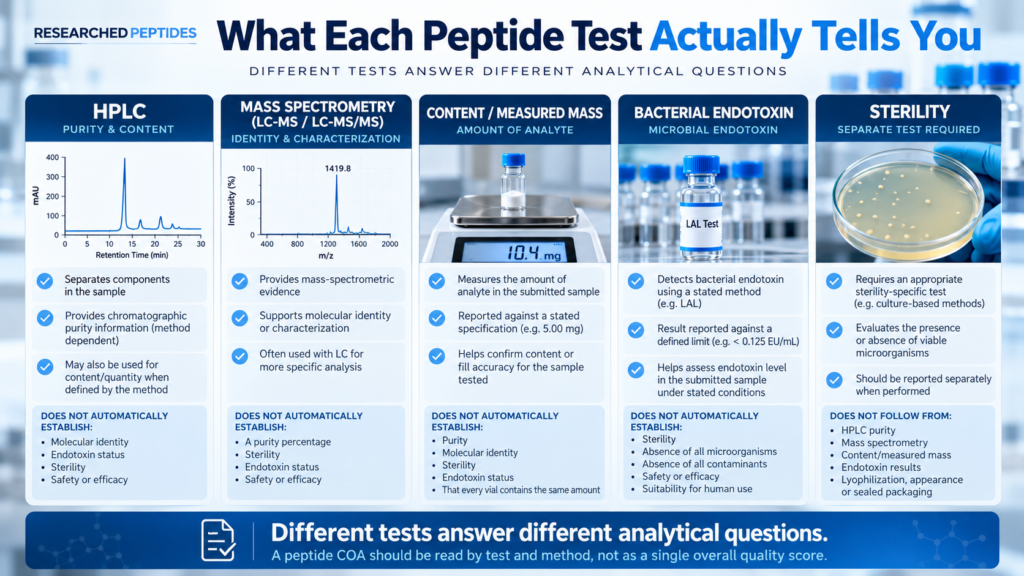
A strong peptide COA should be read by analytical attribute rather than as one overall quality score.
| Analytical Question | What It Addresses | What It Does Not Automatically Establish |
|---|---|---|
| Purity | The purity result as defined by the analytical method used in the report | Identity, sterility, endotoxin status, safety or efficacy |
| Identity / characterization | Evidence supporting whether the analyte corresponds to the intended compound | A purity percentage, sterility or endotoxin status |
| Content / measured mass | Amount of analyte measured in the submitted sample under the stated method | That every vial contains the same amount, or that the material is pure or sterile |
| Bacterial endotoxin | Bacterial endotoxin under the stated method, limit and sample conditions | Sterility, absence of every microorganism or absence of all contaminants |
| Sterility | Requires appropriate sterility-specific evidence | It should not be inferred from purity, endotoxin results, appearance, packaging or lyophilization |
How to Read HPLC Results on a Peptide COA
High-performance liquid chromatography (HPLC) separates components of a sample as they interact differently with a chromatographic system. Depending on the analytical procedure, HPLC or HPLC-UV can provide quantitative information relevant to purity and content.
A chromatogram commonly displays detector response against retention time. Peaks represent components detected as they elute from the chromatographic system.
For peptide COA interpretation, the important point is not simply that a chromatogram exists. Researchers should determine what the laboratory calculated from it and how the report defines the result.
What does an HPLC purity percentage mean?
A reported HPLC purity percentage is the purity result defined by that laboratory’s analytical procedure for the submitted sample.
It should be reported accurately rather than rounded across a meaningful threshold. For example, a laboratory result of 98.99% should not be rewritten as “99%+ purity.”
Precision in reporting matters because the COA is analytical evidence, not advertising copy.
Does HPLC prove peptide identity?
Not automatically.
Chromatographic separation can provide powerful analytical information, but a purity result by itself should not be treated as complete molecular identification. Identification requires a procedure sufficiently specific for the analytical question being asked.
This is one reason complementary analytical methods can be valuable when researchers need information about different attributes of a sample.
How Mass Spectrometry Fits Into Peptide Verification
Mass spectrometry (MS) provides mass-spectrometric evidence useful for molecular identification or characterization. Techniques such as LC-MS and LC-MS/MS combine chromatographic separation with mass-spectrometric analysis.
In simple terms, HPLC and mass spectrometry should not be viewed as two different ways of reporting the same number.
They can answer different analytical questions.
A useful mental model:
Purity: How much of the detected material corresponds to the relevant chromatographic purity result?
Identity / characterization: Does the analytical evidence support that the analyte corresponds to the intended compound?
Content: How much analyte did the laboratory measure in the submitted sample?
The exact interpretation must still follow the laboratory’s stated method. Mass spectrometry should not automatically be described as proving a purity percentage unless the report and analytical procedure specifically support that conclusion.
Content or Fill: Does the Sample Contain the Expected Amount?
A peptide COA may also report measured mass, content or fill accuracy.
This is analytically distinct from purity.
Consider a hypothetical sample labelled with an expected content of 10 mg. If a laboratory method measures 10.4 mg of analyte, that result addresses the amount measured in that submitted sample. A separate purity result addresses a different characteristic.
A sample can therefore have a high reported purity percentage while its measured content differs from the nominal amount. Likewise, a content result close to the expected amount does not by itself establish molecular identity, chromatographic purity, sterility or endotoxin status.
Researchers should read both values independently when both are available.
What Does Bacterial Endotoxin Testing Tell You?
Some peptide laboratory reports may include a bacterial endotoxin test. This testing evaluates bacterial endotoxin under the method, sample conditions, dilution and detection or specification limits stated in the report.
The result should be reported in the same scope.
For example, if a report states a result below a defined analytical limit, the accurate interpretation is that the submitted sample produced the reported endotoxin result under that method and those conditions.
Endotoxin testing is not sterility testing
This distinction is critical.
A bacterial endotoxin result does not automatically establish:
- sterility;
- absence of all microorganisms;
- absence of every possible contaminant;
- general human safety; or
- suitability for human use.
Similarly, a peptide should not be described as sterile merely because it is lyophilized, visually clean, packaged in a sealed vial or accompanied by a purity result.
What Does “PASS” Mean on a COA?
Laboratory reports sometimes compare an analytical result against a specification and mark the result PASS.
Read that term narrowly.
A PASS means that the submitted sample met the laboratory’s stated acceptance criterion for the test shown on the report.
It does not automatically mean:
- the entire product line is certified;
- every future batch will produce the same result;
- the sample is sterile;
- the product is “pharmaceutical grade”;
- the material has received regulatory approval; or
- the material has been established as safe or suitable for human use.
The analytical result should remain connected to the analytical question that produced it.
A Real-World Example: Why COA Scope Matters
Consider how two different peptide reports can contain different types of evidence.
In one third-party report supplied to Researched Peptides for a TB-500 sample identified as TB-003, LC-MS/MS qualitative and quantitative chemical analysis reported a measured quantity of 4.98 mg against a 5.00 mg specification and a reported purity of 98.99% against a ≥98% specification. The sample passed the laboratory specification shown on that report.
The correct interpretation is specific: those are the results reported for that submitted TB-500 sample under the stated analysis.
It would be inaccurate to turn the 98.99% result into “99%+ purity,” because 98.99% is below that threshold. It would also be inappropriate to infer an endotoxin or sterility result from analytical sections that were not part of that evidence.
A separate Researched Peptides Retatrutide report illustrates a different testing scope. That report included HPLC-UV purity/content analysis and a bacterial endotoxin test. Because the report contained an endotoxin section, that specific endotoxin result can be discussed alongside the HPLC-UV findings.
The lesson is simple: read the tests that are actually present rather than assuming every COA contains the same analytical package.
How to Evaluate a Peptide COA: A Practical Checklist
When reviewing a peptide purity certificate or third-party laboratory report, work through the following checklist:
- Match the sample. Confirm the compound name and available sample, batch or lot identifier.
- Identify the laboratory. Determine who performed the analysis.
- Read the analytical method. Look for HPLC/HPLC-UV, LC-MS/MS, endotoxin testing or other specifically named procedures.
- Separate the results. Keep purity, identity or characterization, content and endotoxin results distinct.
- Check the units. Percent purity, milligrams and endotoxin units communicate different information.
- Compare results with specifications. When a specification is shown, determine whether the result met that particular criterion.
- Check what is missing. Never assume an unlisted test was performed.
- Keep the scope narrow. A result belongs to the sample represented by the report unless broader evidence establishes otherwise.
Common COA Interpretation Mistakes
Mistake 1: Treating purity and identity as the same thing
A high chromatographic purity result does not automatically answer the separate question of molecular identity.
Mistake 2: Assuming mass spectrometry means “99% pure”
Mass spectrometry can provide evidence useful for molecular identification or characterization, but a purity percentage should only be attributed to MS when the specific report and method support that interpretation.
Mistake 3: Treating endotoxin testing as sterility testing
These are different analytical questions. A bacterial endotoxin result cannot be used as a substitute for sterility evidence.
Mistake 4: Assuming every COA includes the same tests
Testing scope varies. One report may include HPLC-UV analysis, another LC-MS/MS, and another may also include bacterial endotoxin testing. Read the individual report.
Mistake 5: Turning one COA into a permanent product guarantee
A COA represents the submitted sample or batch identified by that report. It should not automatically be treated as evidence that every vial or future production batch will return an identical result.
Mistake 6: Rounding analytical results for marketing
Analytical numbers should be reported faithfully. A result of 98.99% is 98.99%, not “99%+.”
Why Third-Party Peptide Testing Matters
Independent analytical testing gives researchers evidence they can inspect rather than requiring them to rely entirely on a supplier’s product description.
Its value, however, comes from the specificity and transparency of the evidence.
“Third-party tested” is less informative than knowing which sample was analyzed, which method was used, what was measured, what result was reported and what limitations apply.
Researched Peptides uses independent third-party analytical testing, with methods and results varying by report. Researchers should review the applicable COA to determine which tests were performed on a specific submitted sample or batch.
Inspect the Evidence
When evaluating a research peptide, review the applicable laboratory report and interpret each result according to the analytical method shown.
Frequently Asked Questions About Peptide COAs
Peptide Certificate of Analysis FAQ
A peptide Certificate of Analysis is a laboratory document reporting analytical information for a submitted sample. Depending on the report, it may include sample identification, analytical methods, purity, measured content, molecular characterization, bacterial endotoxin results or other attributes.
HPLC purity is the purity result defined by the chromatographic method used in the report. It should be interpreted according to that procedure and the submitted sample. A high HPLC purity percentage does not by itself establish molecular identity, sterility, endotoxin status, safety or efficacy.
Mass spectrometry can provide evidence useful for molecular identification or characterization by evaluating mass-related information about the analyte. The exact conclusion depends on the analytical procedure and report. It should not automatically be treated as a purity measurement unless the method specifically supports that result.
No. Purity and content answer different analytical questions. Purity describes the purity result defined by the analytical method, while content or measured mass addresses the amount of analyte measured in the submitted sample.
No. Bacterial endotoxin testing and sterility testing are different. An endotoxin result does not establish absence of all microorganisms or prove sterility.
No. PASS means the submitted sample met the laboratory’s stated specification for the particular test shown. It does not by itself establish general safety, sterility, regulatory approval, pharmaceutical-grade status or suitability for human use.
Not automatically. A COA describes the sample or batch represented by that laboratory report. Results should not be generalized to every future batch or vial without supporting evidence.
Look beyond the headline purity percentage. Check the sample identifier, laboratory, analytical method, reported result, units, specification or acceptance criterion, and which additional tests were actually performed. Purity, identity, content, endotoxin and sterility should be evaluated as separate analytical questions.
References & Analytical Standards
- International Council for Harmonisation. ICH Q2(R2): Validation of Analytical Procedures. 2023. Guidance addressing analytical-procedure validation, specificity/selectivity, accuracy, precision and fitness for intended purpose.
- International Council for Harmonisation / U.S. Food and Drug Administration. ICH Q6A: Specifications: Test Procedures and Acceptance Criteria for New Drug Substances and New Drug Products: Chemical Substances. Guidance distinguishing identification, assay/content, impurities and other analytical specifications.
Make the Evidence Easy to Inspect
A useful COA does more than display a purity percentage. Read the sample, method, result and scope together.