The world of science is shifting. In 2026, we are moving away from broad-spectrum solutions and toward precision biology. At the heart of this revolution are peptides—the “biological software” that tells our cells how to behave, heal, and optimize1.
Whether you are an academic researcher or a wellness enthusiast following the latest scientific breakthroughs, this guide will break down exactly what peptides are, how they function, and why they have become the most researched molecules of the decade.
What Exactly Are Peptides? (The “Lego” Analogy)
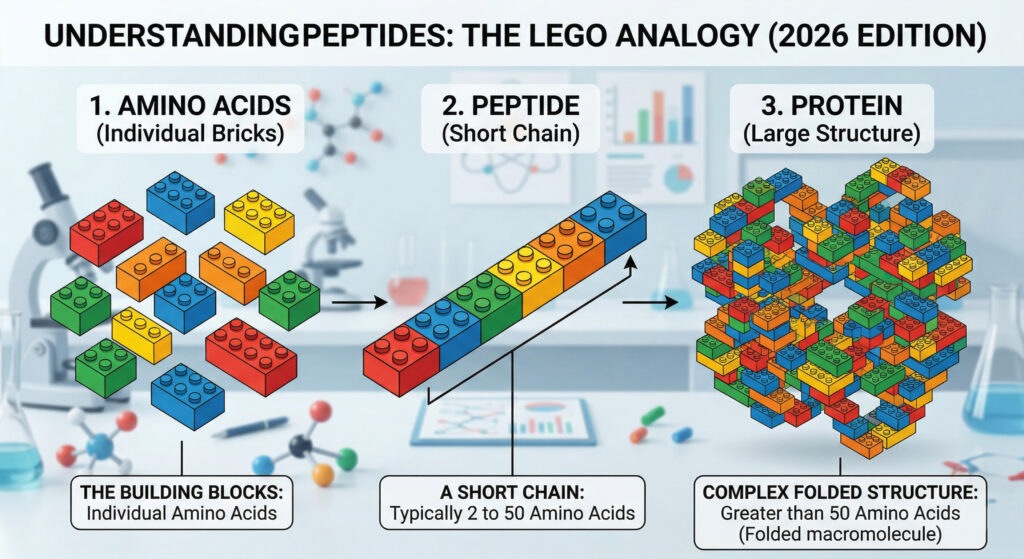
To understand a peptide, you first need to understand amino acids. Think of amino acids as individual Lego bricks. Your body utilizes 20 different types of these bricks, each with a unique shape and biological “job.” When you snap these bricks together in a specific order, you get a peptide.
In the world of biology, sequence matters enormously. In LEGO terms: a 4-brick stack of blue-red-blue-red is structurally different from red-blue-red-blue. In peptides, the exact order of amino acids determines the 3D shape the chain folds into—and that shape determines its biological function entirely. Change the order, and you get a completely different “message” sent to the cell.
- Amino Acid: The individual brick. Each has a common three-letter code (e.g., Gly, Ala, Ser).
- Peptide: A chain of 2–50 amino acids2.
- Protein: A massive, complex Lego castle (typically 50+ amino acids).
Technical Definitions: The Chemical “Snap”
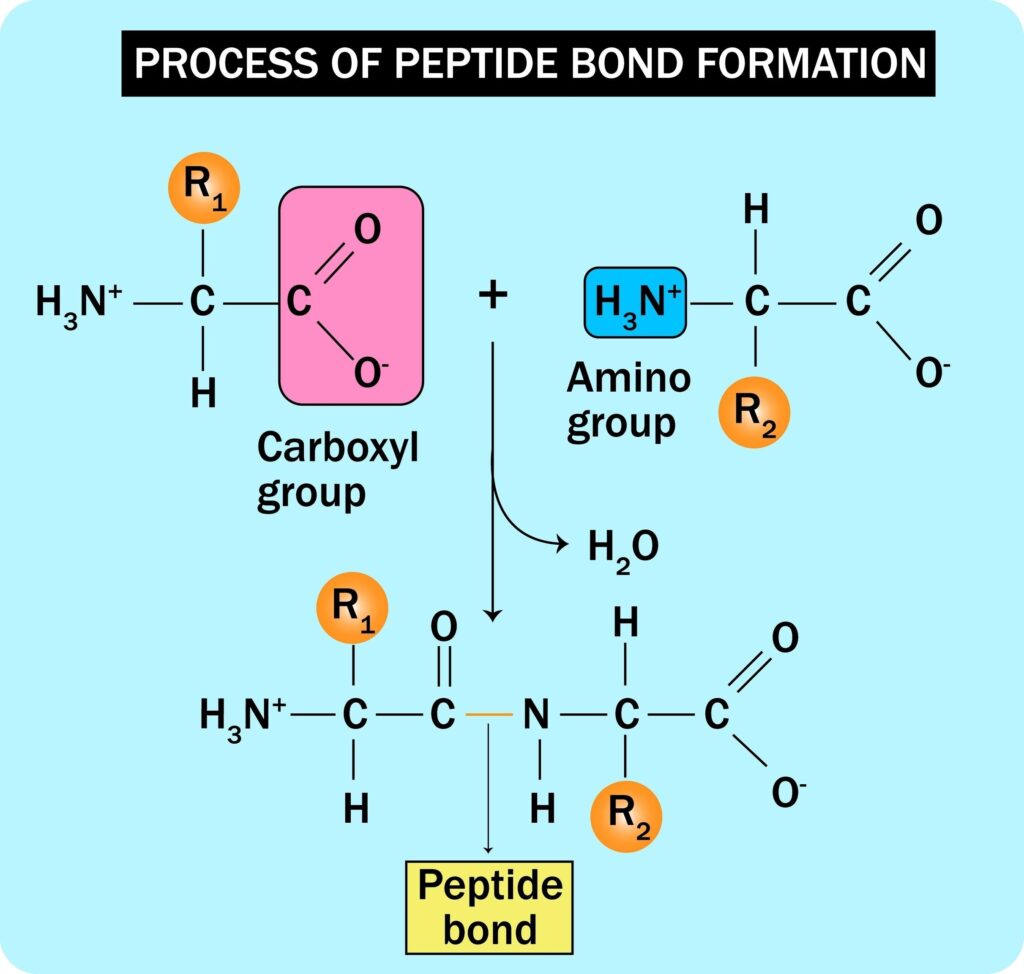
How do these bricks actually stay together? The connection is called a peptide bond. This is a chemical “snap” that occurs when the carboxyl group (-COOH) of one amino acid reacts with the amino group (-NH2) of the next, releasing a water molecule in the process.
Depending on how many bricks are in the set, researchers use specific terms:
- Dipeptide: 2 Amino Acids.
- Tripeptide: 3 Amino Acids (e.g., Glutathione).
- Oligopeptide: A small kit of 3–10 amino acids (e.g., Oxytocin).
- Polypeptide: A medium set of 10–50 amino acids.
How Peptides Work: The Cellular Messenger System
Peptides act as signaling molecules—think of them as text messages between cells3. They bind to specific receptors on cell surfaces and trigger precise responses. Because their sequence programs their shape, they can be engineered to hit very specific targets with minimal “crosstalk” with other systems.
1. Repair & Regeneration
Instructing the body to move fibroblasts to a wound site or grow new blood vessels (angiogenesis).
2. Metabolic Signaling
Telling the pancreas to manage insulin or the brain to signal satiety (fullness).
The Hurdle of Bioavailability
A common question in research is: Why can’t you just take peptides as pills?
The answer lies in Bioavailability—the fraction of the peptide that actually reaches the target tissue in active form. Because peptides are essentially “short proteins,” the human stomach sees them as food. If swallowed, proteolytic enzymes break the “Lego bricks” apart before they can ever send their signal.
To bypass this, most research involves subcutaneous delivery. However, modern science is also exploring structural modifications—such as cyclization (looping the chain), acetylation, or using D-amino acids—specifically designed to resist enzyme breakdown and increase bioavailability4.
Natural vs. Synthetic Peptides
Natural Peptides are made inside the body by ribosomes reading your DNA. In a lab setting, however, we use Synthetic Peptides. These are manufactured using Solid-Phase Peptide Synthesis (SPPS)—essentially assembling the exact brick sequence required, in order, using high-precision chemistry5. This allows for the creation of engineered sequences not found in nature that can achieve more potent or longer-lasting effects.
Understanding Sequence Identity
What makes two peptides “similar” vs. completely different? Scientists look at the sequence identity percentage—how many brick positions match when you align two chains. Two peptides can share 80% identity but have completely different functions if the remaining 20% involves the “active region” that binds to a receptor. This is the core challenge of modern peptide drug design.
Why 2026 is the “Year of the Peptide”
While peptides like Insulin have been around for a century, 2026 marks a turning point due to Precision Stacking. Researchers are no longer looking at one peptide in isolation. Instead, they are studying how peptides work in “synergy”—combining growth hormone secretagogues with tissue repair fragments to achieve accelerated results.
Storage, Stability, and Handling
Peptides are delicate. To prevent degradation, follow these three golden rules:
- Temperature: Keep lyophilized (powder) vials in the refrigerator. Once reconstituted with BAC water, they must stay refrigerated.
- Vibration: Do not shake a reconstituted vial. These molecular chains are fragile; always swirl gently.
- Light: UV rays break down peptide bonds. Store in dark boxes or amber vials.
The “Big Five” Peptides in Modern Research
1. BPC-157 (The Body Protective Compound)
Often called the “Wolverine” peptide, BPC-157 is widely researched for its ability to accelerate the healing of tendons, ligaments, and the gut lining6.
2. TB-500 (Thymosin Beta-4)
This peptide plays a vital role in cell migration and proliferation. It is most commonly researched alongside BPC-157 for systemic recovery7.
3. CJC-1295 & Ipamorelin
These are “Growth Hormone Secretagogues” that signal the pituitary gland to release natural growth hormone, a staple in longevity research.
4. GLP-1 Agonists (Semaglutide/Tirzepatide)
The most famous peptides of the current era, revolutionizing metabolic research and weight management signaling8.
5. NAD+ Precursors & MOTS-c
A new frontier focusing on mitochondrial energy and reversing biological markers of aging.
Common Myths Debunked
Myth: Peptides are Steroids.
False. Steroids are synthetic hormones. Peptides are amino acid chains that modulate existing biological pathways.
Myth: All Peptides are for Bodybuilders.
False. The most exciting research currently is in nootropics (brain health) and autoimmune regulation.
Frequently Asked Questions
Yes, peptides are legal to purchase for laboratory research and educational purposes in Canada. They are not intended for human consumption.
It’s a size convention, not a hard biological rule. Roughly: under ~50 amino acids = peptide, above = protein. The real functional difference is that proteins fold into complex 3D structures that enable enzymatic activity, while smaller peptides mostly function as signals.
In short peptides, three-letter codes (Gly, Ala) are readable. For long proteins with hundreds of amino acids, scientists use one-letter codes (G, A) so sequences can be compared compactly. A protein written in three-letter code would run many pages long.
Reconstitution is the process of adding Bacteriostatic (BAC) water to a freeze-dried peptide powder for research use.
Conclusion
We are only scratching the surface of what peptides can do. As we move through 2026, the ability to “signal” the body to repair itself via peptides is becoming the new standard for health and science. For those entering the world of peptide research, understanding the sequence, stability, and delivery is the key to unlocking the future of precision biology.
References
- Fosgerau, K., & Hoffmann, T. (2015). Peptide therapeutics: current status and future directions. Drug Discovery Today, 20(1), 122-128.
- Berg, J. M., Tymoczko, J. L., & Stryer, L. (2002). Protein Structure and Function. Biochemistry (5th ed.). W H Freeman.
- Kastin, A. J. (Ed.). (2013). Handbook of Biologically Active Peptides. Academic Press.
- Bruno, B. J., Miller, G. D., & Lim, C. S. (2013). Basics and recent advances in peptide and protein drug delivery. Therapeutic Delivery, 4(11), 1443-1467.
- Merrifield, R. B. (1963). Solid Phase Peptide Synthesis. I. The Synthesis of a Tetrapeptide. Journal of the American Chemical Society, 85(14), 2149–2154.
- Chang, C. H., et al. (2011). The promoting effect of pentadecapeptide BPC 157 on tendon healing involves tendon-derived fibroblasts growth and survival. Journal of Orthopaedic Research, 29(3), 346-353.
- Philp, D., & Kleinman, H. K. (2010). Thymosin β4: a multifunctional regenerative peptide. Vitamins & Hormones, 84, 411-424.
- Müller, T. D., et al. (2022). Glucagon-like peptide-1 (GLP-1). Molecular Metabolism, 30, 72-130.
Shop Related Peptides
Tissue Repair & Recovery
Price range: $41.24 through $71.24
Tissue Repair & Recovery
Price range: $41.24 through $71.24
Performance & Endurance
Price range: $52.49 through $74.99
Performance & Endurance
$44.99
Metabolic Support
Price range: $89.99 through $431.96
Metabolic Support
Price range: $71.24 through $108.74
Longevity & Vitality
$89.99
Metabolic Support
$74.99