
Exercise places cells under changing energetic demands. That makes mitochondrial signalling an important area of research—and MOTS-c has emerged as an unusual molecule in that discussion.
MOTS-c is a mitochondrial-encoded peptide that has been investigated in metabolic stress, skeletal muscle, exercise and age-related physical decline. But the evidence behind those topics comes from very different experimental models.
Researchers have administered MOTS-c to mice. They have examined its signalling activity in cells. And in a small human exercise experiment, investigators measured how naturally occurring—or endogenous—MOTS-c changed around exercise.
Those findings are related, but they are not interchangeable.
This guide focuses specifically on MOTS-c exercise research: what researchers have observed in humans, what intervention experiments in mice have reported, how AMPK and metabolic stress fit into the picture, and what the evidence does—and does not—allow us to conclude.
What Is MOTS-c?
MOTS-c, short for mitochondrial open reading frame of the 12S rRNA-c, is a 16-amino-acid peptide encoded by a short open reading frame within mitochondrial 12S rRNA.
Its mitochondrial genetic origin helped make the peptide scientifically interesting because mitochondria are not simply cellular energy-producing organelles. They also participate in signalling networks that allow cells to respond to changes in energy availability and metabolic stress.
Early research connected MOTS-c with skeletal muscle metabolism and AMPK-related signalling. Later work investigated its ability to move into the nucleus during metabolic stress and alter nuclear gene expression.
This article focuses on the exercise and metabolic-stress side of that research. For a broader introduction to the compound, see our MOTS-c Peptide: Mitochondrial Research Guide.
Why Are Researchers Studying MOTS-c and Exercise?
Exercise creates a temporary shift in cellular energy demand. Skeletal muscle must rapidly adjust substrate use, energy production and stress-response pathways as workload changes.
That makes exercise a useful biological model for studying communication between mitochondrial function and wider cellular signalling.
MOTS-c became particularly relevant to this question after researchers reported connections between the peptide, skeletal muscle metabolism, AMPK signalling and cellular adaptation to metabolic stress.
A 2021 study in Nature Communications took the question further by examining MOTS-c in the context of exercise and age-related physical decline. Importantly, that research included both experimental mouse work and measurements in human participants.
The distinction between those two parts of the study is essential.
MOTS-c, Metabolic Stress and AMPK
One of the central pathways in MOTS-c research involves AMP-activated protein kinase, better known as AMPK.
AMPK functions as an important cellular energy-sensing system. When cellular energy conditions change, AMPK signalling can contribute to adjustments in metabolic activity.
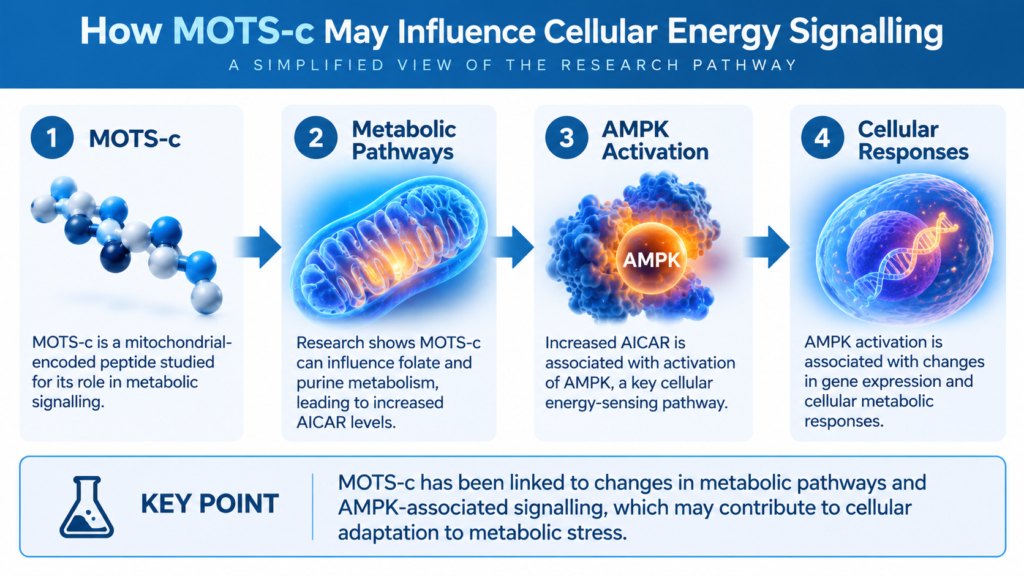
In the original 2015 MOTS-c study, researchers reported that MOTS-c influenced folate metabolism and de novo purine biosynthesis. This was associated with accumulation of 5-aminoimidazole-4-carboxamide ribonucleotide (AICAR), an endogenous intermediate associated with AMPK activation.
MOTS-c → changes in folate/purine metabolism → increased AICAR → AMPK-associated signalling
This pathway helps explain why MOTS-c has attracted attention in metabolic-stress research. It does not mean that every biological observation associated with MOTS-c can be reduced to a single AMPK pathway.
Metabolic Stress Can Also Change Where MOTS-c Is Located
A separate 2018 study added another layer to the mechanism.
Researchers reported that metabolic stress could trigger AMPK-dependent translocation of MOTS-c to the nucleus. Once in the nucleus, MOTS-c was associated with changes in expression across a broad range of genes, including genes containing antioxidant response elements.
The researchers also reported interactions involving stress-responsive transcription factors such as NRF2.
This work is important because it positions MOTS-c within a broader concept of mitonuclear communication: signalling between mitochondria and the nucleus during changing cellular conditions.
In other words, the research question is larger than whether MOTS-c simply changes one metabolic marker. Scientists are investigating whether mitochondrial-encoded signals can participate in coordinated cellular responses to metabolic stress.
Does Exercise Change MOTS-c in Humans?
This is where the exercise literature becomes particularly interesting.
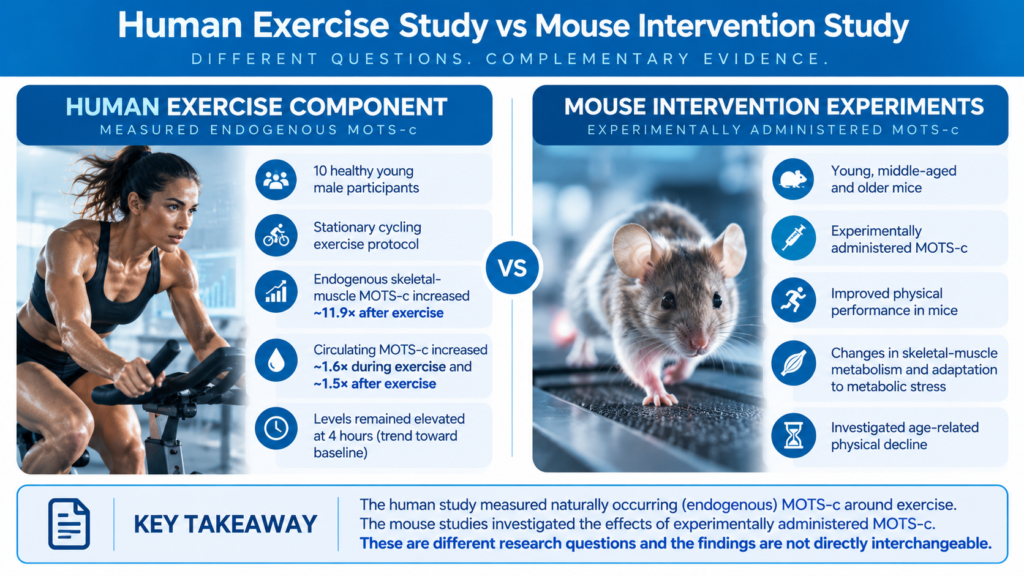
The 2021 Nature Communications study included a small human experiment involving 10 sedentary, healthy young men. Participants performed exercise on a stationary bicycle while researchers examined endogenous MOTS-c responses in skeletal muscle and circulation.
The researchers reported that relative skeletal-muscle MOTS-c levels increased approximately 11.9-fold after exercise and remained elevated at the four-hour measurement, although levels showed a trend toward returning to baseline.
Circulating endogenous MOTS-c also increased, by approximately 1.6-fold during exercise and 1.5-fold after exercise, before returning toward baseline at four hours.
These observations support the idea that endogenous MOTS-c is responsive to exercise-associated physiological conditions.
But there is an important limitation:
The human component measured naturally occurring MOTS-c around exercise. It did not demonstrate that administering MOTS-c improves exercise performance, recovery, body composition or health outcomes in humans.
Endogenous MOTS-c vs Administered MOTS-c
This distinction is one of the most important concepts for interpreting MOTS-c research accurately.
Endogenous MOTS-c refers to MOTS-c produced within the biological system itself.
Administered MOTS-c refers to MOTS-c introduced experimentally by researchers.
If endogenous MOTS-c rises during or after exercise, researchers can reasonably investigate whether the peptide participates in exercise-related signalling. But that observation alone does not establish what happens when MOTS-c is administered from an external source.
Those are different experimental questions requiring different evidence.
| Human Exercise Component | Mouse Intervention Experiments |
|---|---|
| Measured endogenous MOTS-c | Experimentally administered MOTS-c |
| 10 healthy young male participants | Included young, middle-aged and older mice |
| Stationary cycling exercise | Experimental physical-performance and metabolic models |
| Asked whether endogenous MOTS-c changes around exercise | Asked what happens following experimental MOTS-c administration |
| Does not establish administered MOTS-c efficacy in humans | Preclinical findings cannot automatically be extrapolated to humans |
What Did Mouse Exercise Experiments Find?
The animal portion of the 2021 study addressed a different question from the human exercise experiment.
Researchers administered MOTS-c in mouse models and investigated physical performance, skeletal-muscle metabolism and age-related physical decline.
The study included young, middle-aged and older mice. The researchers reported improved physical performance following MOTS-c treatment across the investigated age groups, along with changes associated with skeletal-muscle metabolism and adaptation to metabolic stress.
The older-mouse experiments were particularly relevant to the study’s investigation of age-dependent physical decline.
These results provide preclinical evidence that experimentally administered MOTS-c can influence physical and metabolic phenotypes in mice.
They do not establish that administering MOTS-c produces equivalent performance, metabolic or aging-related outcomes in humans.
MOTS-c and Skeletal Muscle Research
Skeletal muscle appears repeatedly throughout the MOTS-c literature.
The original 2015 research identified skeletal muscle as a major target tissue in the investigated metabolic models. The later exercise study further examined skeletal-muscle metabolism, exercise responses and physical capacity.
This relationship makes biological sense as a research question. Skeletal muscle has substantial energetic demands and must continuously adjust metabolic activity in response to nutrient availability, physical activity and stress.
MOTS-c therefore provides researchers with a potential molecular link between mitochondrial signalling and broader skeletal-muscle metabolic responses.
That should still be described as an active research area rather than evidence that MOTS-c has a demonstrated muscle-building or performance-enhancing effect in humans.
MOTS-c and Metabolic Homeostasis Research
Exercise research is only one part of the broader MOTS-c literature.
In the foundational 2015 study, researchers investigated MOTS-c in cellular systems and mouse models of metabolic dysfunction. They reported effects involving skeletal muscle, AMPK activation, insulin sensitivity and metabolic homeostasis.
In mouse experiments, MOTS-c treatment was reported to prevent age-dependent and high-fat-diet-induced insulin resistance as well as diet-induced obesity under the conditions investigated.
These findings helped establish MOTS-c as a mitochondrial-derived peptide of interest in metabolic research.
However, they remain preclinical findings. They should not be rewritten as evidence that MOTS-c treats obesity, insulin resistance or metabolic disease in humans.
MOTS-c and Aging Research
Aging is another area where the experimental models need to be interpreted carefully.
The 2021 exercise study reported that administered MOTS-c improved physical performance in older mice and investigated age-related changes in muscle homeostasis and physical capacity.
This supports continued research into how mitochondrial signalling may interact with age-related physiological changes.
It does not establish MOTS-c as an anti-aging treatment in humans.
Terms such as “longevity peptide” or “anti-aging peptide” can therefore overstate the available evidence when they are presented as established outcomes rather than research hypotheses or preclinical areas of interest.
What Does MOTS-c Exercise Research Actually Show?
The evidence becomes much easier to interpret when separated by research model.
| Finding | Evidence Context | Interpretation |
|---|---|---|
| MOTS-c is mitochondrial-encoded | Molecular research | Established characteristic of the peptide |
| MOTS-c influences AMPK-associated signalling | Cellular and preclinical research | Supports metabolic-stress research |
| Metabolic stress can trigger nuclear translocation | Cellular/mechanistic research | Supports a role in mitonuclear stress signalling |
| Endogenous MOTS-c changed around exercise | Small human exercise experiment | Supports exercise-responsive biology |
| Administered MOTS-c affected physical performance | Mouse experiments | Preclinical intervention evidence |
| Administered MOTS-c improves human exercise performance | Not established by these studies | Requires appropriate human intervention evidence |
What the Evidence Does Not Establish
Current MOTS-c research is scientifically interesting, but several claims commonly associated with the compound go beyond what the cited evidence demonstrates.
The research discussed in this guide does not establish that administered MOTS-c:
- improves athletic performance in humans;
- accelerates exercise recovery in humans;
- builds skeletal muscle in humans;
- produces clinically meaningful fat loss in humans;
- treats insulin resistance or metabolic disease in humans;
- slows human aging; or
- extends human lifespan.
These distinctions do not make the research less interesting. They make the scientific question clearer.
The strongest interpretation is that MOTS-c is a mitochondrial-encoded signalling peptide with experimental links to metabolic stress, AMPK-associated pathways, skeletal muscle, exercise-responsive biology and age-related physical phenotypes in preclinical models.
Why Human vs Mouse Evidence Matters
Animal models are valuable because they allow researchers to perform controlled interventions that may not initially be practical or appropriate in humans.
But species, experimental conditions, exposure, physiology and study endpoints can all affect results.
That is particularly important with MOTS-c because the human and mouse components of the exercise literature can sound superficially similar while answering different questions.
In humans, researchers observed how endogenous MOTS-c changed around exercise.
In mice, researchers could administer MOTS-c and measure subsequent experimental outcomes.
Combining those findings into a statement such as “MOTS-c improves exercise performance in humans” would cross an evidence boundary that the studies themselves do not establish.
Where Does MOTS-c Research Go Next?
The existing literature raises several useful research questions.
Researchers can continue investigating how endogenous MOTS-c is regulated during different forms of metabolic stress, whether exercise responses vary across populations, how mitochondrial and nuclear signalling interact, and how findings from preclinical intervention models translate—or fail to translate—into human biology.
Larger and more diverse human studies would also help clarify the significance of the exercise-associated changes observed in the small human cohort reported in 2021.
For now, MOTS-c is best understood as an active research subject rather than a compound with established human exercise or anti-aging outcomes.
MOTS-c for Laboratory Research in Canada
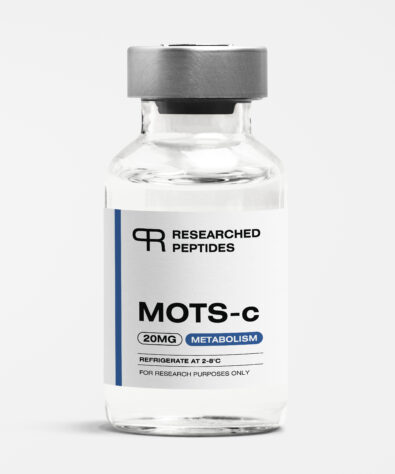
Researched Peptides offers MOTS-c as a 20 mg research product for laboratory and scientific research in Canada.
The Researched Peptides product should be kept conceptually separate from the specific compounds, preparations and experimental conditions used in external published studies. Literature describing a biological finding does not demonstrate that a commercial research product will reproduce that finding.
Metabolic Support
$74.99
Frequently Asked Questions About MOTS-c and Exercise Research
MOTS-c is a 16-amino-acid mitochondrial-encoded peptide studied in areas including metabolic signalling, cellular stress responses, skeletal muscle and exercise biology.
A small human study involving 10 healthy young men reported increases in endogenous skeletal-muscle and circulating MOTS-c around a stationary cycling exercise protocol. The finding suggests that endogenous MOTS-c is exercise responsive, but larger human studies are needed to better characterize the response.
Yes. Human research has included measurement of endogenous MOTS-c around exercise. Importantly, observing naturally occurring MOTS-c during exercise is different from demonstrating the effects of administered MOTS-c in humans.
The studies discussed here do not establish that administered MOTS-c improves exercise performance in humans. Physical-performance findings following MOTS-c administration have been reported in mouse experiments, while the human exercise component measured endogenous MOTS-c responses.
Experimental research has connected MOTS-c with changes in folate and purine metabolism, AICAR accumulation and AMPK-associated signalling. Separate research has also reported AMPK-dependent movement of MOTS-c into the nucleus during metabolic stress.
Research has examined MOTS-c in age-related physical decline and metabolic models, particularly in mice. Those findings do not establish an anti-aging effect or lifespan benefit in humans.
Endogenous MOTS-c is produced within the biological system itself. Administered MOTS-c is introduced experimentally. A change in endogenous MOTS-c during exercise does not by itself demonstrate what externally administered MOTS-c will do.
References
- Lee C, Zeng J, Drew BG, et al. The mitochondrial-derived peptide MOTS-c promotes metabolic homeostasis and reduces obesity and insulin resistance. Cell Metabolism. 2015;21(3):443-454. doi:10.1016/j.cmet.2015.02.009.
- Kim KH, Son JM, Benayoun BA, Lee C. The Mitochondrial-Encoded Peptide MOTS-c Translocates to the Nucleus to Regulate Nuclear Gene Expression in Response to Metabolic Stress. Cell Metabolism. 2018;28(3):516-524.e7. doi:10.1016/j.cmet.2018.06.008.
- Reynolds JC, Lai RW, Woodhead JST, et al. MOTS-c is an exercise-induced mitochondrial-encoded regulator of age-dependent physical decline and muscle homeostasis. Nature Communications. 2021;12:470. doi:10.1038/s41467-020-20790-0.
Explore MOTS-c for Laboratory Research
View the current Researched Peptides MOTS-c research product and product information.