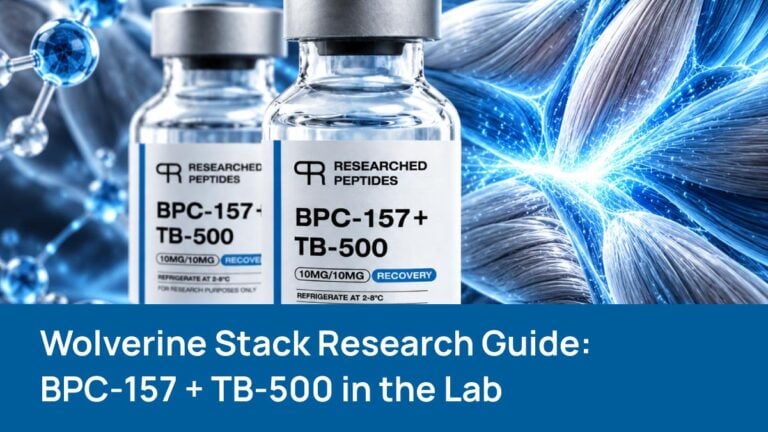
BPC-157 and TB-500 are frequently discussed together in peptide research, particularly in experimental work involving tendon repair, cellular migration, extracellular-matrix organization and other aspects of tissue remodeling.
But BPC-157 and TB-500 are not interchangeable compounds, and their research histories are different.
BPC-157 has been investigated directly in a number of preclinical tendon and tissue models. TB-500 requires an additional distinction: much of the biological literature commonly associated with it actually concerns full-length thymosin beta-4, while published analytical research has identified TB-500 as a shorter fragment corresponding to residues 17–23 of thymosin beta-4.
For researchers comparing BPC-157 vs TB-500, the useful question is therefore not simply which peptide is “better.” A more scientifically meaningful comparison asks: what has each compound actually been studied for, what mechanisms have been investigated, and where do their evidence bases overlap?
That comparison became particularly interesting in 2026, when researchers published a direct experiment evaluating BPC-157, TB-500 and the two compounds together in the same rat Achilles tendon injury model.
BPC-157 vs TB-500: Key Research Differences at a Glance
| Comparison | BPC-157 | TB-500 |
|---|---|---|
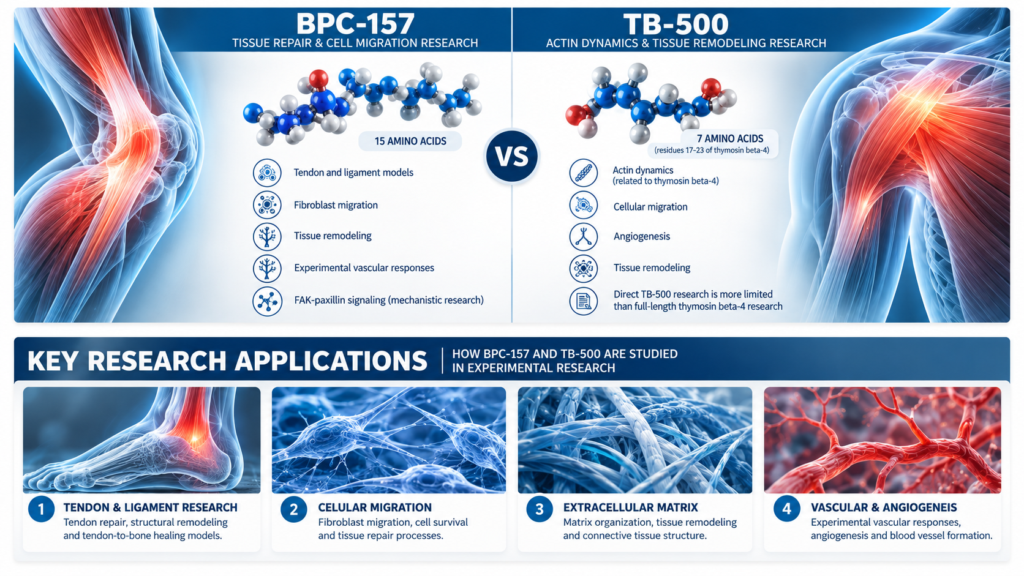
| Molecular context | 15-amino-acid peptide investigated across multiple experimental tissue models | Identified in published analytical research as an N-terminally acetylated fragment corresponding to residues 17–23 of thymosin beta-4 |
| Prominent research areas | Tendon and ligament models, fibroblast migration, tissue remodeling and vascular responses | Direct TB-500 research is more limited; related thymosin beta-4 research includes actin dynamics, cellular migration, angiogenesis and tissue remodeling |
| Mechanistic context | Research includes FAK-paxillin signaling, fibroblast migration and experimental vascular responses | Related to an actin-binding region of thymosin beta-4; full-length thymosin beta-4 has an established role in actin regulation |
| Direct tendon evidence | Multiple preclinical studies including cell and animal models | More limited direct literature; investigated in a 2026 rat Achilles tendon study |
| Head-to-head evidence | BPC-157 and TB-500 were directly compared, individually and together, in a 2026 rat Achilles tendon repair experiment | |
| Human tissue-repair benefit | Not established by the evidence reviewed here | Not established by the evidence reviewed here |
What Is BPC-157?
BPC-157 is a 15-amino-acid peptide that has been investigated in a range of experimental models involving tendons, ligaments, muscle and other tissues.
Much of the scientific interest surrounding BPC-157 comes from preclinical research. This distinction matters because observations in cultured cells and animal injury models do not automatically establish corresponding effects in humans.
BPC-157 and tendon fibroblast migration
A 2011 study examined tendon fibroblasts derived from rat Achilles tendon and tendon explants exposed to BPC-157.
Researchers reported increased tendon-explant outgrowth, greater cell survival under experimental oxidative stress and increased migration of tendon fibroblasts. They also observed increased phosphorylation of FAK and paxillin, proteins involved in cellular adhesion and migration.
The experiment provides mechanistic evidence for why BPC-157 has attracted attention in tendon research. It remains cell- and tissue-based experimental evidence rather than proof of a human therapeutic effect.
BPC-157 in animal tendon research
BPC-157 has also been investigated in rat tendon-injury models. Published experiments have evaluated endpoints including functional recovery, biomechanical properties, histological changes, inflammatory measures, vascular responses and tendon-to-bone healing.
This gives BPC-157 a relatively direct preclinical research history in tendon biology, although the evidence remains predominantly experimental and should not be generalized into established human outcomes.
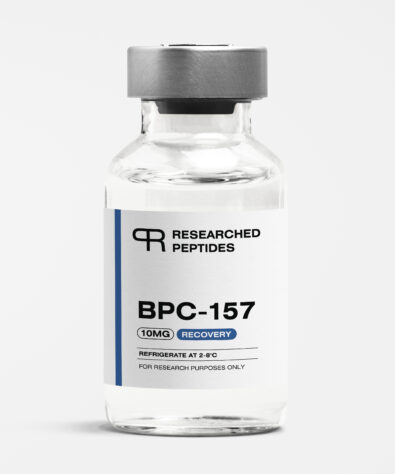
Researchers looking specifically at the compound can view the Researched Peptides BPC-157 research product.
What Is TB-500?
TB-500 requires more careful terminology because TB-500 and full-length thymosin beta-4 are frequently discussed as though they were the same molecule.
They are not.
Thymosin beta-4 is a naturally occurring 43-amino-acid polypeptide with an important relationship to actin regulation. Published research has investigated thymosin beta-4 in areas including cellular migration, angiogenesis and tissue-remodeling processes.
In a 2012 analytical study, researchers identified TB-500 as an N-terminally acetylated fragment corresponding to residues 17–23 of human thymosin beta-4. The identified sequence was Ac-LKKTETQ.
This distinction is central to an accurate BPC-157 vs TB-500 comparison: biological findings produced using full-length thymosin beta-4 cannot automatically be assigned to the shorter TB-500 fragment.
TB-500, thymosin beta-4 and actin
Actin is a major component of the cellular cytoskeleton and contributes to cell shape, structural organization and movement.
Full-length thymosin beta-4 is well characterized for its interaction with G-actin. Research involving its actin-binding region has also investigated processes related to endothelial-cell migration and angiogenesis.
That literature provides useful mechanistic context for why the thymosin beta-4 region associated with TB-500 is scientifically interesting. It should still be described according to the exact molecule used in each experiment.
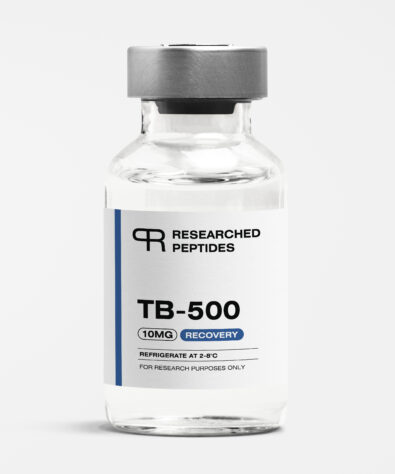
Researchers examining TB-500 independently can view the Researched Peptides TB-500 research product.
BPC-157 vs TB-500: Differences in Research Applications
The strongest distinction between these peptides is not a simple list of claimed effects. It is the type of experimental questions researchers have used them to investigate.
BPC-157: fibroblast migration and tendon-remodeling research
BPC-157 has been investigated relatively directly in experimental tendon research.
Studies have examined tendon fibroblast migration, cell survival under experimental stress, FAK-paxillin signaling, vascular responses and structural or biomechanical changes following tendon injury in animal models.
For that reason, BPC-157 research questions frequently focus on how a peptide may influence cellular and structural events within an experimentally injured tissue.
TB-500: actin-related and cellular-migration research
The research context surrounding TB-500 is different.
Much of the mechanistic framework comes from thymosin beta-4 research involving actin dynamics, cellular movement, endothelial responses and angiogenic processes. TB-500 corresponds to a short region of thymosin beta-4 that includes an actin-binding sequence.
However, because full-length thymosin beta-4 and TB-500 are distinct molecules, researchers should avoid treating the much broader thymosin beta-4 literature as though every finding were generated directly with TB-500.
Where the research areas overlap
The two research areas intersect around processes relevant to tissue remodeling.
BPC-157 experiments have examined cellular migration, extracellular-matrix organization and vascular responses. Thymosin beta-4 research has separately examined actin regulation, cellular migration and angiogenesis.
That overlap helps explain why BPC-157 and TB-500 are frequently investigated or discussed together.
But overlapping research areas do not establish that the compounds have identical mechanisms, equivalent effects or a synergistic relationship.
Have BPC-157 and TB-500 Been Compared Directly?
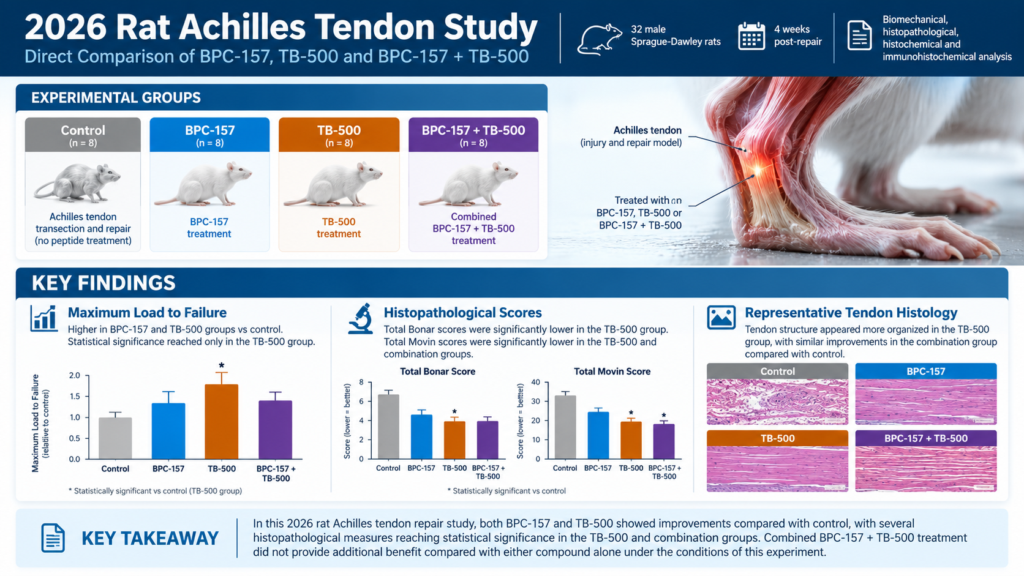
Yes. A 2026 study published in Joint Diseases and Related Surgery directly compared BPC-157 and TB-500 in a rat Achilles tendon repair model.
The experiment involved 32 male Sprague-Dawley rats following standardized Achilles tendon transection and repair. The animals were divided into four experimental groups:
- Control
- BPC-157
- TB-500
- BPC-157 + TB-500
After four weeks, researchers evaluated biomechanical, histopathological, histochemical and immunohistochemical measures.
What did the direct comparison find?
Maximum load to failure was higher in the BPC-157 and TB-500 groups than in the control group, although statistical significance for that endpoint was reached only in the TB-500 group.
The researchers also reported differences in histopathological measures. Total Bonar scores were significantly lower in the TB-500 group, while total Movin scores were significantly lower in the TB-500 and combination groups relative to controls.
Those results make the experiment particularly useful because BPC-157 and TB-500 were evaluated within the same model rather than compared indirectly across unrelated studies.
However, this should not be converted into a universal conclusion that TB-500 is “better than” BPC-157.
The experiment involved one injury model, one species, one observation period and a limited number of animals. The results describe what occurred under those particular experimental conditions. They do not establish a comparative ranking in humans or across other tissues and research models.
What Happened When BPC-157 and TB-500 Were Combined?
The same 2026 experiment also tested the compounds together.
This is important because BPC-157 and TB-500 are often paired under the informal name Wolverine Stack, based partly on the idea that their different research profiles might complement one another.
In this experiment, however, the researchers concluded that combined BPC-157 + TB-500 treatment did not provide additional benefit compared with either compound alone.
That finding does not establish that interactions between the compounds are impossible under every experimental condition. It does show why combination effects must be tested rather than inferred from separate mechanisms.
Mechanistic complementarity is not the same thing as demonstrated synergy.
For a deeper examination of the combination evidence, see our Wolverine Stack Research Guide.
BPC-157 vs TB-500: How Should Researchers Think About the Difference?
The most useful comparison depends on the experimental question.
| Research Question | Relevant Literature | Important Limitation |
|---|---|---|
| Tendon fibroblast migration | BPC-157 has direct cell-based research examining migration and FAK-paxillin signaling | Cell-based findings do not establish human tissue outcomes |
| Actin-related cellular processes | Thymosin beta-4 has substantial mechanistic relevance; TB-500 contains an identified actin-binding-region fragment | Full-length thymosin beta-4 evidence cannot automatically be assigned to TB-500 |
| Experimental Achilles tendon repair | Both BPC-157 and TB-500 were evaluated directly in the 2026 rat experiment | Single preclinical model; results should not be generalized to humans or other tissues |
| Combined BPC-157 + TB-500 research | The 2026 rat experiment directly evaluated the combination | No additional benefit over either compound alone was demonstrated in that experiment |
BPC-157, TB-500 and Wolverine Blend Research Options
BPC-157 and TB-500 can therefore represent different experimental approaches rather than interchangeable versions of the same research question.
Researchers investigating BPC-157 independently can select the individual compound. Researchers investigating TB-500 independently can likewise isolate that experimental condition.
When the research question specifically concerns BPC-157 and TB-500 together, Researched Peptides also offers the Wolverine Blend as a combined preparation.
The presence of a combined research option should not be interpreted as evidence that the blend is superior to either peptide alone. In fact, the current direct animal evidence makes that distinction especially important: the 2026 Achilles tendon experiment did not demonstrate an additional benefit from the combination over the individual compounds under the conditions studied.
Tissue Repair & Recovery
Price range: $41.24 through $71.24
Tissue Repair & Recovery
Price range: $41.24 through $71.24

Tissue Repair & Recovery
Frequently Asked Questions
BPC-157 vs TB-500 Research FAQ
BPC-157 and TB-500 are different peptides with different research histories. BPC-157 has been investigated directly in multiple preclinical tendon and tissue models, including studies of fibroblast migration and FAK-paxillin signaling. TB-500 has been identified as an acetylated fragment corresponding to residues 17–23 of thymosin beta-4, and much of its broader mechanistic context comes from research involving the full-length thymosin beta-4 molecule.
No. Full-length thymosin beta-4 is a 43-amino-acid polypeptide. Published analytical research identified TB-500 as an N-terminally acetylated fragment corresponding to residues 17–23 of thymosin beta-4. Findings involving full-length thymosin beta-4 therefore should not automatically be presented as direct evidence for TB-500.
Yes. A 2026 rat Achilles tendon study directly compared a control group, BPC-157, TB-500 and BPC-157 + TB-500. It provides direct preclinical comparative evidence under one experimental design, but it does not establish which compound would perform better across other research models or in humans.
For maximum load to failure, both individual peptide groups were higher than controls, but statistical significance was reached only in the TB-500 group. TB-500 also showed significant differences in several histopathological measures. Those findings apply to that specific rat Achilles tendon experiment and should not be converted into a general conclusion that TB-500 is superior to BPC-157 across other models, tissues or humans.
Synergy has not been established by the evidence reviewed here. In the 2026 rat Achilles tendon experiment, combined BPC-157 + TB-500 treatment did not provide additional benefit compared with either compound alone. Different experimental models could produce different observations, but synergy should not be assumed without direct supporting evidence.
Their research areas overlap around processes relevant to tissue remodeling. BPC-157 research includes fibroblast migration, extracellular-matrix and vascular responses, while thymosin beta-4 research includes actin dynamics, cellular migration and angiogenesis. That overlap creates a reasonable combination research question, but mechanistic overlap does not itself demonstrate an additive or synergistic effect.
No established human tissue-repair benefit should be inferred from the evidence discussed in this article. Much of the relevant BPC-157 evidence is preclinical, and the direct BPC-157 vs TB-500 Achilles tendon comparison was conducted in rats.
References
- Biçer O, Adanir O, Güleryüz Y, et al. Effects of BPC-157 and TB-500 on Achilles tendon healing in rats: a histopathological and biomechanical study. Joint Diseases and Related Surgery. 2026;37(3):822-837. doi:10.52312/jdrs.2026.2951.
- Chang CH, Tsai WC, Lin MS, Hsu YH, Pang JHS. The promoting effect of pentadecapeptide BPC 157 on tendon healing involves tendon outgrowth, cell survival, and cell migration. Journal of Applied Physiology. 2011;110(3):774-780. doi:10.1152/japplphysiol.00945.2010.
- Esposito S, Deventer K, Goeman J, Van der Eycken J, Van Eenoo P. Synthesis and characterization of the N-terminal acetylated 17-23 fragment of thymosin beta 4 identified in TB-500, a product suspected to possess doping potential. Drug Testing and Analysis. 2012;4(9):733-738. doi:10.1002/dta.1402.
- Philp D, Huff T, Gho YS, Hannappel E, Kleinman HK. The actin binding site on thymosin beta4 promotes angiogenesis. FASEB Journal. 2003. doi:10.1096/fj.03-0121fje.
Explore BPC-157 and TB-500 Research Products
Compare the individual BPC-157 and TB-500 research products or explore the combined Wolverine Blend for experimental questions involving both compounds.
Tissue Repair & Recovery
Price range: $41.24 through $71.24
Tissue Repair & Recovery
Price range: $41.24 through $71.24
Tissue Repair & Recovery