
In contemporary metabolic biology and preclinical models, investigating the maintenance of intracellular bioenergetics remains a central imperative. Age-associated declines in critical coenzymes directly impair mitochondrial oxidative phosphorylation, DNA repair mechanisms, and sirtuin-mediated epigenetic regulation. To map these metabolic shifts in modern trial frameworks, development teams exploring cellular vitality are prioritizing NAD+ research Canada protocols to quantify how exogenous coenzyme administration influences cellular homeostasis.
This technical guide evaluates the biochemical architecture of Nicotinamide Adenine Dinucleotide, analyzes current cellular aging models, outlines standardized volumetric preparation procedures for laboratory 500mg vials, and details analytical quality control metrics necessary for trial validation.
NAD+ Architecture & Enzymatic Kinetics
NAD+ (Nicotinamide Adenine Dinucleotide) is an essential dinucleotide composed of two phosphate groups joined by an anhydride bond, linking an adenine nucleoside to a nicotinamide riboside moiety. Its molecular formula is expressed as C21H27N7O14P2 with a baseline molecular weight of 663.43 Da.
Every foundational nicotinamide adenine dinucleotide study demonstrates that this coenzyme acts as a vital electron carrier, cycling continuously between its oxidized state (NAD+) and reduced state (NADH). Beyond its redox duties, it functions as an essential substrate for several critical enzyme families in cellular preservation:
- Sirtuin Activation (SIRT1-SIRT7): It serves as a mandatory co-substrate for Class III histone deacetylases, driving epigenetic silencing, mitochondrial biogenesis, and caloric-restriction signaling pathways.
- PARP-Mediated Genomic Integrity: It directly fuels Poly(ADP-ribose) Polymerases (specifically PARP1), which detect and orchestrate single-strand DNA break repairs across active chromatin matrices.
- cADP-Ribose Synthase Activity: It acts as a precursor for cyclic ADP-ribose via CD38 and CD157 ectoenzymes, regulating intracellular calcium signaling waves required for cellular division.
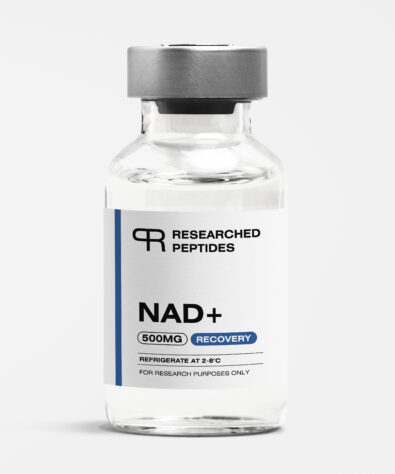
Longevity & Vitality
$89.99
Research Supplies
Price range: $3.74 through $14.99
Mitochondrial Bioenergetics in Cellular Aging Research
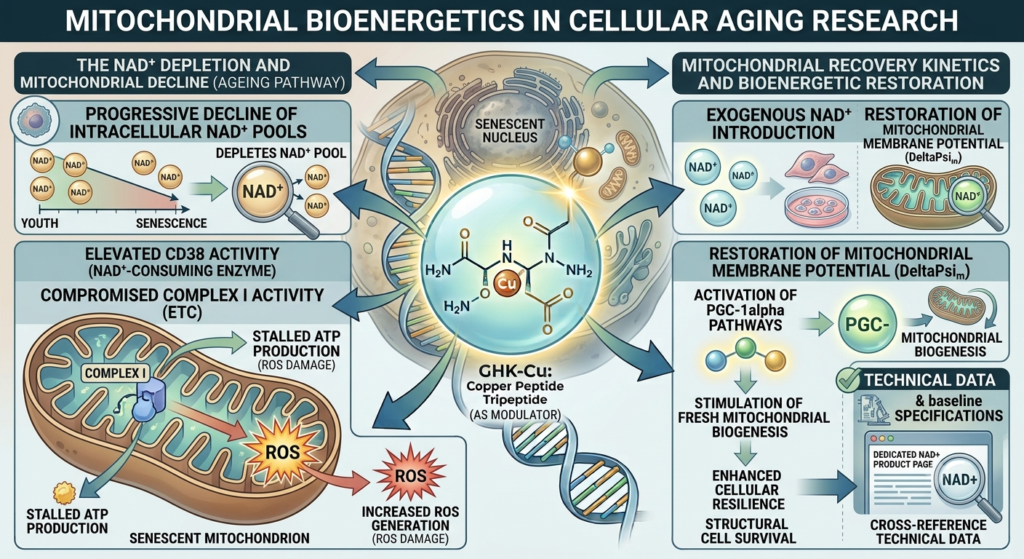
The primary focus of modern cellular aging research centers on overcoming the progressive decline of intracellular NAD+ pools observed in senescent biological models. As tissues experience metabolic stress, elevated activity of the NAD+-consuming enzyme CD38 depletes the coenzyme pool, resulting in compromised Complex I activity within the mitochondrial electron transport chain. This drop stalls ATP production and increases the generation of damaging reactive oxygen species (ROS).
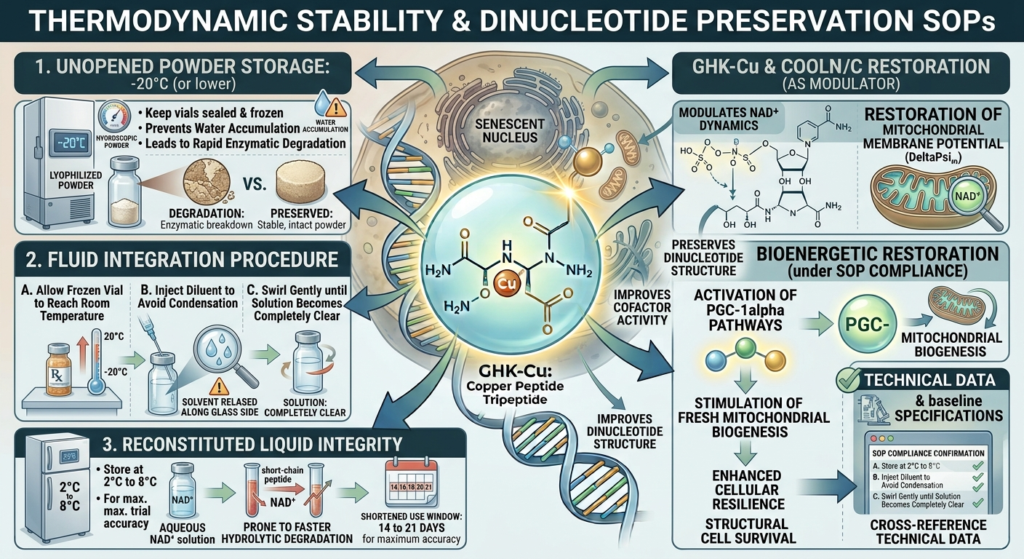
Exogenous introduction of pure NAD+ or its immediate metabolic precursors in cell cultures helps restore mitochondrial membrane potential ($DeltaPsi_m$), activating PGC-1$alpha$ pathways to stimulate fresh mitochondrial biogenesis. This bioenergetic restoration supports cellular resilience against metabolic stressors and enhances structural cell survival. Laboratories evaluating these mitochondrial recovery kinetics cross-reference baseline specifications against technical data available on the dedicated NAD+ product page.
Volumetric Dilution & Preparation SOPs for NAD+ Vials
To prevent baseline drift and ensure data reproducibility across repetitive assay models, meticulous preparation protocols are critical. Subtle shifts in target concentrations can introduce unwanted variation in cellular responses, meaning that establishing a precise, standardized reconstitution map is a mandatory prerequisite for any formal study design.
Lyophilized chemical cakes must be carefully brought to a liquid state using an appropriate sterile diluent. For extended observational studies, the industry standard is Bacteriostatic Water (0.9% Benzyl Alcohol), which provides an effective anti-microbial barrier to inhibit bacterial growth over multi-week testing cycles. The table below details standard dilution configurations across common laboratory 500mg vial structures:
| Vial Mass Total | Reconstitution Liquid Volume | Resulting Core Concentration | Standard Micro-Dose Aliquot |
|---|---|---|---|
| 500 mg (500,000 mcg) | 5.0 mL | 100,000 mcg / mL (100 mg/mL) | 10,000 mcg (10 mg) per 0.10 mL unit |
| 500 mg (500,000 mcg) | 10.0 mL | 50,000 mcg / mL (50 mg/mL) | 5,000 mcg (5 mg) per 0.10 mL unit |
| 500 mg (500,000 mcg) | 20.0 mL | 25,000 mcg / mL (25 mg/mL) | 2,500 mcg (2.5 mg) per 0.10 mL unit |
Purity Profiling & Chemical Validation Controls
When domestic research bodies arrange to purchase chemical compounds for bioenergetic assays, validating raw material purity represents the primary safeguard against compromised experimental readouts. Minor faults during synthesis or purification can yield degraded nicotinamide breakdown products or residual processing salts, which can induce unexpected cell toxicity or cross-react with secondary enzymatic pathways in live assays.
Every genuine batch of NAD+ must be validated by independent testing using High-Performance Liquid Chromatography (HPLC) to confirm a chemical purity rating exceeding 98.0%. Simultaneously, Mass Spectrometry (MS) analysis should be used to confirm that the observed mass matches the theoretical profile of 663.43 Da. Vials that reveal signs of early moisture ingress—such as a sticky, clumped, or discolored appearance of the dry powder cake—should be discarded immediately, as unchecked moisture initiates rapid hydrolysis and breaks down the dinucleotide structure.
Thermodynamic Stability & Dinucleotide Preservation SOPs
Nicotinamide adenine dinucleotide is highly sensitive to thermal fluctuations and ambient moisture. Preserving cofactor activity across cellular bioenergetic trials requires strict storage practices:
- Unopened Powder Storage: Store raw lyophilized NAD+ vials at -20°C (or lower). Because dinucleotide powders are hygroscopic, keeping vials sealed and frozen prevents water accumulation that leads to rapid enzymatic degradation.
- Fluid Integration Procedure: Allow the frozen vial to reach room temperature before injecting the diluent to avoid condensation inside the glass. Slowly release the solvent along the side of the vial and swirl gently until the solution becomes completely clear.
- Reconstituted Liquid Integrity: Aqueous NAD+ is prone to faster hydrolytic degradation than standard short-chain peptides. Store reconstituted solutions at 2°C to 8°C and use within a shortened window of 14 to 21 days for maximum trial accuracy.
Summary: Preclinical Horizons in Bioenergetic Studies
As a critical coenzyme in mitochondrial respiration, NAD+ serves as the central driver for cellular energy transfer and metabolic regulation. Laboratory models show that maintaining adequate intracellular NAD+ pools directly supports sirtuin activation (SIRT1–SIRT7) and PARP-mediated DNA repair mechanisms. Given the chemical sensitivity of dinucleotide compounds, experimental consistency relies heavily on utilizing pure lyophilized preparations, protecting reconstituted aliquots from thermal degradation, and standardizing baseline concentration math across cellular assays.
Longevity & Vitality
$89.99
Metabolic Support
$74.99
References
1. Rajman, L., Chwalek, K., & Sinclair, D. A. (2018). Therapeutic potential of NAD-boosting molecules: The in vivo evidence. Cell Metabolism, 27(3), 529-547. https://doi.org/10.1016/j.cmet.2018.02.011
2. Yoshino, J., Baur, J. A., & Imai, S. I. (2018). NAD+ intermediates: The biology and therapeutic potential of NMN and NR. Cell Metabolism, 27(3), 513-528. https://doi.org/10.1016/j.cmet.2017.11.002
3. Covarrubias, A. J., Perrone, R., Grozio, A., & Verdin, E. (2021). NAD+ metabolism and its roles in cellular processes during ageing. Nature Reviews Molecular Cell Biology, 22(2), 119-141. https://doi.org/10.1038/s41580-020-00313-x