Retatrutide, semaglutide and tirzepatide belong to the same broad area of incretin and metabolic research, but they are not interchangeable compounds.
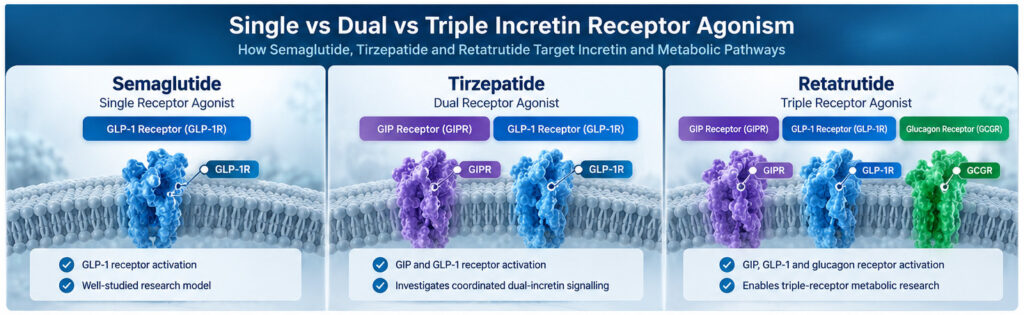
The clearest difference is their receptor architecture. Semaglutide primarily targets the GLP-1 receptor. Tirzepatide activates both GIP and GLP-1 receptors. Retatrutide extends the multi-receptor approach further by activating GIP, GLP-1 and glucagon receptors.
That progression—from single to dual to triple receptor agonism—makes the three compounds particularly useful for understanding how incretin research has evolved. It also creates an important comparison problem: a compound with more receptor targets is not automatically “better,” and results from separate clinical trials cannot be treated as if the compounds were tested head-to-head under identical conditions.
This guide compares retatrutide vs semaglutide vs tirzepatide across receptor targets, biological rationale, clinical evidence and the limitations researchers should understand when interpreting single-, dual- and triple-agonist data.
Retatrutide vs Semaglutide vs Tirzepatide at a Glance
| Compound | Principal Receptor Targets | Research Model | Key Comparison Question |
|---|---|---|---|
| Semaglutide | GLP-1 | Single-receptor agonism | What can sustained GLP-1 receptor activation accomplish on its own? |
| Tirzepatide | GIP + GLP-1 | Dual-receptor agonism | How does adding GIP receptor agonism change the biological and clinical profile? |
| Retatrutide | GIP + GLP-1 + glucagon | Triple-receptor agonism | What changes when glucagon receptor agonism is added to GIP/GLP-1 activity? |
Important: Receptor count describes mechanism, not a universal ranking of the compounds. Biological effects depend on receptor pharmacology, dose, exposure, study population, trial design and other factors.
Why Compare These Three Incretin Research Compounds?
Incretins are nutrient-responsive hormones involved in metabolic signalling. Two of the most important systems in this field are glucagon-like peptide-1 (GLP-1) and glucose-dependent insulinotropic polypeptide (GIP).
Research into engineered agonists has progressively moved beyond activating a single receptor. Semaglutide provides a well-studied example of sustained GLP-1 receptor agonism. Tirzepatide combines GIP and GLP-1 receptor activity in one molecule. Retatrutide adds glucagon receptor activity to that dual-incretin architecture.
The comparison therefore involves more than asking which compound produced a larger numerical change in a particular clinical trial. The more scientifically useful questions are:
- Which receptors does each molecule activate?
- What biological role does each receptor contribute to the research model?
- What evidence comes from direct head-to-head experiments?
- What evidence comes from separate trials that should not be directly equated?
- What does the additional glucagon receptor component of retatrutide allow researchers to investigate?
Semaglutide: The Single GLP-1 Receptor Model
Semaglutide is a GLP-1 receptor agonist. Its mechanism makes it the simplest receptor architecture of the three compounds compared here.
GLP-1 receptor signalling has been extensively investigated in relation to glucose-dependent insulin secretion, glucagon regulation, appetite and energy intake. Long-acting GLP-1 analogues made it possible to study sustained activation of this pathway rather than the very short-lived signalling associated with endogenous GLP-1.
This makes semaglutide an important reference point for modern incretin research: it demonstrates what can be observed when the GLP-1 pathway is pharmacologically prolonged without simultaneously engineering GIP or glucagon receptor agonism into the same molecule.
What did the STEP 1 trial report?
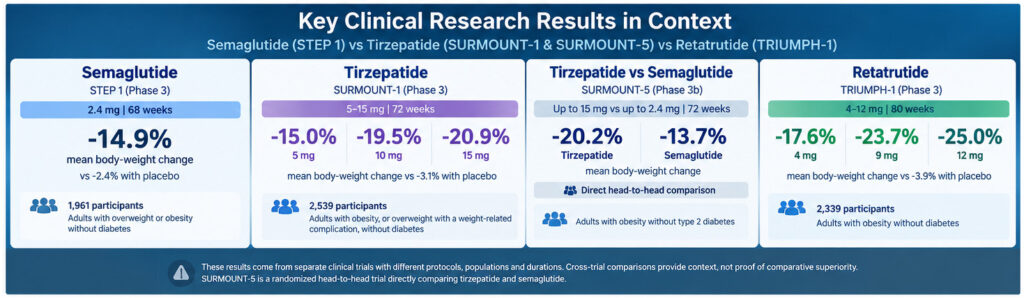
The Phase 3 STEP 1 trial enrolled 1,961 adults with overweight or obesity without diabetes and compared once-weekly semaglutide 2.4 mg with placebo alongside lifestyle intervention for 68 weeks.
Mean body-weight change at week 68 was -14.9% with semaglutide compared with -2.4% with placebo. Gastrointestinal events, particularly nausea and diarrhea, were among the most commonly reported adverse events.
STEP 1 established an important clinical benchmark for sustained GLP-1 receptor agonism. It does not, however, tell researchers what would happen if GIP or glucagon receptor activity were added to the same experimental design.
Tirzepatide: Adding GIP to GLP-1 Receptor Agonism
Tirzepatide is a dual GIP and GLP-1 receptor agonist. Its design moves beyond the single GLP-1 receptor model by combining two nutrient-responsive signalling systems in one peptide.
Both GIP and GLP-1 participate in glucose-dependent endocrine signalling, but the biological profile of tirzepatide should not be reduced to the idea that it is simply “semaglutide plus another receptor.” Tirzepatide is a distinct molecule with its own receptor pharmacology.
From a research perspective, the important shift is that tirzepatide allows investigators to examine coordinated GIP/GLP-1 receptor agonism rather than GLP-1 receptor agonism alone.
What did SURMOUNT-1 report?
The Phase 3 SURMOUNT-1 trial enrolled 2,539 adults with obesity, or overweight with at least one weight-related complication, without diabetes. Participants received tirzepatide or placebo for 72 weeks.
At week 72, mean body-weight change was -15.0% with 5 mg, -19.5% with 10 mg and -20.9% with 15 mg tirzepatide, compared with -3.1% with placebo.
Those results were generated under a different protocol from STEP 1, so comparing the percentages from the two separate trials is informative but not equivalent to a randomized head-to-head comparison.
Tirzepatide vs semaglutide: direct head-to-head evidence
That distinction became easier to evaluate with SURMOUNT-5, a randomized Phase 3b trial specifically comparing tirzepatide with semaglutide in adults with obesity without type 2 diabetes.
Participants received the maximum tolerated dose of tirzepatide (10 mg or 15 mg) or semaglutide (1.7 mg or 2.4 mg) for 72 weeks. Mean body-weight change was -20.2% with tirzepatide and -13.7% with semaglutide.
This is substantially stronger comparative evidence than placing independent STEP and SURMOUNT trial results beside one another because both compounds were evaluated within the same randomized study.
Retatrutide: Adding a Third Glucagon Receptor Target
Retatrutide (LY3437943) is a triple agonist of the GIP, GLP-1 and glucagon receptors.
The glucagon receptor is the feature that most clearly separates retatrutide from tirzepatide. Instead of studying only the combined incretin pathways represented by GIP and GLP-1, retatrutide introduces a third signalling system associated with hepatic metabolism and energy balance.
This creates a more complex research model. GLP-1 and GIP receptor signalling contribute to nutrient-responsive metabolic regulation, while glucagon receptor activation introduces another set of metabolic effects. The research question is therefore not simply whether three targets are stronger than two. It is how simultaneous signalling across these three receptor systems changes the overall metabolic response.
Phase 2 retatrutide research
A 2023 Phase 2 randomized trial evaluated retatrutide in 338 adults with obesity or overweight plus a weight-related condition who did not have diabetes.
At 48 weeks, least-squares mean body-weight changes were -8.7% in the 1 mg group, -17.1% in the combined 4 mg group, -22.8% in the combined 8 mg group and -24.2% in the 12 mg group, compared with -2.1% with placebo.
The most common adverse events were gastrointestinal and were generally dose-related. The trial also reported dose-dependent increases in heart rate that peaked during the study and subsequently declined.
TRIUMPH-1: Phase 3 evidence in 2026
The retatrutide evidence base advanced substantially with TRIUMPH-1, a Phase 3 randomized, double-blind trial involving 2,339 participants with obesity without diabetes.
In the peer-reviewed 2026 report, mean body-weight changes at 80 weeks were -17.6% with 4 mg, -23.7% with 9 mg and -25.0% with 12 mg retatrutide, compared with -3.9% with placebo.
These findings move retatrutide beyond the earlier Phase 2 evidence base and provide large Phase 3 data for triple GIP/GLP-1/glucagon receptor agonism.
They still do not create a randomized head-to-head comparison between retatrutide, tirzepatide and semaglutide. Differences among separate trials can reflect population characteristics, duration, dosing, estimands, discontinuation patterns and other design features in addition to the compounds themselves.
Single vs Dual vs Triple Agonism: What Actually Changes?
| Research Feature | Semaglutide | Tirzepatide | Retatrutide |
|---|---|---|---|
| GLP-1 receptor | Yes | Yes | Yes |
| GIP receptor | No | Yes | Yes |
| Glucagon receptor | No | No | Yes |
| Mechanistic model | Single agonist | Dual agonist | Triple agonist |
| Direct semaglutide comparison | Reference compound | Yes — SURMOUNT-5 | No comparable Phase 3 head-to-head trial discussed here |
| Large Phase 3 obesity evidence | Yes | Yes | Yes |
What Does GLP-1 Contribute?
GLP-1 receptor agonism is the common mechanistic denominator across all three compounds.
GLP-1 is involved in glucose-dependent insulin secretion and metabolic signalling, and pharmacological GLP-1 receptor activation has also been studied extensively in relation to appetite and energy intake.
Semaglutide isolates this general research strategy most clearly because GLP-1R is its principal incretin receptor target. Tirzepatide and retatrutide retain GLP-1 receptor activity while incorporating additional receptor systems.
What Does GIP Add in Tirzepatide and Retatrutide?
GIP, or glucose-dependent insulinotropic polypeptide, is another incretin hormone involved in nutrient-responsive endocrine signalling.
Tirzepatide and retatrutide both activate the GIP receptor in addition to GLP-1R. This allows researchers to investigate a coordinated multi-receptor state that cannot be reproduced by a GLP-1-selective agonist alone.
The head-to-head SURMOUNT-5 trial demonstrates that tirzepatide and semaglutide can produce different outcomes under the same clinical study framework. However, those differences should be attributed to the compounds as complete pharmacological entities—not simplistically to “GIP adding X percent” to an otherwise identical GLP-1 effect.
What Does the Glucagon Receptor Add to Retatrutide?
Retatrutide adds glucagon receptor agonism to the GIP/GLP-1 architecture.
Glucagon is traditionally associated with hepatic glucose regulation, but glucagon-receptor signalling is also relevant to broader questions involving substrate metabolism and energy expenditure. Incorporating controlled glucagon-receptor activity into a multi-agonist therefore creates a different metabolic research model from GLP-1 agonism alone or combined GIP/GLP-1 agonism.
This is one reason retatrutide has attracted substantial research interest. Its architecture permits investigation of whether the effects of appetite- and nutrient-related incretin signalling can be combined with glucagon-receptor-mediated metabolic effects within a single molecule.
That mechanistic rationale should not be confused with proof that triple agonism will always outperform dual or single agonism. Receptor balance, potency, dose, exposure and experimental context all matter.
Can the Clinical-Trial Weight Results Be Compared Directly?
Not without important qualifications.
It is tempting to place the headline percentages from STEP 1, SURMOUNT-1 and TRIUMPH-1 in a single ranking. Scientifically, that would overstate what separate trials can establish.
| Trial | Compound | Duration | Selected Reported Result |
|---|---|---|---|
| STEP 1 | Semaglutide 2.4 mg | 68 weeks | -14.9% mean body-weight change |
| SURMOUNT-1 | Tirzepatide 15 mg | 72 weeks | -20.9% mean body-weight change |
| TRIUMPH-1 | Retatrutide 12 mg | 80 weeks | -25.0% mean body-weight change in the peer-reviewed Phase 3 analysis |
Do not interpret this table as a head-to-head ranking. These results come from different trials with different protocols, durations, populations and statistical approaches. Cross-trial percentages provide context, not proof of comparative superiority.
The stronger comparison is the randomized SURMOUNT-5 trial, because tirzepatide and semaglutide were evaluated within the same study. Equivalent head-to-head Phase 3 evidence comparing retatrutide directly with both compounds is not established by the studies summarized here.
How the Evidence Base Differs Among the Three Compounds
Another important difference is evidence maturity.
Semaglutide has an extensive clinical research history across metabolic and cardiovascular questions. Tirzepatide also has a large Phase 3 evidence base and now has direct randomized obesity data against semaglutide.
Retatrutide is newer. Its evidence base has advanced rapidly from early clinical research to the 2023 Phase 2 trial and now to peer-reviewed Phase 3 TRIUMPH-1 data in 2026. That makes triple-receptor agonism considerably better characterized than it was only a few years ago, while still leaving important comparative questions open.
For researchers, this means that receptor architecture and evidence maturity should be considered separately. A newer compound can introduce a more complex mechanistic model while simultaneously having a shorter research history.
What Should Researchers Take From the Comparison?
1. Semaglutide provides the clearest single-incretin reference model
Semaglutide’s selective GLP-1 receptor agonism makes it useful for examining sustained GLP-1 signalling without engineered GIP or glucagon receptor agonism in the same molecule.
2. Tirzepatide tests coordinated dual-incretin signalling
Tirzepatide adds GIP receptor activity to GLP-1 receptor agonism. Importantly, randomized head-to-head research now directly compares tirzepatide and semaglutide rather than requiring researchers to rely only on separate trials.
3. Retatrutide extends the model into triple-receptor biology
Retatrutide adds glucagon receptor activity to GIP/GLP-1 agonism, creating a distinct experimental framework for studying coordinated incretin and glucagon signalling.
4. More receptor targets do not automatically establish superiority
Counting receptor targets is useful for classifying mechanism. It is not sufficient for predicting the magnitude of a biological effect. Relative receptor activity, exposure, dose and experimental conditions remain critical.
5. Cross-trial comparisons require restraint
A larger percentage reported in one independent trial does not prove that one molecule would outperform another in the same population under the same protocol. Direct randomized comparisons provide stronger evidence for comparative conclusions.
Retatrutide, Semaglutide and Tirzepatide for Canadian Laboratory Research
For Canadian researchers studying incretin signalling, these three compounds represent distinct experimental architectures rather than interchangeable versions of the same peptide.
Researched Peptides currently lists all three compounds for laboratory research:
- Semaglutide — a GLP-1 receptor agonist research model.
- Tirzepatide — a dual GIP/GLP-1 receptor agonist research model.
- Retatrutide — a triple GIP/GLP-1/glucagon receptor agonist research model.
The published clinical literature and the commercial research products should remain conceptually separate. Clinical trials establish findings about the compounds and formulations evaluated under defined study protocols. Product-specific analytical documentation addresses a different question: the characteristics of a particular research material or submitted sample.
Frequently Asked Questions
Incretin Research Comparison FAQ
The clearest mechanistic difference is receptor targeting. Semaglutide is a GLP-1 receptor agonist. Tirzepatide activates GIP and GLP-1 receptors. Retatrutide activates GIP, GLP-1 and glucagon receptors. This creates single-, dual- and triple-receptor research models respectively.
The phrase “triple GLP-1 agonist” is sometimes used informally, but it is imprecise. Retatrutide does not activate three GLP-1 receptors. It is a triple hormone-receptor agonist targeting three distinct receptor systems: GIP, GLP-1 and glucagon.
Semaglutide primarily targets the GLP-1 receptor, whereas tirzepatide activates both GIP and GLP-1 receptors. The randomized SURMOUNT-5 trial directly compared the two compounds in adults with obesity without type 2 diabetes, providing stronger comparative evidence than comparing results from independent trials.
Both compounds activate GIP and GLP-1 receptors, but retatrutide also activates the glucagon receptor. That third receptor introduces another metabolic signalling pathway and is the defining mechanistic difference between the dual- and triple-agonist research models.
No. Results from independent trials can provide useful context, but differences in study population, duration, dosing, statistical estimands and trial design prevent them from functioning as a controlled head-to-head comparison. Direct randomized trials provide stronger evidence when the research question is comparative.
Yes. Peer-reviewed Phase 3 TRIUMPH-1 results were published in 2026. The trial evaluated retatrutide in adults with obesity without diabetes and reported substantial body-weight changes across the evaluated retatrutide groups compared with placebo.
No. Receptor count describes mechanistic architecture, not guaranteed comparative performance. Dose, receptor pharmacology, exposure, study population, experimental design and other factors affect observed outcomes. Direct comparative evidence is required for strong superiority conclusions.
No. Researched Peptides products are intended for laboratory and scientific research only. Published clinical-trial findings discussed in this article should not be interpreted as personal-use instructions or as evidence that a commercial research product will reproduce a clinical-study outcome.
References
- Wilding JPH, Batterham RL, Calanna S, et al. Once-Weekly Semaglutide in Adults with Overweight or Obesity. New England Journal of Medicine. 2021;384:989-1002. doi:10.1056/NEJMoa2032183.
- Jastreboff AM, Aronne LJ, Ahmad NN, et al. Tirzepatide Once Weekly for the Treatment of Obesity. New England Journal of Medicine. 2022;387:205-216. doi:10.1056/NEJMoa2206038.
- Aronne LJ, Bade Horn D, le Roux CW, et al. Tirzepatide as Compared with Semaglutide for the Treatment of Obesity. New England Journal of Medicine. 2025;393:26-36. doi:10.1056/NEJMoa2416394.
- Jastreboff AM, Kaplan LM, Frías JP, et al. Triple-Hormone-Receptor Agonist Retatrutide for Obesity — A Phase 2 Trial. New England Journal of Medicine. 2023;389:514-526. doi:10.1056/NEJMoa2301972.
- Jastreboff AM, Kaplan LM, Davies MJ, et al. Retatrutide, a Triple Hormone Receptor Agonist, for Treatment of Obesity. New England Journal of Medicine. Published online September 29, 2026. doi:10.1056/NEJMoa2604169.
Explore Incretin Research Peptides
Compare single, dual and triple-receptor research compounds and review the current product information for each.
Metabolic Support
Price range: $74.99 through $149.99
Metabolic Support
Price range: $71.24 through $108.74

Metabolic Support
Price range: $89.99 through $431.96