In modern preclinical research, maintaining chemical stability and preventing secondary degradation across experimental timelines are primary technical objectives. When procuring materials for laboratory trials, investigators face a fundamental choice regarding physical form: freeze-dried solid cakes versus pre-mixed liquid solutions. To establish reliable control baselines, researchers examining lyophilized peptides research stability metrics are evaluating how physical state impacts shelf life, structural integrity, and assay reproducibility.
This technical guide analyzes the freeze-drying process, compares degradation rates between solid and liquid preparations, details standard reconstitution protocols using Bacteriostatic Water, and outlines key storage protocols required to preserve experimental data.
Biochemical Fundamentals of Lyophilization (Freeze-Drying)
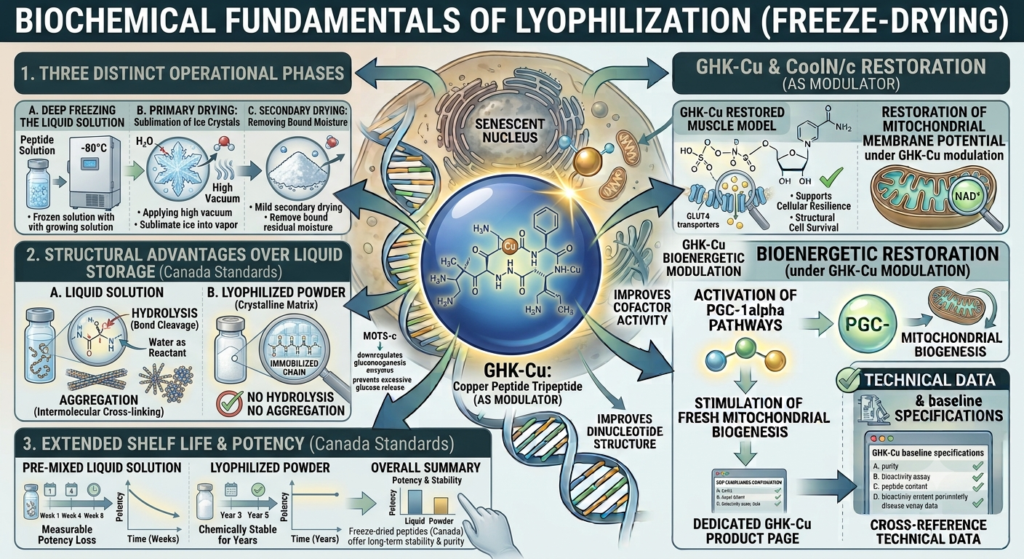
Lyophilization is a specialized dehydration process that removes water from a delicate peptide solution via sublimation. The process involves three distinct operational phases: deep freezing the liquid solution, applying a high vacuum during primary drying to sublimate ice crystals directly into vapor, and applying mild secondary drying to remove bound residual moisture.
In laboratory environments, sourcing high-grade freeze-dried peptides Canada standards provides distinct structural advantages over liquid-stored variants:
- Prevention of Hydrolysis: Water acts as a primary reactant in peptide bond cleavage. Removing water halts spontaneous nucleophilic attacks on the amide backbone.
- Inhibition of Aggregation: In solid crystalline matrices, individual peptide chains are physically immobilized, preventing unwanted intermolecular cross-linking and fibril formation.
- Extended Shelf Life: Lyophilized powders held at -20°C remain chemically stable for years, whereas pre-mixed liquid solutions suffer measurable potency loss within weeks.
Degradation Vectors: A Direct Peptide Stability Comparison
Conducting a rigorous peptide stability comparison highlights why liquid preparations are inherently vulnerable during shipping and storage. When dissolved in water, peptides undergo rapid chemical degradation via deamidation, oxidation, and diketopiperazine formation—rates that accelerate exponentially when exposed to ambient transit temperatures or vibration.
Conversely, freeze-dried powders maintain a stable solid matrix that resists ambient thermal stress during domestic transport. Once localized to the lab bench, researchers maintain full control over the exact time of fluid reconstitution, ensuring that liquid degradation timers only begin when the active assay is ready to start. To compare the operational parameters of both states, review the comparative breakdown below:
| Stability Parameter | Lyophilized (Freeze-Dried) State | Pre-Mixed Liquid State |
|---|---|---|
| Long-Term Storage Horizon | 24 to 48 Months (at -20°C) | 3 to 4 Weeks (at 2°C to 8°C before active degradation) |
| Transit Temperature Sensitivity | High tolerance; resists ambient fluctuations during shipping | Extreme vulnerability; rapid breakdown without continuous cold-chain transit |
| Hydrolysis & Deamidation Risk | Near-Zero (water molecules sublimated out of matrix) | High (continuous water interaction degrades amide backbone) |
| Reconstitution Flexibility | Complete control over diluent type and exact target molarity | Fixed concentration; locked into manufacturer diluent baseline |
Standardizing Reconstitution Media & Volumetric Control
Because pre-mixed liquid solutions carry significant stability risks, standard laboratory protocols dictate purchasing lyophilized compounds and performing in-house liquid transition using a verified diluent. The gold standard for multi-week observational assays is Bacteriostatic Water (0.9% Benzyl Alcohol), which prevents microbial contamination while preserving solution clarity.
When transitioning a dry cake to a liquid state, researchers must introduce the diluent slowly down the interior glass wall of the vial. Direct fluid impact on the pellet should be avoided to prevent mechanical shearing of sensitive peptide bonds. Gentle rotation of the vial—never vigorous agitation—ensures complete dissolution while maintaining sequence integrity across sample groups.
Tissue Repair & Recovery
Price range: $41.24 through $71.24
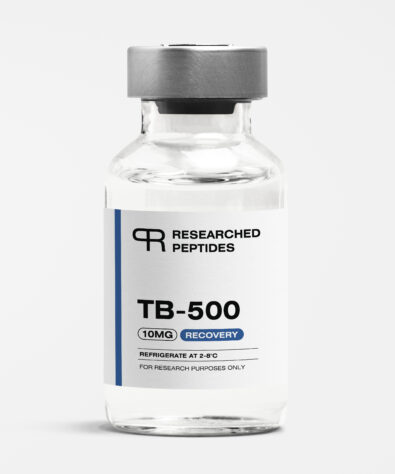
Tissue Repair & Recovery
Price range: $41.24 through $71.24
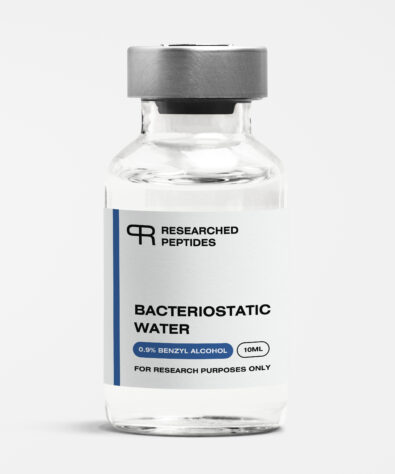
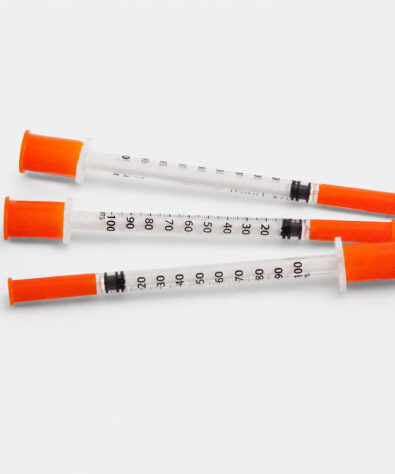
Research Supplies
Price range: $3.74 through $14.99
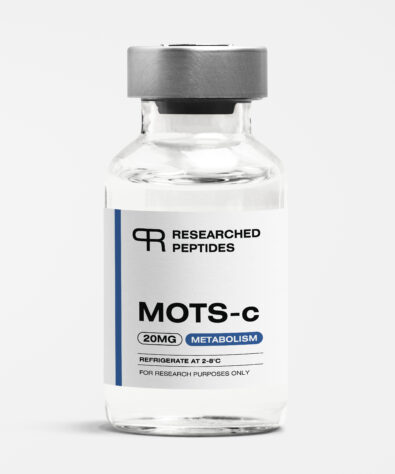
Metabolic Support
$74.99
Longevity & Vitality
$44.99
Analytical Purity Verification & QC Benchmarks
Before deploying any reconstituted peptide solution into live cell cultures or animal models, verifying raw material purity is mandatory. Imperfections during lyophilization or solid-phase synthesis can introduce truncated sequences or moisture traps that destabilize the material over time.
- HPLC Purity Profiling: Ensure every batch is backed by High-Performance Liquid Chromatography confirming a purity threshold exceeding 98.0%.
- Mass Spectrometry (MS): Verify that the observed molecular weight matches theoretical sequence calculations.
- Cake Inspection: Inspect the dry pellet prior to fluid introduction. A uniform, dense crystalline cake indicates proper lyophilization, whereas a melted or shrunken pellet signals moisture ingress and early hydrolysis.
Thermal Stability Guidelines & Handling SOPs
Maintaining structural baseline integrity requires strict, continuous adherence to thermal management protocols across both physical states:
- Lyophilized Powder Maintenance: Prior to reconstitution, dry chemical vials should be held at a stable temperature of -20°C. Keeping the vials deep-frozen insulates the crystal structures from fluctuating humidity levels and ambient light degradation.
- Post-Reconstitution Protocol: Once brought to a liquid state using sterile Bacteriostatic Water, the solution must be continuously refrigerated between 2°C and 8°C. Reconstituted aliquots should be completely utilized within a 30-day window to eliminate the risk of potency decay.
- Freeze-Thaw Prevention: Repeatedly freezing and thawing liquid peptide solutions creates ice crystals that shear peptide chains. Avoid re-freezing once a vial has been reconstituted.
Summary: Why Lyophilized Peptides Remain the Gold Standard
In preclinical biochemical evaluation, lyophilized peptides are unequivocally superior to pre-mixed liquid solutions. By eliminating moisture prior to transit, freeze-dried preparations insulate sensitive amino acid sequences from hydrolysis, transit friction, and thermal degradation. Sourcing raw materials in their lyophilized form—and executing precise, in-house reconstitution with sterile Bacteriostatic Water—provides research teams with full control over concentration math, trial timing, and data integrity. To explore high-purity, independently verified research materials, browse the complete catalog at the primary Researched Peptides Shop.
References
1. Manning, M. C., Chou, D. K., Murphy, B. M., Payne, R. W., & Katayama, D. S. (2010). Stability of protein pharmaceuticals: An update. Pharmaceutical Research, 27(4), 544-575. https://doi.org/10.1007/s11095-009-0045-6
2. Wang, W. (2000). Lyophilization and development of solid protein pharmaceuticals. International Journal of Pharmaceutics, 203(1-2), 1-60. https://doi.org/10.1016/S0378-5173(00)00423-3
3. Carpenter, J. F., Pikal, M. J., Chang, B. S., & Randolph, T. W. (1997). Rational design of stable lyophilized protein formulations: Some practical advice. Pharmaceutical Research, 14(8), 969-975. https://doi.org/10.1023/A:1012180707283