
Melanotan II (MT-II) is a synthetic cyclic analogue of alpha-melanocyte-stimulating hormone (α-MSH) that has been used experimentally to investigate the melanocortin receptor system.
That system helps explain why Melanotan II appears in several seemingly different areas of research. Melanocortin receptors are involved in biological processes ranging from pigmentation to central nervous-system signalling, appetite regulation and sexual function.
Melanotan II is particularly interesting because it is not highly selective for one melanocortin receptor. Instead, it acts as a potent agonist across multiple receptor subtypes. That broad activity creates a useful experimental probe, but it also means that observations associated with one pathway should not automatically be generalized to another.
This guide examines what Melanotan II is, how melanocortin receptor signalling works, what early human studies actually reported, how those findings compare with the broader preclinical literature, and what researchers in Canada should understand about the current evidence and regulatory context.
What Is Melanotan II?
Melanotan II is a synthetic cyclic peptide derived from research into analogues of α-MSH, an endogenous melanocortin peptide produced from the larger precursor protein proopiomelanocortin (POMC).
Structurally, MT-II was developed from the biologically active region of α-MSH and incorporates a cyclic lactam configuration. This design produced a peptide with potent melanocortin-receptor activity and greater resistance to degradation than the native hormone.
Pharmacological research describes Melanotan II as a non-selective melanocortin receptor agonist. Experimental work has demonstrated agonist activity at multiple melanocortin receptor subtypes, including MC1R, MC3R, MC4R and MC5R.
This lack of receptor selectivity is central to understanding the compound. Melanotan II should not be viewed simply as a pigmentation research peptide. Its receptor activity intersects with several biological systems, which is why MT-II has appeared in research involving pigmentation, feeding behaviour, energy balance and sexual function.
Melanotan II is not the same compound as afamelanotide
Melanotan II is sometimes discussed alongside Melanotan I, now known as afamelanotide. They are related α-MSH analogues, but they are not interchangeable compounds.
MT-II is a shorter cyclic analogue with broad melanocortin-receptor activity. Findings involving afamelanotide therefore should not automatically be presented as direct evidence for Melanotan II.
How the Melanocortin Receptor System Works
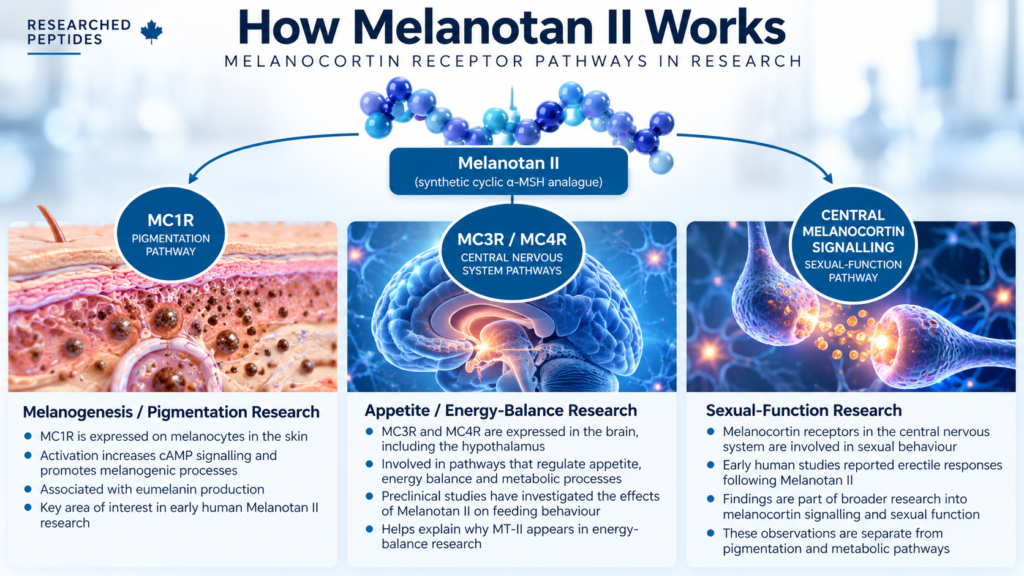
The melanocortin system includes five known G-protein-coupled receptor subtypes: MC1R, MC2R, MC3R, MC4R and MC5R. Their distribution and biological functions differ, which means activating different receptors can produce very different experimental observations.
For Melanotan II research, three areas are particularly useful for understanding the literature:
| Receptor / Pathway | Research Context | Why It Matters for MT-II |
|---|---|---|
| MC1R | Melanocytes and pigmentation biology | Provides the clearest mechanistic link between melanocortin signalling and increased melanogenesis. |
| MC3R / MC4R | Central nervous-system and energy-balance research | Experimental studies have used MT-II to investigate feeding and metabolic signalling. |
| Central melanocortin signalling | Sexual-function research | Unexpected observations in early studies led to controlled investigations of erectile and sexual responses. |
The important point is that these are different research pathways. A pigmentation observation involving MC1R does not prove a metabolic effect, and an observation involving central melanocortin signalling does not establish a therapeutic application.
MC1R and Melanotan II Pigmentation Research
The melanocortin-1 receptor (MC1R) is expressed on melanocytes and has a well-established role in pigmentation biology.
Activation of MC1R increases intracellular cyclic AMP signalling and promotes melanogenic processes, including activity associated with eumelanin production. Because Melanotan II can activate MC1R, pigmentation became one of the earliest areas investigated in human MT-II research.
What did the early human study find?
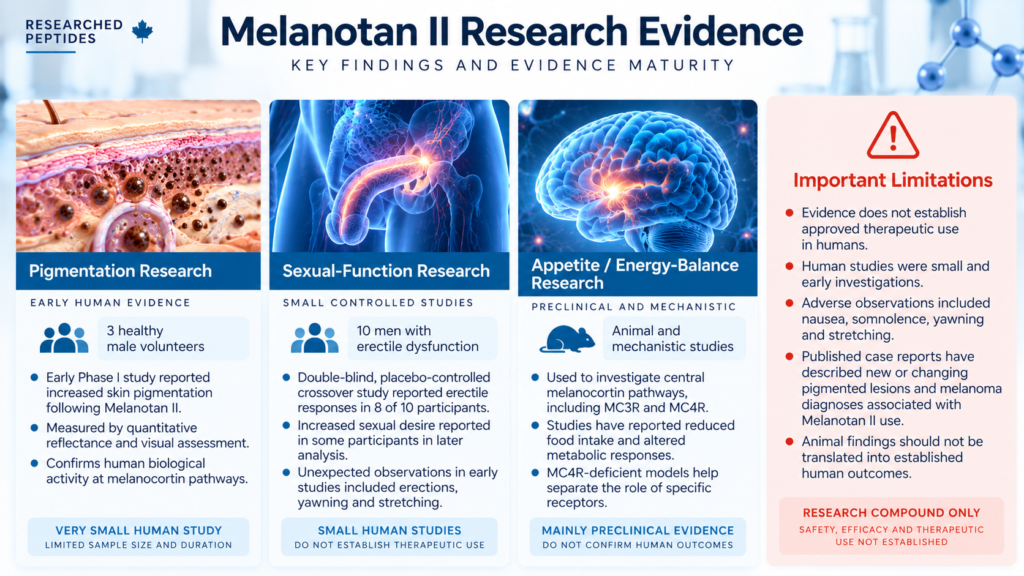
A 1996 pilot Phase I study evaluated Melanotan II in just three healthy male volunteers. The experiment was placebo controlled and investigated escalating exposure over a short study period.
Researchers reported increased pigmentation in two participants, measured both by quantitative reflectance and visual assessment after the experimental period.
The study is important because it provides direct human evidence that MT-II can influence pigmentation. But its limitations are equally important: the sample consisted of only three participants, the experimental period was short, and the study was an early-phase investigation rather than evidence of an established therapeutic application.
The investigators also reported nausea at multiple exposure levels. Somnolence and fatigue occurred in one participant at the highest level studied, while stretching, yawning and spontaneous erections were also observed.
Those unexpected observations became scientifically important because they pointed researchers toward another part of melanocortin biology.
Melanotan II and Sexual-Function Research
The spontaneous erectile responses observed during early MT-II research led investigators to examine melanocortin signalling in sexual function more directly.
In one double-blind, placebo-controlled crossover study, 10 men with psychogenic erectile dysfunction received Melanotan II or placebo while penile rigidity was monitored over six hours.
Researchers reported clinically apparent erections in eight of the ten participants following MT-II. Objective monitoring also showed a longer period of high tip rigidity following MT-II than after placebo.
A separate investigation involving men with organic causes of erectile dysfunction likewise reported erectile responses following MT-II administration.
Later analysis of human MT-II research described increased sexual desire in some participants in addition to the erectile observations.
These findings helped establish the melanocortin system as an area of interest in sexual-function research. They should not, however, be interpreted as evidence that Melanotan II is an approved treatment. The studies were small, early investigations, and adverse observations including nausea, stretching and yawning were reported.
MC3R, MC4R and Energy-Balance Research
Melanocortin signalling also plays an important role in experimental research into appetite and energy balance.
Much of this work is preclinical. Animal studies have used Melanotan II as a non-selective melanocortin agonist to investigate central pathways involving MC3R and MC4R.
For example, experiments in mice have found that MT-II can reduce food intake and alter metabolic responses. Studies using MC4R-deficient animals have helped researchers investigate how much of the acute feeding and metabolic response is mediated through the melanocortin-4 receptor.
This is useful mechanistic evidence because receptor-knockout models can help separate the contribution of individual signalling pathways.
It does not mean that animal feeding experiments establish a weight-loss effect, treatment indication or expected outcome in humans. The model and research question need to remain explicit.
What Does the Current Melanotan II Evidence Actually Show?
The MT-II literature spans several evidence levels, and treating all of them as equivalent can produce misleading conclusions.
| Research Area | Evidence Type | What It Supports | Important Limitation |
|---|---|---|---|
| Pigmentation | Mechanistic research + very small early human study | MT-II can activate pigmentation-related melanocortin pathways; increased pigmentation was reported in early human research. | The initial human pilot involved only three participants. |
| Sexual function | Small placebo-controlled human studies | MT-II produced measurable erectile responses in experimental settings. | Small studies do not establish an approved therapeutic role. |
| Appetite / energy balance | Predominantly animal and mechanistic research | Supports investigation of central melanocortin pathways, particularly MC4R. | Animal findings should not be converted into established human outcomes. |
| Established therapeutic use of MT-II | Not established by the evidence reviewed here | The compound remains scientifically useful for studying melanocortin biology. | Research findings do not establish approved therapeutic use, safety or efficacy. |
Why Receptor Selectivity Matters
One of the most useful lessons from Melanotan II research is that receptor selectivity matters.
A compound that strongly activates one receptor can be useful for studying a narrowly defined pathway. A non-selective agonist such as MT-II can activate several receptor populations, making it useful for broader melanocortin research but also making interpretation more complicated.
For example, MC1R activity provides a mechanistic basis for pigmentation research, while central melanocortin receptors are relevant to feeding behaviour and other neurological responses.
This broad pharmacology is one reason researchers subsequently developed and investigated more selective melanocortin ligands. By comparing compounds with different receptor preferences, researchers can better identify which receptor subtype contributes to a particular experimental response.
Melanotan II Research Limitations and Safety Signals
A technically useful Melanotan II research guide should include the limitations of the evidence, not only the observations that make the compound interesting.
Human evidence remains small
Some MT-II research was conducted directly in humans, which distinguishes it from compounds supported almost entirely by animal research. However, the early MT-II studies involved small participant groups and focused on narrow experimental questions.
They do not constitute a modern, large clinical evidence base establishing general safety or therapeutic efficacy.
Adverse observations occurred in controlled studies
Nausea was repeatedly reported in early human MT-II research. Other observations included yawning, stretching, fatigue or somnolence, decreased appetite and spontaneous erections.
These findings are scientifically relevant because they illustrate the broader physiological consequences that can accompany activation of multiple melanocortin pathways.
Case reports cannot establish causation
Published case reports have described new or changing pigmented lesions and melanoma diagnoses temporally associated with unregulated Melanotan II use. Case reports can identify potential safety signals, but they cannot establish that MT-II caused an individual cancer diagnosis.
Some reported individuals also had other melanoma risk factors, including fair skin, ultraviolet exposure or tanning-bed use and family or genetic risk factors. The appropriate conclusion is therefore cautious: these reports warrant attention and further investigation, but they should not be represented as proof of a simple causal relationship.
Melanotan II Research in Canada: Regulatory Context
Canadian search interest around Melanotan II often mixes laboratory research questions with questions about personal use. Those are not the same issue.
Health Canada has specifically identified Melanotan I and Melanotan II among unauthorized injectable peptide drugs in public advisories. The agency states that unauthorized drug products have not been assessed by Health Canada for safety, efficacy and quality.
Health Canada has also stated that labelling a peptide “For Research Use Only – Not for Human Consumption” does not by itself make a product legal or exempt it from applicable regulatory requirements.
This article therefore discusses MT-II as a research compound and scientific subject. It should not be read as personal-use, medical, injection or dosing guidance.
Melanotan II as a Laboratory Research Compound
For laboratory researchers, the value of MT-II comes from the breadth of the melanocortin questions it can help investigate.
Its non-selective receptor profile makes it relevant to experimental questions involving melanocortin receptor pharmacology, MC1R-associated pigmentation pathways, central melanocortin signalling and comparisons with more selective receptor ligands.
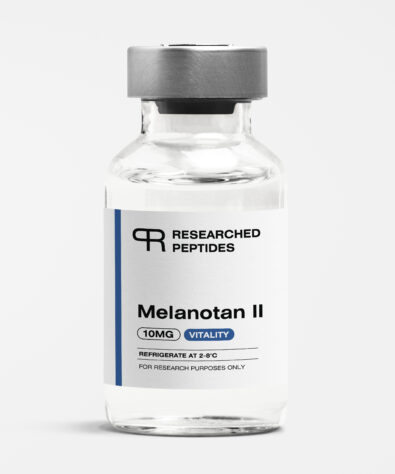
The Researched Peptides Melanotan II product contains 10 mg of Melanotan II and is supplied for laboratory and scientific research.
That product fact should remain separate from the scientific literature discussed above. Studies involving Melanotan II establish observations about the compound under the specific experimental conditions investigated; they do not independently establish the purity, identity, safety or biological performance of a particular commercial vial.
Melanotan II 10mg – Research Peptide
Explore the current Researched Peptides Melanotan II product specifications and available research-product information.
Longevity & Vitality
$41.24
Frequently Asked Questions
Melanotan II Research FAQ
Melanotan II, or MT-II, is a synthetic cyclic analogue of alpha-melanocyte-stimulating hormone. It is a potent, non-selective melanocortin receptor agonist that has been used experimentally to investigate pigmentation, central melanocortin signalling and other biological processes.
Pharmacological research describes Melanotan II as a non-selective melanocortin agonist with activity at multiple receptor subtypes, including MC1R, MC3R, MC4R and MC5R. Different receptors are associated with different experimental pathways, which is why MT-II appears in several areas of research.
MC1R is expressed on melanocytes and is strongly associated with melanogenesis and pigmentation biology. Activation of MC1R provides the primary mechanistic explanation for pigmentation changes observed in early MT-II research.
Yes. Small early human studies investigated pigmentation and sexual-function responses to Melanotan II. These studies provide direct human observations but involved limited participant numbers and do not establish an approved therapeutic application or a comprehensive safety profile.
No. Both compounds are synthetic analogues related to alpha-MSH, but Melanotan II and afamelanotide are distinct molecules with different structures and pharmacological profiles. Evidence involving one should not automatically be attributed to the other.
MT-II has been widely used in animal and mechanistic experiments investigating central melanocortin signalling. Studies using MC4R-deficient animals have helped researchers examine the contribution of MC4R to feeding and metabolic responses. These are predominantly preclinical findings and should not be translated directly into established human outcomes.
Health Canada has identified Melanotan I and II in public advisories concerning unauthorized injectable peptide drugs. Health Canada states that unauthorized drug products have not been assessed for safety, efficacy and quality and that “research use only” labelling does not itself exempt a product from regulatory requirements.
The current Researched Peptides catalogue lists Melanotan II as a 10 mg research peptide intended for laboratory and scientific research.
References
- Dorr RT, Lines R, Levine N, et al. Evaluation of melanotan-II, a superpotent cyclic melanotropic peptide in a pilot phase-I clinical study. Life Sciences. 1996;58(20):1777-1784. PMID: 8637402.
- Wessells H, Fuciarelli K, Hansen J, et al. Synthetic melanotropic peptide initiates erections in men with psychogenic erectile dysfunction: double-blind, placebo-controlled crossover study. Journal of Urology. 1998. PMID: 9679884.
- Wessells H, Levine N, Hadley ME, Dorr R, Hruby V. Melanocortin receptor agonists, penile erection, and sexual motivation: human studies with Melanotan II. International Journal of Impotence Research. 2000;12 Suppl 4:S74-S79. doi:10.1038/sj.ijir.3900582.
- Wessells H, Gralnek D, Dorr R, Hruby VJ, Hadley ME, Levine N. Effect of an alpha-melanocyte stimulating hormone analog on penile erection and sexual desire in men with organic erectile dysfunction. Urology. 2000. PMID: 11018622.
- Chen AS, Metzger JM, Trumbauer ME, et al. Role of the melanocortin-4 receptor in metabolic rate and food intake in mice. Transgenic Research. 2000. PMID: 10951699.
- Raposinho PD, White RB, Aubert ML. The melanocortin agonist Melanotan-II reduces the orexigenic and adipogenic effects of neuropeptide Y. Journal of Neuroendocrinology. 2003;15(2):173-181. doi:10.1046/j.1365-2826.2003.00962.x.
- Ericson M, Larkö O, Vahlquist A, et al. Melanoma associated with the use of melanotan-II. Dermatology. Published case report. PMID: 24355990.
- Health Canada. Think twice before injecting peptides bought online: unauthorized products can seriously harm you. Public advisory. Updated April 9, 2026.
Explore Melanotan II for Laboratory Research
View the 10 mg Melanotan II research product and current product information.