Research Disclaimer: This article discusses Ipamorelin and growth-hormone-secretagogue research for scientific and educational purposes. Researched Peptides products are intended for laboratory and scientific research only. Published findings discussed below should not be interpreted as medical advice, personal-use guidance, or evidence of established human therapeutic benefit.
Ipamorelin is a synthetic peptide studied as a growth hormone secretagogue: a compound capable of stimulating growth hormone (GH) release through the growth hormone secretagogue receptor system.
What makes Ipamorelin particularly interesting to researchers is not simply its ability to stimulate GH release. Early pharmacological studies investigated whether that response could be produced with greater hormonal selectivity than was observed with earlier growth hormone-releasing peptides such as GHRP-2 and GHRP-6.
This guide examines what Ipamorelin is, how its growth-hormone-secretagogue mechanism has been investigated, what animal and human studies have actually reported, and where the evidence remains limited.
What Is Ipamorelin?
Ipamorelin is a synthetic pentapeptide originally developed during research into peptide growth hormone secretagogues. Its reported sequence is Aib-His-D-2-Nal-D-Phe-Lys-NH2.
Growth hormone secretagogues are compounds investigated for their ability to stimulate GH secretion through receptor pathways distinct from the classical growth hormone-releasing hormone (GHRH) receptor pathway.
In an influential 1998 study, Raun and colleagues characterized Ipamorelin in cell and animal models and reported potent GH-releasing activity. Pharmacological antagonist experiments indicated that its effects were mediated through a GHRP-like receptor rather than the GHRH receptor.
This work is also the origin of Ipamorelin’s frequently cited description as a selective growth hormone secretagogue. That term needs some context: it describes findings from particular experimental comparisons and should not be interpreted as meaning that Ipamorelin has been proven to act exclusively on one biological process under every condition.
How Does Ipamorelin Work in Experimental Research?
The central research question surrounding Ipamorelin involves the growth hormone secretagogue receptor system.
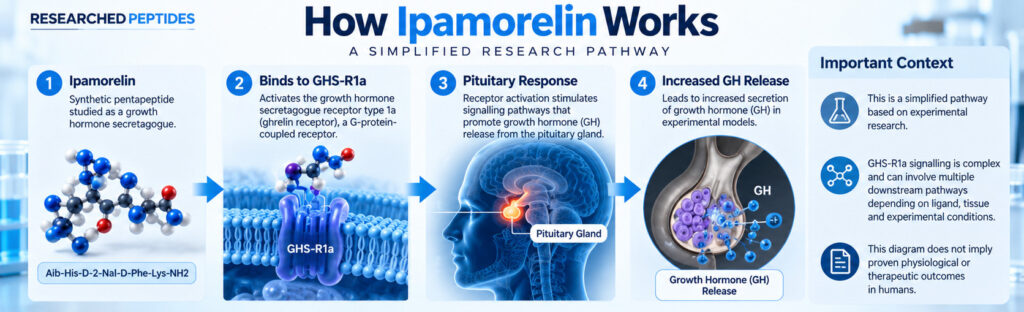
The growth hormone secretagogue receptor type 1a (GHS-R1a), commonly called the ghrelin receptor, is a G-protein-coupled receptor involved in endocrine signalling. Ghrelin is its best-known endogenous ligand, while a variety of synthetic peptide and non-peptide compounds have been developed to investigate the receptor and its downstream biology.
Experimental growth hormone secretagogues can stimulate signalling associated with pituitary GH release. Ipamorelin belongs to this broader research class.
A Simplified Research Pathway
Ipamorelin → growth hormone secretagogue receptor signalling → pituitary response → increased GH release in experimental models
This simplified pathway is useful for understanding the central mechanism being investigated, but it should not be treated as a complete description of the receptor’s biology. GHS-R1a signalling is complex, and receptor activation can involve multiple downstream pathways depending on ligand, tissue and experimental conditions.
Why Is Ipamorelin Described as a Selective GHRP?
One of the most important early Ipamorelin studies compared its hormonal effects with other growth hormone-releasing peptides.
Raun and colleagues investigated Ipamorelin alongside GHRP-2 and GHRP-6 in several experimental systems. In swine, the researchers reported that GHRP-2 and GHRP-6 increased plasma ACTH and cortisol, whereas Ipamorelin did not produce ACTH or cortisol responses significantly different from those observed following GHRH stimulation under the study conditions.
The researchers therefore described Ipamorelin as a GHRP-receptor agonist displaying comparatively strong selectivity for GH release.
Important context: This finding came from defined experimental models and comparisons. It does not establish that Ipamorelin is universally selective in every species, concentration, tissue or experimental setting.
Ipamorelin and Growth Hormone Release
The most direct research finding associated with Ipamorelin is stimulation of growth hormone release.
Early experiments demonstrated GH release in cultured rat pituitary cells as well as in animal models. Researchers subsequently investigated Ipamorelin pharmacokinetics and pharmacodynamics in humans.
In a study of healthy male volunteers, researchers used five different intravenous infusion levels and measured both circulating Ipamorelin and GH concentrations. Eight participants were studied at each dose level.
The study reported an episodic GH response following Ipamorelin administration. GH concentrations reached a peak at approximately 0.67 hours and then declined toward negligible concentrations. The investigators also reported dose-proportional pharmacokinetic behaviour across the studied range and an approximately two-hour terminal half-life under the experimental conditions.
Evidence boundary: This provides human evidence that administered Ipamorelin can influence GH secretion. It does not answer the much broader question of whether Ipamorelin produces meaningful therapeutic, performance, body-composition, recovery or anti-aging outcomes in humans.
What Has Human Ipamorelin Research Actually Shown?
The distinction between a pharmacodynamic response and a demonstrated health or performance outcome is essential when interpreting Ipamorelin research.
| Research Question | What the Evidence Shows |
|---|---|
| Can Ipamorelin stimulate GH release? | Yes. GH release has been demonstrated in experimental models and in a controlled human PK/PD study. |
| Has human pharmacokinetics been studied? | Yes. A controlled study characterized circulating Ipamorelin concentrations and GH responses across several intravenous infusion levels. |
| Does that prove muscle-growth or performance benefits? | No. Demonstrating GH release is not equivalent to demonstrating improvements in muscle growth, athletic performance or recovery. |
| Does it establish anti-aging effects? | No. The available pharmacodynamic evidence does not establish an anti-aging effect in humans. |
| Does it establish a therapeutic benefit? | No established human therapeutic benefit follows from the available GH-response evidence alone. |
Ipamorelin vs Earlier Growth Hormone-Releasing Peptides
Ipamorelin is often discussed alongside GHRP-2 and GHRP-6 because these compounds were investigated within the same broader class of synthetic growth hormone secretagogues.
The comparison is useful scientifically because early studies found that all three compounds could stimulate GH release, while their broader hormonal responses were not identical.
In the 1998 experimental work, GHRP-2 and GHRP-6 increased ACTH and cortisol in the swine model. Ipamorelin showed a more GH-selective profile under the same experimental conditions.
This difference helped establish Ipamorelin as a useful research compound for investigating whether growth hormone secretagogue signalling could be separated, at least partly, from some of the additional hormonal responses observed with earlier GHRPs.
Ipamorelin, Ghrelin and GHS-R1a Research
Modern discussion of growth hormone secretagogues frequently centres on GHS-R1a, also known as the ghrelin receptor.
Ghrelin is an endogenous peptide ligand for this receptor and is involved in a wider biological network than GH release alone. GHS-R1a has complex signalling behaviour, including substantial constitutive activity and multiple downstream signalling pathways.
This complexity is one reason researchers should be cautious about reducing Ipamorelin to a simple equation such as “receptor activation equals growth hormone equals a particular physiological benefit.” Receptor pharmacology, hormone secretion and downstream biological outcomes are separate levels of evidence.
What Does Current Ipamorelin Evidence Support?
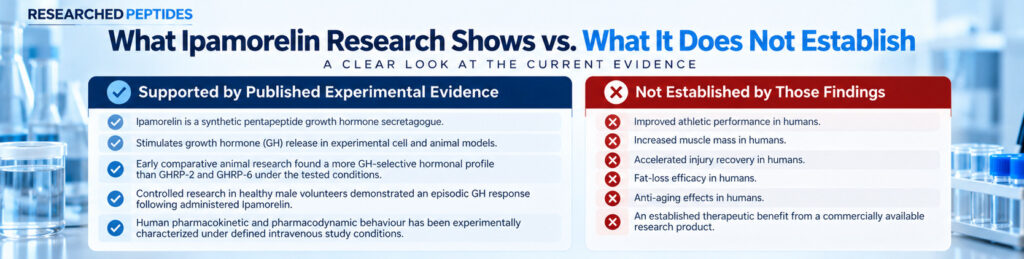
Supported by Published Experimental Evidence
- Ipamorelin is a synthetic pentapeptide growth hormone secretagogue.
- It stimulates GH release in experimental cell and animal models.
- Early comparative animal research found a more GH-selective hormonal profile than GHRP-2 and GHRP-6 under the tested conditions.
- Controlled research in healthy male volunteers demonstrated an episodic GH response following administered Ipamorelin.
- Human pharmacokinetic and pharmacodynamic behaviour has been experimentally characterized under defined intravenous study conditions.
Not Established by Those Findings
- Improved athletic performance in humans.
- Increased muscle mass in humans.
- Accelerated injury recovery in humans.
- Fat-loss efficacy in humans.
- Anti-aging effects in humans.
- An established therapeutic benefit from a commercially available research product.
Keeping those categories separate is important. A compound can produce a measurable endocrine response without that response automatically establishing a clinically meaningful downstream outcome.
Why Is Ipamorelin Scientifically Interesting?
Ipamorelin remains an interesting research compound because it allows several related biological questions to be investigated without treating them as the same question.
Researchers can examine growth hormone secretagogue receptor pharmacology, pituitary GH release, ligand selectivity, endocrine response profiles and pharmacokinetic/pharmacodynamic relationships.
Its early development is particularly useful historically because it demonstrates how medicinal chemistry can be used to investigate whether closely related receptor agonists produce different hormonal response profiles.
Ipamorelin for Laboratory Research in Canada
Researched Peptides currently offers Ipamorelin as a 5 mg research product for laboratory and scientific research. The commercial research product should be kept conceptually separate from the compounds and formulations used in published external studies.
A published experiment can help explain why Ipamorelin is scientifically interesting, but it does not establish that a commercial research vial will reproduce a particular biological result.
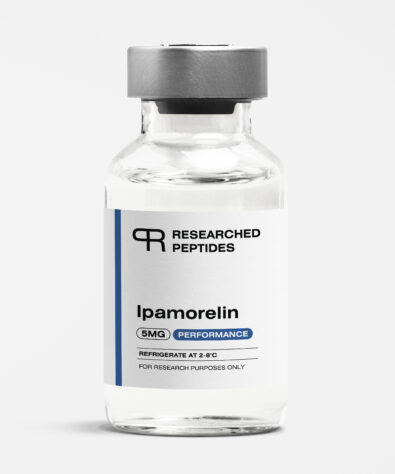
Performance & Endurance
$44.99
Ipamorelin is a synthetic pentapeptide studied as a growth hormone secretagogue. Experimental research has investigated its ability to stimulate GH release through the growth hormone secretagogue receptor system.
Ipamorelin belongs to the broader class of peptide growth hormone secretagogues and was originally characterized as a GHRP-receptor agonist. Early research compared its pharmacological profile with compounds including GHRP-2 and GHRP-6.
Published experimental research has demonstrated GH release following Ipamorelin exposure in cell and animal models, and a controlled human pharmacokinetic/pharmacodynamic study also reported an episodic GH response. That finding does not by itself establish a therapeutic or performance benefit.
In early comparative research, Ipamorelin produced GH release while showing less ACTH and cortisol response than GHRP-2 and GHRP-6 in a swine model. The term selective refers to that experimental hormonal profile and should not be interpreted as proof of universal biological specificity.
No. Ghrelin is an endogenous hormone and natural ligand of the growth hormone secretagogue receptor. Ipamorelin is a synthetic peptide growth hormone secretagogue studied for its activity within the same broader receptor system.
Yes. A controlled pharmacokinetic/pharmacodynamic study evaluated Ipamorelin in healthy male volunteers and measured both circulating Ipamorelin and GH responses. This provides human pharmacological evidence but does not establish the broader benefits frequently attributed to Ipamorelin online.
References
- Raun K, Hansen BS, Johansen NL, et al. Ipamorelin, the first selective growth hormone secretagogue. European Journal of Endocrinology. 1998;139(5):552-561. doi:10.1530/eje.0.1390552.
- Gobburu JVS, Agersø H, Jusko WJ, Ynddal L. Pharmacokinetic-pharmacodynamic modeling of ipamorelin, a growth hormone releasing peptide, in human volunteers. Pharmaceutical Research. 1999;16(9):1412-1416. doi:10.1023/A:1018955126402.
- Ankersen M, Johansen NL, Madsen K, et al. A new series of highly potent growth hormone-releasing peptides derived from ipamorelin. Journal of Medicinal Chemistry. 1998;41(19):3699-3704. doi:10.1021/jm9801962.
Explore Ipamorelin for Laboratory Research
View the current Researched Peptides Ipamorelin research product and product information.